Every year, Kenyan taxpayers are called to bankroll democracy—but what they get in return is a façade. Since 2013, in the name of political party funding, sold as a noble investment in national cohesion and democratic growth, more than Sh7 billion has been paid from the public purse.
Yet what stands in its place is a network of hollow shells: parties that vanish between election cycles, maintain no grassroots presence, and operate with rented headquarters. Far from strengthening democracy, this State-sponsored subsidy has bred a culture of apathy, entitlement, and political inertia. What began as a promise to institutionalise party politics has become a costly illusion—an ever-deepening pit with little to show for its depth.
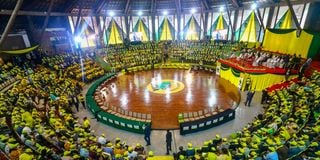
President William Ruto addresses delegates during the UDA National Governing Council meeting at the Bomas of Kenya in Nairobi on September 29, 2023.
Photo credit: Wilfred Nyangaresi | Nation Media Group
Few political parties in Kenya can genuinely claim a national presence. At best, they have become little more than bargaining platforms for their regional kingpins. Some politicians openly say parties are vehicles for personal ambition rather than ideological clarity or public service. Instead of nurturing participatory democracy, these parties operate as instruments of convenience, springing to life around elections and collapsing into irrelevance thereafter.
Now is this what we are spending our money on? Put another way, what value do we show for the Sh7 billion that we have used so far on these parties? Despite receiving generous allocations from the Political Parties Fund, many outfits remain dormant outside election cycles, with no meaningful grassroots activity or civic education programmes to show for it. In fact, some parties operate more like private franchises than democratic institutions—demanding monthly contributions from their elected members. In essence, the structure serves the political elite, not the public interest.
Now, the season of ethnic realignment is upon us once more, as the country begins its slow march toward the 2027 General Election. The political cauldron is bubbling again. New outfits are emerging. Dormant ones are being resurrected. It’s a political Lazarus season.
Besides gunning for power, party owners are looking at the potential brought by public funds that follow victory. Instead of fostering democracy, party financing appears to be subsidising elite politicking and ethnic entrepreneurship. With billions squandered and no meaningful ideological growth to show, one must ask: Is Kenya funding democracy or just underwriting dysfunction?
Orange Democratic Movement delegates during the party's ODM National Governing Council at the Bomas of Kenya on February 25, 2022.
Photo credit: Francis Nderitu | Nation Media Group
In either search for power, money, or both, political outfits are mushrooming with predictable speed, their architects unapologetically labelling them “political vans”—vehicles not of ideology but of ethnic arithmetic. These formations serve one principal function: as platforms for tribal chiefs to negotiate power, revealing a profound national inability to sustain truly ideological or national parties.
By March 2025, Kenya had 91 registered political parties— including the new kid on the block, Democracy for the Citizens Party of former Vice President Rigathi Gachagua — and the numbers are still increasing.
To resolve our failure to structure national parties, we have now crafted coalitions as the alternative. Coalition-building, wrapped in the illusion of national unity, has encouraged the mushrooming of tribal outfits which are used to negotiate “shares” within the government, as Gachagua told us of the United Democratic Alliance boardroom deals. As a result, our “national parties” are nothing but multi-ethnic coalitions of ethnic parties—marriages of convenience that splinter as soon as the arithmetic no longer adds up. The problem with that is that political bargaining tables are dominated by the numerically advantaged, leaving smaller communities sidelined.
We all recall Kalonzo Musyoka’s experience with Uhuru Kenyatta and William Ruto camps ahead of the 2013 elections. Despite his seniority and vice-presidential credentials, he was offered a tertiary position, that of a Speaker, revealing how political weight is often reduced to ethnic headcounts.
Scholars such as Prof Donald Horowitz have long argued that ethnic party systems are unstable by design. Kenya’s shifting party alignments offer a textbook case. At independence, the formation of Kanu — a party seen as dominated by Central Kenya and Nyanza regions — prompted the creation of Kadu, an alliance of minority groups fearful of marginalisation. To their credit, both parties articulated distinct vision: Majimbo federal system for Kadu and a unitary state for Kanu, hence its single-finger salute.
Today, most political parties have no ideological position and most have cannibalised Kanu’s constitution. Again, the few political parties that have attempted to rally the entire nation – think of Mwai Kibaki’s National Rainbow Coalition (Narc) — the grand alliance that swept Mwai Kibaki into power in 2002 ended up feeling the weight of tribal rivalries and personal ambition.
n the 1990s, when the Forum for the Restoration of Democracy (Ford) emerged as a potent threat to the Kanu regime, ethnic rivalries once again sabotaged a national movement. Kenneth Matiba, buoyed by supremacist whispers, declared his presidential bid under the mantra "Let the people decide," drawing his power base from the Gema bloc. He formed his Ford-Asili party. In retaliation, Oginga Odinga launched Ford-Kenya, helping fracture the opposition and handing Kanu yet another lease on power.
Orange Democratic Movement leader Raila Odinga addressing party delegates at the Bomas of Kenya on February 25, 2022.
Photo credit: Francis Nderitu | Nation Media Group
Today, UDA, President William Ruto’s flagship party, faces similar tremors. To his credit, Ruto built the party not by retreating to his ethnic bastion, but by forging cross-regional alliances—particularly with the Mt. Kenya region. Yet that alliance now seems fragile. Former Deputy President Rigathi Gachagua’s noisy exit from UDA, and the unveiling of his own political vehicle, may well mark the unraveling. His public lament—that Mt Kenya “made a mistake” by not negotiating power through their own party—is a thinly veiled call for ethnic consolidation.
This rhetoric is not new. In Kenya, ethnic bargaining remains the currency of power. Since independence, communities have traded political loyalty for cabinet slots, infrastructure promises, and patronage. One of the boldest moves came from Paul Ngei, who dared to launch the Akamba People’s Party (APP) to negotiate leverage within Jomo Kenyatta’s government. Ngei’s gamble revealed a fundamental truth of Kenyan politics: power is rarely courted on ideology—it is brokered at the tribal altar.
At the moment, Kenya appears trapped in a political déjà vu, playing the same divisive hand once mastered by colonial administrators. We now mirror the logic that birthed ethnically-engineered formations such as the Maasai United Front, Ronald Ngala’s Coast African Peoples Union, and Taita Towett’s Kalenjin Political Alliance—later absorbed into Kadu. Even Kanu, long held as a nationalist monolith, was in truth a fragile coalition comprising Tom Mboya’s People’s Convention Party, Argwings-Kodhek’s Nairobi African District Congress, and fragments of the banned Kenya African Union.
So here we are, three decades and more than Sh7 billion in public political party funding later, stuck subsidising dysfunction. Rather than nurture institutions of ideology and national vision, we bankroll tribal brokerage firms. Instead of birthing movements of conscience, we midwife syndicates of convenience.
The question is no longer academic: Are we funding democracy—or merely underwriting a grand illusion?
Kamau is a PhD candidate in History, University of Toronto, Canada. Email: [email protected] ; On X: @johnkamau1