Barely months after emerging as one of the fiercest opposition voices against President William Ruto, the Linda Mwananchi movement is confronting a dilemma that could make or break it ahead of the General Election.
The movement, which brings together leaders from ODM, Jubilee, Wiper, Ford Kenya, among other fringe outfits, has gained traction among opposition supporters disillusioned with both President Ruto's administration and Dr Oburu Oginga’s ODM faction's growing cooperation with the Kenya Kwanza government.
Yet, amid the growing popularity lies an unresolved debate over leadership, political identity and the movement's future direction.
Should Linda Mwananchi evolve into a political party, remain a pressure movement, or become part of a broader opposition coalition seeking to unseat President Ruto?
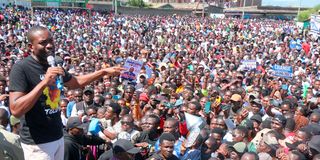
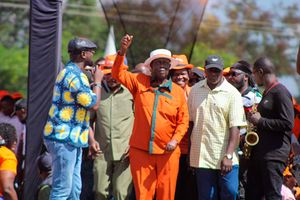
Linda Mwananchi brigade draws a crowd in Kondele en route to K'Owuor Grounds, Kisumu, for a rally on April 26, 2026.
Photo credit: File | Nation
The question has exposed sharp differences among some of the movement's leading figures, especially after the Registrar of Political Parties, John Cox Lorionokou, slammed the door shut for any possible registration of the movement as a political party.
This followed a move by a promoter, Mr Charles Wanyonyi, to apply for the reservation of the name Linda Mwananchi Party of Kenya. The future of the movement now appears to have exposed differences among its leaders, including ODM Secretary General and Nairobi Senator Edwin Sifuna, Siaya Governor James Orengo, Embakasi East MP Babu Owino and Saboti MP Caleb Amisi.
At the centre of the debate is Mr Sifuna's argument that defeating an incumbent president requires a united opposition front, hence the need to join forces with the United Opposition brigade.
"We as Linda Mwananchi have resolved not to allow ourselves to be used to enable Ruto secure a second term. We are convinced that there is no other formula other than a united ticket against William Ruto," Mr Sifuna says.
His position places him closer to the emerging opposition alliance associated with former Deputy President Rigathi Gachagua and Wiper leader Kalonzo Musyoka, where strategists see him as the best bet for a running mate slot. For Mr Sifuna, Kenya's political realities leave little room for multiple opposition candidates.
Mr Orengo has instead focused on what he sees as a struggle to reclaim ODM's ideological identity, even hinting at making another stab at the presidency himself. While criticising the party's cooperation with President Ruto, he has maintained that leaders allied to Linda Mwananchi are not preparing to leave ODM.
"We are still members of ODM. We are struggling within the party, fighting within the party," Mr Orengo, who has declared himself the de facto ODM party leader, told Sunday Nation .
He argues that the current arrangement between ODM and UDA is eroding the party's founding ideals and weakening Raila Odinga's political legacy. "The arrangement that Ruto has now with ODM is killing both the vision of the party and the vision of Raila. It is destroying his legacy.”
Kenya's former Prime Minister Raila Odinga.
Photo credit: File | Nation
The governor has also insisted that ODM should keep open the possibility of fielding its own presidential candidate in 2027, a position that complicates efforts to quickly align with a broader opposition coalition.
The divisions have been amplified by emerging personal ambitions among some of the movement's leaders. Embakasi East MP Babu Owino yesterday declared that he no longer sees himself serving under another political party leader. "On my own behalf, as Babu Owino, Baba (Raila Odinga) was the last party leader I had. The time is now ripe for me to be a party leader. I cannot and will never again serve under somebody else as my party leader," he declared.
Mr Owino further argued that if Linda Mwananchi joins any political formation, it should do so under its own party structure. "We must have our party."
His sentiments were echoed by Mr Amisi, who has cautioned against discussing mergers before the movement establishes its own political identity.
"Linda Mwananchi has got no option but to have a political party. We should stop confusing supporters because we did not start this movement to join others," Mr Amisi, who has since acquired the People's Renaissance Movement Party, told Sunday Nation .
The push for an independent political vehicle reflects concerns among some members that the movement could lose its identity if absorbed into a larger coalition. Those concerns have also been voiced by Linda Mwananchi, spokesperson, and Suba South MP Caroli Omondi, who views the dispute as part of a wider ideological battle within ODM. According to Mr Omondi, ODM is increasingly divided between the Linda Mwananchi faction and the Dr Oginga-led Linda Ground faction.
Mr Omondi claimed the Linda Mwananchi wing remains committed to ODM's traditional ideals and believes the party should continue working with Raila's long-time allies to build a united opposition capable of defeating President Ruto in 2027.
"The broad-based government experiment has failed the people," Mr Omondi told Sunday Nation yesterday, adding that some ODM leaders have become more interested in preserving the party name than defending its founding values. He warned that if efforts to reclaim the party's original direction fail, the movement could chart a new path.
“The differences may prove irreconcilable. To get around this crossroads, we will refer to Baba’s Political Toolkit and learn from his example. If the Linda Ground group fails to retrace their steps and return to the people, we will do what Baba did in 1996, when he led the people out of Ford-Kenya into NDP, and give the people an alternative party that carries their hopes and aspirations,” Mr Omondi said.
He went on: “We will unite the entire opposition under a rebranded Azimio Coalition. It is not the name of a party that is important, but its commitment to serve the people.”
His remarks underscore the difficult choices facing Linda Mwananchi, where ideological differences, leadership ambitions and competing strategies are increasingly threatening to overshadow the unity that initially fuelled its rise.
The growing calls for an independent political vehicle suggest a section of the movement fears losing its identity if it becomes merely another component of a larger opposition coalition.
Jubilee Party deputy organising secretary Pauline Njoroge argues that political movements often begin as broad coalitions before eventually crystallising into parties. "We’ve a common purpose. We are opposed to this regime and for good reasons," she said.
Drawing parallels with ODM's own origins, Ms Njoroge, a member of the Uhuru Kenyatta-led Party’s Executive Committee, noted that many of Kenya's major political parties began as alliances of leaders from different political backgrounds.
"It is not the first time a movement has been made by people from different parties. Even ODM started as a movement with Raila from LDP and Uhuru from Kanu, and ended up as a party. So, we still have time to give Kenyans the best option ever," she said.
Then President Uhuru Kenyatta and the late former ODM leader Raila Odinga at the KICC in Nairobi during the Jubilee Party's National Delegates Conference on February 26, 2022.
Photo credit: PSCU
Her remarks reflect an attempt to keep multiple options open while the movement continues expanding its national footprint.
Political analyst Dismas Mokua believes the movement's biggest challenge lies not in its political positioning but in its organisational foundations.
Mr Mokua says that Linda Mwananchi has enjoyed rapid growth because of the prominence and popularity of its leaders. However, he warns that political formations around personalities, rather than ideas, often struggle to maintain momentum. "The probability does exist that Linda Mwananchi is going to experience leadership wrangles because the political formation is anchored around personalities and not ideas," he says.
According to Mr Mokua, signs of turbulence are already emerging as leaders seek to define their respective roles within the movement. He argues that the group has yet to articulate a compelling policy agenda capable of sustaining support beyond opposition to President Ruto. Most supporters, he notes, are rallying around personalities rather than a clearly defined political philosophy.
Without a coherent ideological identity, he warns, the movement risks plateauing before the next election cycle reaches its peak.
Multi-Media University of Kenya don Gitile Naituli sees the current tensions as part of a normal transition experienced by emerging political movements.
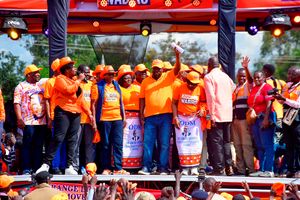
The Linda Mwananchi team during a rally at Tononoka Grounds in Mombasa on March 29, 2026.
According to Prof Naituli, Linda Mwananchi is united largely by what it opposes rather than by a settled agreement on what it seeks to become. "The challenge facing the Linda Mwananchi movement is neither unusual nor fatal. The tough transition is moving from shared dissatisfaction to a shared political project."
Prof Naituli argues that the movement must first decide whether it wants to become a political party, a pressure group or a constituent bloc within a broader opposition coalition. Until that question is answered, disagreements over alliances and leadership are likely to persist, he says.
Political analyst Herman Manyora warns the opposition should not assume the popular “Wantam” slogan alone can deliver victory. Opposition leaders must move beyond rhetoric and quickly agree on a single candidate capable of mounting a credible challenge, he says.