Former Deputy President Rigathi Gachagua’s political calculations for 2027 are increasingly being complicated by a question that could determine the extent of his influence in Mt Kenya — whether he will have a place on the ballot himself or be forced to negotiate from outside the race.
The dilemma is tied to his continuing legal battle over the impeachment that removed him from office in October 2024. In June, the High Court declined to quash the Senate’s impeachment resolution, although it found that his fair-trial rights had been infringed and issued other declaratory orders. He vowed to pursue an appeal.
For Mr Gachagua, political pundits say, the stakes go beyond the question of whether he can personally contest. He has increasingly positioned himself as a leading voice of the Mt Kenya opposition to President William Ruto , making his ability to shape the region’s eventual presidential choice an important part of his political strategy.
But should the courts fail to clear his path to the ballot, analysts opine, he could face an awkward choice. “Backing an opposition ticket without a prominent Mt Kenya figure could make it harder for him to mobilise the region behind the alliance while potentially reducing his bargaining power within a coalition led by politicians from other regions,” says Mr Steve Ngari.
Backing another Mt Kenya politician for the top position, he adds, could present a different problem by potentially elevating a rival and leaving Mr Gachagua operating from the political periphery of the very coalition he helped build.
Supporters of the Kenya Kwanza administration have also framed the retention of Prof Kindiki as evidence that Mt Kenya would continue to have a senior representative on the national ticket.
Prof Kindiki has warned that Mt Kenya risks being relegated to “number 20” in the opposition hierarchy, arguing that supporting President Ruto offers the region a clearer route back to the presidency.
“After William Ruto, ni sisi . Ile team nyingine tuko number 20; tutafikiwa after 200 years. We must have an honest conversation,” the DP said.
This places Mr Gachagua at a political crossroads as an opposition alliance without a homegrown Mt Kenya figure could leave him defending a difficult proposition in the region, while a Ruto-Kindiki ticket offers Mt Kenya a familiar regional presence within government.
“The emerging contest, therefore, is not simply about who will carry the opposition banner in 2027. It is also about who speaks for Mt Kenya, who negotiates its interests and whether Gachagua can retain that influence if he is unable to personally contest the election,” says political analyst Geoffrey Mboya.
That question has become more complicated with the emergence of several possible political players from the region, each bringing a different calculation to the opposition equation.
Among them is Nyandarua Senator John Methu, one of Mr Gachagua’s closest political allies and the secretary-general-designate of the Democracy for Citizens Party (DCP). With Mr Gachagua away from the country, Mr Methu has increasingly taken charge of party activities and emerged as one of his most visible lieutenants.
There are reports within political circles that Mr Gachagua could consider Mr Methu as a possible Mt Kenya face on an opposition ticket if the courts ultimately shut the door on his own candidature.
Such an arrangement would allow Mr Gachagua to retain a direct link to the region’s political project without personally appearing on the ticket. But it would also carry its own risk as advocate Chris Omore puts it. “Elevating another politician could create an alternative centre of influence in Mt Kenya, particularly if that candidate develops a national profile,” Mr Omore says.
The same dilemma explains the significance of Safina Party leader Jimi Wanjigi, who has already declared presidential ambitions and held political consultations with Mr Gachagua at Wamunyoro home twice.
Mr Gachagua and Mr Wanjigi described the meeting as part of wider consultations on the formation of the next government.
Mr Wanjigi presents a different proposition from Mr Methu. “He is not simply a potential running mate or regional mobiliser but a presidential aspirant with a national political vehicle,” says advocate Nelson Osiemo.
“If the opposition eventually settles on a presidential candidate from outside the region, Wanjigi could provide an alternative homegrown presidential project. The question then becomes whether Gachagua would support such a bid, negotiate with it or seek to maintain DCP as the principal vehicle for Mt Kenya opposition politics,” Mr Osiemo says.
That meeting therefore acquired significance beyond the two men as it raised questions about whether Mr Gachagua is already preparing for a political environment in which he may have to determine where his support base goes rather than asking voters to vote for him.
Mr Gachagua has said he is ready to back whoever wins the opposition ticket,
“If we do our arithmetic and find that Sifuna will send President Ruto home early, so be it. And there is no problem, by the way, even I, Riggy G, can deputise Sifuna. There is nothing wrong with that,” he said during his US trip.
Kiharu MP Ndindi Nyoro when he announced that he had defected from UDA to the People's Party of Kenya at Safari Park Hotel, Nairobi on August 17, 2026.
Photo credit: Lucy Wanjiru | Nation Media Group
Kiharu MP Ndindi Nyoro has established the People's Party of Kenya (PPK) and embarked on an aggressive national mobilisation and recruitment campaign. The party has attracted hundreds of aspirants, with a particularly strong presence in Mt Kenya, while Mr Nyoro has presented it as an independent opposition vehicle.
Mr Nyoro's previous association with President Ruto has made him a target of suspicion among sections of the opposition, but he has rejected claims that PPK is a government project and insists that the party is intended to expand opposition numbers.
His political trajectory is therefore important to Mr Gachagua's calculations. A successful PPK would give Mr Nyoro an independent organisational base in a region where DCP has sought to consolidate opposition support.
Mr Gachagua's earlier push for opposition parties in Mt Kenya to consolidate around DCP has already encountered resistance from leaders including Party of National Unity chief Peter Munya and his Democratic Party counterpart Justin Muturi.
In August, Mr Munya, Mr Muturi and Devolution Empowerment Party leader Lenny Kivuti rejected calls for their parties to dissolve and join DCP, insisting that opposition parties could cooperate without surrendering their identities.
Mr Munya subsequently argued that negotiations for a united opposition should take place at a neutral venue rather than Mr Gachagua's Wamunyoro residence.
“Even if he remains the most prominent opposition figure from Mt Kenya, he cannot automatically assume that every regional politician will subordinate his or her political vehicle to DCP,” argues political analyst Dismas Mokua.
Mr Muturi, Mr Munya and others have their own constituencies, parties and ambitions. Their resistance means that a united opposition ticket will have to accommodate several centres of influence rather than simply operate under one regional command.
The former Justice minister, who was the late ODM leader Raila Odinga's running mate in 2022 and remains associated with the opposition camp, is herself a prominent Mt Kenya figure. Her position means that any discussion about the region's representation cannot easily be reduced to a Gachagua-versus-Kindiki contest.
Jubilee Presidential candidate Fred Matiang'i is another key factor. His Jubilee presidential bid gives the opposition another national-level contender, while his association with the United Alternative Government places him within the wider discussions on how the opposition could eventually settle on one candidate.
Wiper Patriotic Front leader Kalonzo Musyoka remains a leading presidential contender within the opposition, while Nairobi Senator Edwin Sifuna has emerged as an important figure in the Linda Mwananchi movement. Any eventual Kalonzo-led ticket would have to answer the same question confronting the wider opposition — how to secure substantial Mt Kenya support without a prominent politician from the region occupying one of its top slots.
For Mr Gachagua, that is the heart of the dilemma.
If he is cleared to contest, the calculation is relatively straightforward: he can seek the presidency and ask Mt Kenya voters to rally behind his candidature.
If he is not, the choices become more complicated.
Analysts say that he could support a national opposition ticket without a Mt Kenya principal, relying on the region's desire for political change to overcome the absence of one of its own.
The Ruto-Kindiki ticket, meanwhile, offers the government a simple counterargument: Mt Kenya already has one of its own at the centre of the administration.
Prof Kindiki has repeatedly used that position to call for support for President Ruto, while saying the region's interests can be advanced through its representation in government.
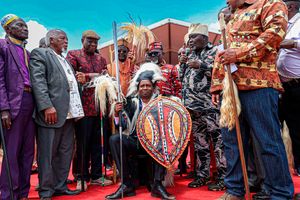
Elders from Mt Kenya region install Deputy President Kithure Kindiki as the spokesperson of the region at Kirigiti Stadium in Kiambu County.
Photo credit: DPCS
The opposition may ask Mt Kenya to make a national change without guaranteeing the region a place on its top ticket, while President Ruto can point to Prof Kindiki as evidence of continued regional representation.
Mr Gachagua's challenge, therefore, according to pundits, is not merely to oppose the President, but to determine whether the political capital he has accumulated in Mt Kenya can be transferred to another candidate without diminishing his own influence.
That is where Mr Methu, Mr Wanjigi, Mr Nyoro, Ms Karua, Mr Munya and Mr Muturi become important pieces of the equation.
The more credible alternatives emerge, the harder it becomes for Mr Gachagua to remain the sole gatekeeper of the region's opposition vote.
Yet if he succeeds in coordinating these competing interests around a single opposition project, he could retain considerable leverage even without being on the ballot.
For now, however, the former Deputy President faces an unresolved political equation.
The courts will determine the legal dimension of his personal ambitions. The opposition negotiations will determine the shape of the national ticket. And Mt Kenya voters will ultimately determine whether Mr Gachagua can transfer his political influence to the candidate or coalition he chooses to support.
Until those questions are settled, pundits insist, his position remains defined by one uncomfortable possibility: he may have to decide who should carry Mt Kenya's political aspirations at the very moment when another leader carrying those aspirations could become a threat to his own influence.