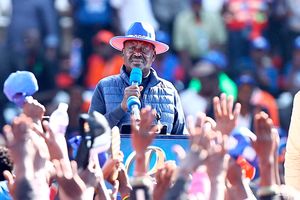
In the volatile landscape of Kenyan politics, few moments have captured the raw intensity of leadership frustration quite like the day Raila Odinga publicly lost his temper in Mombasa in 2009.
It was not just a rant, but rather a roar from a Prime Minister who felt stripped of dignity, slighted by protocol, and betrayed by the very government he had helped to form.
Standing before a crowd under a poorly arranged shelter with a visibly torn carpet and no functioning toilet facilities, Raila Odinga unleashed a tirade that laid bare the simmering tensions within the Grand Coalition Government.
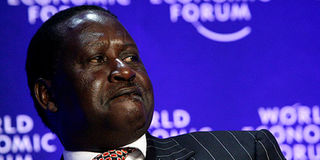
Former Prime Minister Raila Odinga.
Photo credit: File| Nation Media Group
What the crowd witnessed was not the Raila of measured diplomacy or fiery campaign rhetoric. This was a man pushed to the edge.
“A whole Prime Minister comes to an event like this, and we are told the PC (Provincial Commissioner) isn’t around... he has travelled to Nairobi. If Kibaki was the one coming to this event, would the PC be unavailable?” he thundered, his voice quivering with anger and disbelief.
To understand the depth of this moment, one must rewind to the chaotic months following the 2007 elections, whose disputed results plunged Kenya into a nightmare of post-election violence.
The eventual formation of a Grand Coalition Government, brokered by international mediators, was hailed as a political truce. But beneath the surface, bitterness festered, especially within the Orange Democratic Movement (ODM), which maintained it had won the election but been robbed of victory.
Raila's outburst in Mombasa came shortly after the collapse of the Kilaguni talks, a retreat meant to mend the coalition’s fraying ties. But instead of reconciliation, the meeting at Tsavo’s Kilaguni Lodge revealed how deep the divisions ran between ODM and the Party of National Unity (PNU).
The ODM camp accused President Mwai Kibaki and his allies of primitive governance and deliberate attempts to sideline them in government operations, a far cry from the promised 50:50 power-sharing deal.
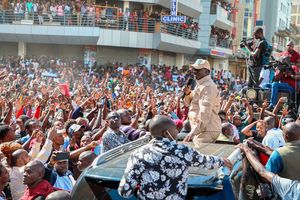
Azimio La Umoja (One Kenya Coalition Party) coalition presidential candidate Raila Odinga addresses the crowd during a campaign rally in Kirigiti Stadium, Kiambu, Kenya on August 1, 2022, ahead of Kenya's general election. - On August 9, 2022, Kenyans will head to the polls in a contested tight battle between veteran opposition leader Raila Odinga and current Deputy President William Ruto as they traverse the country vying for electorate support.
Photo credit: Photo | Nation
Addressing the crowd in Mombasa, a visibly agitated Raila abandoned diplomatic restraint in favour of open confrontation.
“They stole our victory and then they insult us on a daily basis! Is that noble, eh?!” he exclaimed, pacing before the stunned audience. “I am saying that it is a must that we are accorded our due respect. Thieves must respect the owners of wealth, and we are the owners of wealth!”
Raila was responding not just to bad optics at a public event, but to what he perceived as a calculated campaign of disrespect, orchestrated from the highest office in the land.
At the time, districts were being carved out without ODM’s input and government appointments were made unilaterally. Key decisions were being made behind closed doors, and the symbolism of power –the rituals, the protocols, the courtesies— were being weaponised to belittle him.
The absence of a full carpet and proper sanitation at an official event was not just a logistical oversight. To him, it was an insult and an intentional snub.
“And then they claim that I am respected? I’d rather they even remove this carpet altogether! There is no respect!”
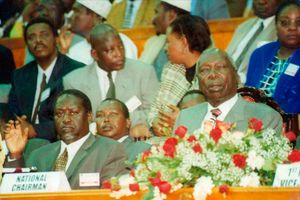
Former President Mwai Kibaki.
Photo credit: File | Nation Media Group
President Kibaki, calm and composed, would respond days later, not with fire, but with ice. Dismissing the Prime Minister’s remarks as theatrics, he warned, “As leaders, we must be conscious of our actions and our speech.”
Kibaki refused to be drawn into the emotional theatrics, emphasising instead the need for stability and national service.
“I will not be sidetracked in undertaking my noble duties of serving our people and leading them in creating a better country,” he said, in a statement that many interpreted as a veiled rebuke.