Jubilee Party candidate Dr Fred Matiang’i is pushing for a “scientific” formula to select a joint United Opposition candidate for the 2027 presidential election.
The former Cabinet Secretary warned that any “boardroom deals” could cause the coalition to break up before the polls.
A crucial retreat, which was due to begin in Naivasha today, has been postponed until next week amid reports of simmering tension over how to select a presidential candidate.
In the wide-ranging interview with Sunday Nation , Dr Matiang’i laid out what he termed a “scientific, transparent, inclusive and objective” model for the selection process. His remarks appear to be targeting some of his co-principals, who prefer a negotiated line-up.
The Jubilee Deputy Party Leader cautioned that the method used to select a joint candidate could determine whether the coalition survives or hands President William Ruto an easy path to a second term.
United Opposition leaders, led Rigathi Gachagua (centre), address the media in Nairobi on December 11, 2025.
Photo credit: Dennis Onsongo | Nation Media Group
The former Interior Cabinet Secretary believes that he is the candidate who can dislodge Dr Ruto from power during the election.
His remarks come at a delicate time for the opposition, which is seeking to coalesce disparate parties and personalities — including former Deputy President Rigathi Gachagua (Democracy for the Citizen’s Party Leader - DCP) and Wiper Patriotic Front Leader Kalonzo Musyoka — into a single formidable force capable of unseating the incumbent.
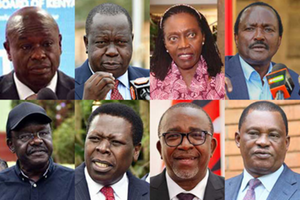
The other opposition principals are; People’s Liberation Party Leader (PLP) Martha Karua, Democratic Action Party – Kenya (DAP-K) chief Eugene Wamalwa and Democratic Party (DP) leader Justin Muturi , who are all gunning for the coalition’s ticket.
When asked about how the United Opposition should pick its flag bearer, Dr Matiang’i was unequivocal.
“My honest view is that it should be a scientific, transparent and objective process that can pass muster,” he said. “You cannot frog-march parties, individuals and Kenyan voters to a decision, because the result and effect will be disastrous,” he said.
If four or five candidates are in the race for the coalition’s ticket, he said, the losers must be able to return to their supporters and convincingly explain to them why they did not emerge on top.
“If the system used is not objective and credible, then it becomes a zero-sum game. The other four cannot persuade their supporters to back the winner. And once that happens, you have failed,” Dr Matiang’i said.
This has been a familiar problem in Kenyan coalition politics: elite consensus without grassroots buy-in. In previous election cycles, pre-election pacts have often unravelled after nominations, with disgruntled aspirants either defecting or offering lukewarm support.
In the case of the 2007 General Election, Mr Musyoka, then leader of the defunct Orange Democratic Movement – Kenya (ODM-K) broke ranks with other ODM Pentagon members; former party leader Raila Odinga , President Ruto, Prime Cabinet Secretary Musalia Mudavadi , Mr Najib Balala and Joe Nyaga (now deceased), to independently contest the top seat against Raila and Mwai Kibaki of the Party of National Unity. Mr Musyoka would later be named Vice President after Kibaki’s contested victory.
United Opposition leaders Fred Matiangi and Rigathi Gachagua during a funeral service in Muranga County on February 6, 2026.
Photo credit: Mwangi Muiruri | Nation Media Group
A similar scenario was witnessed in 2002 when then Ford People leader, Simeon Nyachae, also went to the ballot after Raila’s famous “Kibaki Tosha” declaration.
And in the last presidential election in 2022, Mr Musyoka protested after Ms Karua was picked, instead of him, as Raila’s running mate. He threatened to go it alone but was implored to back the Raila-Karua ticket on the Azimio la Umoja-One Kenya ticket.
Dr Matiang’i said that a technical committee led by former Agriculture minister Kipruto arap Kirwa, has been tasked with exploring coalition-building frameworks and the best method for identifying an opposition candidate. He said that whatever formula will be arrived at must be publicly defensible.
“Whether it’s a poll that will be carried out, it must be scientifically sound. It cannot be me and you and two other people sitting in a boardroom and deciding who the candidate is. That decision will collapse from the day it is announced,” he warned.
Political analysts say this position reflects lessons from past opposition arrangements where informal “gentlemen’s agreements” proved insufficient to contain post-nomination fallout.
Dr Matiang’i added: “If the process lacks respect and credibility, it will backfire. And the result and effect is that it will give the incumbent (Dr Ruto) an opportunity,” he said.
Since taking office, Dr Ruto has consolidated his support base within Kenya Kwanza Alliance while navigating economic turbulence and rising public discontent over taxation and cost-of-living pressures.
Opposition unity, therefore, is seen as the only viable path to mounting a serious challenge in 2027.
Speculation has been swirling around about possible friction between Dr Matiang’i and Mr Gachagua, both viewed as heavyweight figures within the opposition orbit. There are reports indicating that the former DP was keen on a Kalonzo candidacy, “owing to his experience.”
However, Dr Matiang’i dismissed speculations of tension between Mr Gachagua and himself.
“There is no tension between me and anyone else on this earth. I have no quarrel with anybody,” he said. “I am probably the only person running for public office right now who has no political baggage.”
He portrayed himself as a technocrat-turned-candidate, unencumbered by broken agreements or inflammatory political rhetoric.
“I have never entered into an agreement with anybody and broken it. I have never been on a platform insulting anyone. I am just basically Fred who wants to deliver,” he said.
His pitch is that of a results-oriented administrator rather than a conventional politician—a distinction he believes could appeal to voters fatigued by partisan theatrics.
On whether he would accept another role should he fail to clinch the ticket, Dr Matiang’i declined to speculate.
“You don’t cross the bridge before you get there. You don’t shave your head on your way to the barber,” he quipped.
The response reflects both caution and calculation. Committing to a fallback position could weaken his bargaining power, yet ruling out alternatives might paint him as inflexible.
Dr Matiang’i was keen to distinguish the United Opposition from the former Azimio coalition, which recently named Mr Musyoka as party leader. He said that the two formations are not interchangeable.
Wiper party leader Kalonzo Musyoka (centre) and other leaders of the United Opposition (from left) Rigathi Gachagua, Justin Muturi and Martha Karua address the media outside Vigilance House in Nairobi on January 30, 2026.
Photo credit: Bonface Bogita | Nation Media Group
“I cannot see the correlation between Azimio and the 2027 General Election,” he said, adding that the United Opposition represents a distinct arrangement.
This differentiation is significant. By signalling a clean break from previous configurations, Dr Matiang’i appears to be appealing to voters who may associate past coalitions with internal wrangles and electoral disappointments.
The United Opposition spokesperson, Dr Mukhisa Kituyi, had earlier indicated that the coalition is not inclined to resuscitate Azimio as currently constituted.
“No. As United Opposition, we have not discussed the resuscitation of Azimio,” Dr Kituyi told the Nation.
Throughout the interview, Dr Matiang’i stressed the importance of good leadership.
“Kenya’s problem is leadership, period,” he said. “We have self-serving leadership that is based on looting the country and filling their pockets.”
He pledged to fight corruption “like my life depends on it,” invoking his tenure in government, where he claims to have implemented reforms within existing legal frameworks and successfully defended his decisions in court.
Dr Matiang’i also called for merit-based recruitment in public service and an end to what he described as patronage-driven appointments.
“The youth are not asking us to cook for them. They are asking us to do our work so that opportunities will be there,” he said.
As opposition leaders plan their retreat, expectations are high that they will clarify both their policy direction and nomination roadmap.
“We are going to have discussions on how we move forward, how we engage the people of Kenya, what our priorities are,” he said.
Insiders say the retreat could either cement a structured pathway to unity—or expose unresolved rivalries.
If Dr Matiang’i’s model gains traction, the coalition may adopt a data-driven selection mechanism designed to reassure supporters across regions and parties. If it does not, the risk of fragmentation looms large.
Dr Matiang’i’s intervention is both principled and strategic. By championing a “scientific” process, he positions himself as a defender of fairness and inclusivity—values that resonate with voters wary of elite bargains. At the same time, he implicitly challenges rivals to commit to the same standard.
Should the coalition embrace his model and he emerges victorious, his legitimacy would be difficult to contest. Should he lose, he has already framed the benchmark for acceptance: transparency and objectivity.
But if the opposition opts for expediency over process, his warning is stark. “That decision collapses the joint efforts from the day it is announced,” he said.
In a political landscape where alliances are fragile and ambitions run deep, the method may matter as much as the candidate.
And as 2027 inches closer, the United Opposition faces a fundamental question: will it build unity on science and credibility—or risk division that could secure President Ruto’s re-election by default?
For Dr Matiang’i, the answer could define not only his political future but the opposition’s collective fate.
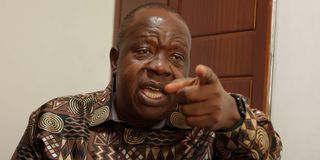
Jubilee Party Deputy Party leader Fred Matiang'i.
Photo credit: Evans Habil | Nation Media Group
The former powerful CS also delved on recent accusations by Deputy President Prof Kithure Kindiki asking him to come clean on the Ruaraka land saga. Dr Matiang’i dismissed the allegations as reckless political talk.
Senior government officials
He said it was improper for serving ministers and senior government officials to make public claims without investigations.
“There is a rule of thumb,” he said. “Civilised, respectable and responsible government officials… don’t make allegations. They act on them.”
Dr Matiang’i argued that if credible evidence existed, it should be forwarded to investigative agencies for action. “If I know Justus stole, I go to the DCI or the police and say, this is my evidence—arrest him. I don’t shout from a political platform.”
He challenged his accusers to pursue legal recovery mechanisms if fraud occurred. “If they know where the land is that I took in Ruaraka, let them take it tomorrow. The law is very clear—you can recover the land and the payment.”
Dr Matiang’i equally denied responsibility for the River Yala killings during his tenure as Interior CS, saying security decisions were made collectively within the National Security Council, where President Ruto—then Deputy President—was his senior.
“If you go by ranking, he should actually be the one to answer that question, not even me, because he was my boss at that particular time,” he said.
He noted that former Inspector General of Police Joseph Boinet and ex-Defence CS Monica Juma, now senior security advisers to President Ruto, also served then and should equally face any emerging questions on the same.
Dr Matiang’i called for a public inquiry: “I’m the one asking for a public inquiry. I’m ready to go and say what I know.” He dismissed the claims as “political dishonesty” and “plain idiocy.”