Determined to form a strong alliance to unseat President William Ruto in 2027, the United Opposition is set to abandon Azimio as its electoral vehicle in favour of a new coalition framework.
United Opposition spokesperson Dr Mukhisa Kituyi, a member of the opposition’s inner circle, has indicated that the coalition is not inclined to revive Azimio in its current form.
“No. As United Opposition, we have not discussed the resuscitation of Azimio,” Dr Kituyi told the Nation . “We are having a retreat this weekend to iron out issues, including this one, which will be addressed. We shall give a comprehensive statement on Monday afternoon at the end of our retreat in Naivasha.”
This revelation by Dr Kituyi comes as a contradiction to the actions of the outfit’s executive chairman, Uhuru Kenyatta, who two weeks ago moved to install Wiper leader Kalonzo Musyoka as Azimio leader, replacing the late ODM leader Raila Odinga, among other changes. This, we gathered, was done in order to position Azimio as a formidable challenger to Dr Ruto’s Kenya Kwanza alliance in next year's polls.
The United Opposition’s two-day retreat, scheduled for Sunday and Monday, will bring together principals and members of the coalition’s technical committee to deliberate on structure, leadership, strategy, and the controversial 2027 presidential ticket.
However, even before any formal resolutions are announced, it is possible that Azimio, as a political brand and legal entity, will not be the vehicle that carries the opposition into the next election.
Democracy for the Citizens Party (DCP) deputy party leader Cleophas Malala struck a cautious but revealing tone, emphasising that Azimio remains a legally recognised coalition governed by the Political Parties Act.
“Azimio is an existing coalition which has timelines, so we respect it the way it is. We are yet to receive any report from the technical team,” Mr Malala said.
“Azimio is a coalition with timelines and governed by the Political Parties Act. For it to be dissolved, there are legal ways to be followed. If they want to maintain it, the Political Parties Act can also allow it to engage with other partners, so it’s an open game.”
Yet Mr Malala was categorical on one point — the overriding objective of the emerging alliance is singular.
“So long as they believe in Wantam, us we will work with anybody, whether it’s a self-help group. So long as the agenda is to have Ruto go.”
That “Wantam” slogan — shorthand for “one term” — has become the rallying call of opposition leaders determined to deny President Ruto a second term.
While the United Opposition is wavering over Azimio's future, the Orange Democratic Movement (ODM) appears to have already made up its mind.
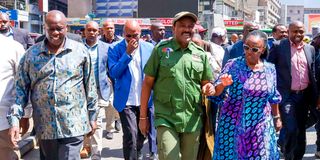
Wiper party leader Kalonzo Musyoka (centre) and other leaders of the United Opposition (from left) Rigathi Gachagua, Justin Muturi and Martha Karua address the media outside Vigilance House in Nairobi on January 30, 2026.
Photo credit: Bonface Bogita | Nation Media Group
ODM party leader Dr Oburu Oginga on Wednesday dismissed suggestions that Azimio could be rebranded or restructured without his party’s concurrence.
“Azimio — we are the Azimio, the majority and the strongest party which is ODM. You cannot make any decision without the concurrence of ODM,” Dr Oginga said during the party’s NEC meeting in Mombasa.
“You cannot purport to appoint a new leader of Azimio excluding and bypassing ODM. If ODM has not agreed, then there is nothing like a resolution on Azimio.”
In a statement that underscores the widening rift, Dr Oginga declared that Azimio effectively ceased to exist when ODM walked away.
“In fact, Azimio died when ODM left it. We left it a long time ago and it’s only a formality which we have not performed — and we are going to perform it very soon. We are going to exit that moribund organisation called Azimio.”
His blunt assessment leaves Mr Musyoka — recently installed by some Azimio affiliates as coalition leader following Raila Odinga’s death — in a delicate position. Without ODM, Azimio risks being an empty shell.
For Mr Musyoka, Azimio was both a political platform that would make him the automatic flag bearer.
Mr Kenyatta, who backed Azimio in 2022 and remains an influential figure in opposition circles, must now weigh whether to anchor his political capital in a new formation or attempt to salvage the old coalition framework.
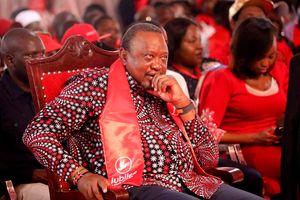
Jubilee Party leader and retired President Uhuru Kenyatta during a past Jubilee National Delegates Conference.
Photo credit: Lucy Wanjiru | Nation Media Group
Multiple sources within the opposition’s technical committee say the prevailing mood favours a fresh start — a new coalition name, a new legal structure and a rebranded manifesto aimed at distancing the alliance from past electoral disappointments.
“Azimio carries baggage,” said a source within Mr Gachagua’s DCP party familiar with the retreat agenda. “There is a feeling among some principals that we need a clean break from 2007, 2013 and 2022.”
There are concerns within Mr Gachagua’s camp that adopting Azimio as the United Opposition’s 2027 vehicle would tilt the balance of power in favour of Mr Kenyatta, effectively drawing Mr Musyoka and former Interior Cabinet Secretary Dr Fred Matiang’i into his political orbit and strengthening his hand in shaping the coalition’s direction.
Political analyst Chris Omore argues that reviving Azimio would significantly weaken Mr Gachagua’s bargaining power within the opposition, effectively placing him under Mr Kenyatta’s political shadow and diminishing his influence in shaping any future government structure.
“This is not just about a coalition name; it is about control of the centre of gravity,” said Mr Omore. “If Azimio becomes the vehicle, the architecture of power automatically tilts toward those who built and owned it. In that setup, Mr Gachagua risks being reduced from a principal to a participant, with limited say over the configuration of a proposed government.”
Beyond the Azimio question, the Naivasha retreat will scrutinise at least five power-sharing scenarios already developed by the coalition’s technical team.
Jubilee Party Deputy party leader Fred Matiang'i (left), People's Liberation Party Leader Martha Karua (right) and Wiper party leader Kalonzo Musyoka at Anniversary Towers, Nairobi on January 28, 2026 after a meeting with IEBC.
Photo credit: Lucy Wanjiru | Nation Media Group
The proposed scenarios revolve around three top positions — President, Deputy President and Prime Minister — with additional roles such as Senate Speaker and National Assembly Speaker reserved for senior figures who miss out on the top slots.
Although the Constitution does not currently provide for a Prime Minister, the technical team is considering recommending constitutional amendments after 2027 to reintroduce the post, mirroring President Ruto’s creation of the Prime Cabinet Secretary position in 2022.
Under one scenario, Mr Musyoka would be the presidential candidate, with Fred Matiang’i, Eugene Wamalwa or George Natembeya as running mates, and Mr Gachagua as Prime Minister.
Another scenario proposes Dr Matiang’i as flag bearer, with Musyoka, Martha Karua or Justin Muturi as deputy, and Mr Gachagua, Mr Wamalwa or Mr Natembeya as Prime Minister.
A third model contemplates Mr Gachagua as presidential candidate — subject to court clearance following his October 2024 impeachment — with Mr Musyoka as Prime Minister.
In a recent interview, DAP-K leader Eugene Wamalwa noted that coalition building remains a process.
“Coalition-building is a process, not an event. We have not arrived at a candidate. Our priority is to address underlying issues before making any announcements.”
The technical team is expected to conduct a SWOT (Strengths, Weaknesses, Opportunities and Threats) analysis of all prospective candidates, factoring in national appeal, political baggage and regional dynamics.
“We won’t be distracted. If we listen to them, we won’t implement critical programmes like affordable housing or SHA,” he said recently.
“It’s not about one or two terms. The real question is — who decides? It is the people at the ballot.”
Despite the jostling, opposition leaders insist they will unveil a joint candidate and power-sharing formula by December 2026, arguing that early disclosure could invite state interference.
“We are patriotic and committed to doing the right thing for Kenya. We will delay the unveiling to prevent interference,” Mr Gachagua said.
Political analysts caution that while the vision of a united front is taking shape, unresolved tensions — including the Azimio question — could derail momentum.
“Azimio symbolised a moment in time,” said advocate Chris Omore. “The question is whether the opposition can create a new narrative that speaks to Gen Z voters and reform-minded Kenyans without being trapped by old rivalries.”