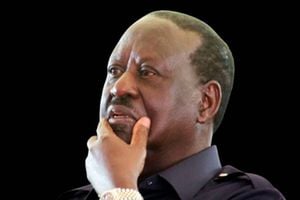
Veteran politician Raila Odinga has once again wiggled himself to a position of power and influence in President William Ruto’s administration, cementing his credential as the country’s ultimate political survivor.
For Mr Odinga, his deals with those in government began in 1998 when he entered into a cooperation agreement with President Daniel Moi, later turned into a merger between his National Democratic Party (NDP) and Kanu in 2002 — and he was then named Energy minister and Kanu secretary general — before he inked a Kofi Annan-brokered Grand Coalition deal with President Mwai Kibaki in 2008, making him Prime Minister and ending the post-election violence.
When he lost to President Uhuru Kenyatta in 2013, Mr Odinga went on an Okoa Kenya referendum signature collection drive that was in 2016 rejected by the electoral agency, saying only 891,598 signatures out of the 1.6 million submitted by the Coalition for Reforms and Democracy (Cord), had been found to be authentic.
He would later use this to call for the removal of Independent Electoral and Boundaries Commission (IEBC) chairman Issack Hassan and his fellow commissioners, which happened in late 2016.
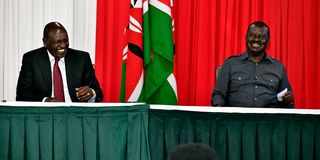
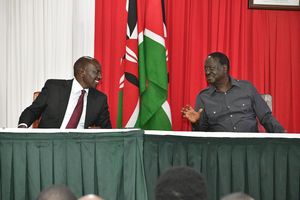
President William Ruto and former Prime Minister Raila Odinga at State House in Mombasa on February 24, 2025.
Photo credit: PCS
He would then shake hands with President Kenyatta on the steps of Harambee House on March 9, 2018, ending months of violent demonstrations and getting into what then Deputy President William Ruto later called ‘a mongrel of a governance system where it’s not clear if it’s the opposition in government; or the government in the opposition.”
Initially swearing not to accept any such plans, he, in 2023, caved in, calling for the formation of a National Dialogue Committee (Nadco) that ironed out issues and recommended, among other things, the formation of the office of Prime Minister and that of the Official Leader of Opposition.
Ruto-Raila pact: What's in it for the common mwananchi?
But a delay in Parliament and what looked like the government dragging its feet on the deal— combined with youth-led protests on high taxation and bad governance in June 2024 — brought back the discussions, leading to the inclusion of key allies of Mr Odinga in government.
President Ruto then rolled out a red carpet campaign for Mr Odinga for the African Union Commission chairperson seat, which he lost in February this year.
Facing threats from a growing opposition team, including his impeached deputy Rigathi Gachagua, former vice president Kalonzo Musyoka , and People’s Liberation Party boss Martha Karua , among others, Dr Ruto went in with the big guns: A cooperation agreement between his ruling United Democratic Alliance (UDA) party and Mr Odinga’s ODM.
And with it, Mr Odinga has once again risen like a phoenix from the ashes to claim position of influence and power in the Kenya Kwanza administration, whose leaders – in the 2022 presidential elections – asked voters to retire him to his Bondo home.
“We make it clear that the memorandum we have signed today does not define the formation of a political coalition between ODM and UDA. However, its successful implementation could form the basis of steps towards the establishment of a stable country in future,” Mr Odinga explained on Friday during the signing of the agreement.
But allies of the former Prime Minister are already occupying positions of power both in the Cabinet and in Parliament.
In the Cabinet, Dr Ruto has incorporated John Mbadi (National Treasury), Mr Opiyo Wandayi (Energy and Petroleum), Ali Hassan Joho (Mining and Blue Economy), Wycliffe Oparanya (Cooperatives and MSMES) and Beatrice Askul (East Africa Community and ASAL).
The current political cooperation is no different from other political deals that Mr Odinga has entered with former Presidents, whom he first faced off with in elections before making peace.
In most of the instances, Mr Odinga has come out as a major beneficiary, reinventing himself for the subsequent political battles and earning positions of influence for himself and his allies.
“This unity that you have put together today is not about the two of you, because Baba has seen it all; in fact, he has enough for all generations. The President has sat in all positions. So, in my thinking, this unity is for the young people, women, the marginalized...it is for all Kenyans who have felt like they have never been part of Kenya,” said ODM national chairperson Gladys Wanga, who is also the Homa Bay governor.
Ruto and Raila sign political cooperation deal
Mr Odinga first pulled such a political surprise with retired President Daniel Moi in 1998 when, after the 1997 General Election, Mr Odinga who came third after Moi and Mwai Kibaki, met the President at his Kabarak, Nakuru home and agreed to a co-operation between Kanu and National Development Party (NDP).
Then in 2001, Mr Odinga cemented this cooperation through a merger between his NDP and then ruling Kanu. He was then named ‘New Kanu’ Secretary General.
Mr Odinga took the decision after facing off with Mr Moi in 1997, when he first race for the presidency.
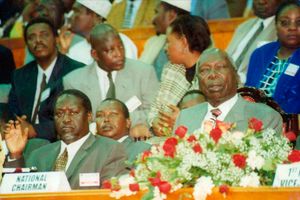
Raila Odinga and President Daniel arap Moi at Kasarani stadium during the Kanu-NDP merger.
Photo credit: File | Nation Media Group
In the deal, Mr Odinga was named Kanu Secretary General. President Moi also appointed him as Energy Minister.
US-based university lecturer and political analyst Prof David Monda argues that for Mr Odinga and many others, he is the “first and foremost the prime political survivor that puts enlightened self-interest above all.”
“This character then informs his tactics on national politics whether the NDP pact with Moi, handshake with Kibaki and Uhuru and the budding truce with Ruto,” observes US-based university lecturer and political analyst, Prof Monda.
Suba South MP Caroli Omondi describes politics as a game of exchanging favours and making compromises.
“The first question then would be whether or not the favours exchanged or compromises made advance progressive politics by delivering the greatest good for the greatest number or they only serve immediate narrow partisan or individual interests?’ said Mr Omondi.
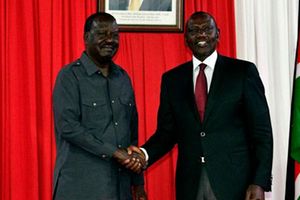
President Kibaki shakes hands with Raila Odinga (right) outside Harambee House in Nairobi in January, 2008.
In 2007 – after the deadly post-election violence triggered by the disputed presidential results — Mr Odinga became the country’s Prime Minister under the Grand Coalition government that was negotiated by former Secretary General Koffi Annan.
In the deal, Mr Kibaki’s Party of National Unity (PNU) and Mr Odinga’s ODM each shared 22 Cabinet slots.
During the handshake period with Mr Kenyatta, Mr Odinga’s allies, especially in Parliament were handed chairmanship of powerful committees.
Mr Odinga and Mr Kenyatta also tried to amend the constitution through the Building Bridges Initiative (BBI).
“The truce often gives the necessary political capital that occasions the much-desired peace and calm. He may not be adjudged the ultimate rescuer, but a tactical political master negotiator who has no room for capsule tokens, rather, one who comes to the party with his own knife. It is the sharpness of his political knife that enables him to cut huge shares for himself for his fill and survival,” says Mr Javas Bigambo, a political analyst.
Prof Monda notes that some of these political tactics are purely ad hoc, survivalist and transactional.
“Once the immediate purpose for which they serve is passed, Raila can quickly change tact and abandon a previously accepted political agreement. This is something Ruto will need to watch keenly in the run-up to 2027. So ultimately he appears the ultimate rescuer for Kenya's successive political regimes, but this tendency is closely tied to his political tactics that are purely ad hoc, survivalist and transactional,” Prof Monda says.