The electoral body is starting its preparations for next year's general election from a position of confidence deficit with one of its key customers, the United Opposition, who accuse it of being pro-government.
The United Opposition has laid out key ultimatums they want resolved before they can be convinced that the IEBC is in a position to oversee free, fair and verifiable elections.
At the top of the list is Smartmatic, the voting technology company the Commission deployed in the 2022 polls. They want it dropped.
The company has received negative publicity around the world in recent years. It was accused of gifting a luxury home to Venezuela’s election chief in 2017.
Last October, the United States Justice Department levelled foreign bribery charges against Smartmatic. According to CNN , the indictment relates to an alleged bribe of Sh130 million paid to the top election official in the Philippines to secure lucrative contracts for the country's 2016 elections.
The indictment does not include any allegations of voter fraud or election rigging against Smartmatic.
“Smartmatic’s user-friendly software helped workers make informed decisions with operational intelligence and functional protocols. Performance data showed a remarkable improvement compared to prior elections, with 94 per cent of polling stations opening by 7 am on election day,” the tech company said after the 2022 elections.
This appears to be now a familiar pattern in the country's electoral cycle where rightly or wrongly: The Commission is publicly confronted, its neutrality questioned, its technology choices are rejected, and senior officials are demanded to be removed.
The standoff echoes the disputes that defined the contested elections of 2013, 2017 and 2022.
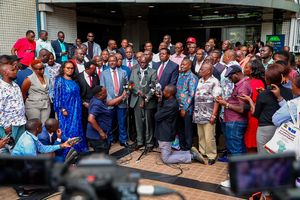
During a meeting with IEBC commissioners in Nairobi this week, opposition leaders described a credibility crisis that they said was threatening the 2027 General Election.
They accused the commission of opaque procurement and weak enforcement against electoral violence, and said that it was operating under a growing public perception that it had become politically captured.
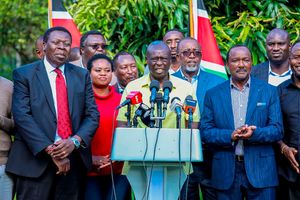
DCP leader Rigathi Gachagua (Centre) flanked by other opposition leaders address journalists at Anniversary Towers, Nairobi on January 28, 2026, after a meeting with IEBC.
Photo credit: Lucy Wanjiru | Nation Media Group
Other non-negotiable demands, they said, were the sacking of IEBC CEO Marjan Hussein Marjan and urgent institutional reforms to restore trust in a body they said was increasingly viewed as a “William Ruto Commission”.
“We are very unhappy with the procurement process of the KIEMS kits and the discredited Smartmatic organisation, discredited worldwide,” Wiper leader Kalonzo Musyoka said, warning that technology decisions were already shaping doubts about the credibility of the next election.
The Wiper leader argued that public confidence was collapsing. “The perception out there is that this is a William Ruto Commission. We gave them the opportunity to prove us wrong not for us, but for the whole country,” he said.
The confrontation follows a well-worn path in the country’s electoral history, where opposition movements have repeatedly accused the electoral and its predecessors of manipulation, compromised technology and political bias often with destabilising consequences.
In 2017, then opposition leader Raila Odinga (now deceased) rejected presidential results after alleging the electoral commission’s IT systems had been hacked to manipulate outcomes in favour of then President Uhuru Kenyatta. The IEBC’s chief executive at the time, Ezra Chiloba, denied any breach, insisting the system had not been compromised. The dispute spiralled into nationwide tension, sporadic violence and court battles that ultimately saw the Supreme Court nullify the election, an unprecedented ruling in Africa.
The current standoff also revives memories of the street pressure campaigns that preceded the 2017 election, when opposition leader Raila Odinga mobilised weekly protests aimed at forcing the disbandment and reform of the IEBC. In 2016, police repeatedly clashed with demonstrators outside the commission’s offices at Anniversary Towers detaining dozens as officers armed with batons moved to disperse crowds. The late Odinga vowed that the pickets would continue “every week until the IEBC is reformed.”
Similar accusations trailed the 2013 and 2022 elections, where technology failures, disputed tallying processes and claims of institutional bias became central to opposition challenges. Seven years later, the United Opposition is once again positioning election technology as the frontline of political trust and mistrust.
Democratic Action Party leader Eugene Wamalwa linked Kenya’s KIEMS kits to discredited systems used elsewhere in the region, arguing that controversial foreign technology has become a backdoor for election manipulation.
“This same technology was used recently in Uganda. The KIEMS kit failed there. We do not want to see a similar election in Kenya,” Mr Wamalwa said.
Independent Electoral and Boundaries Commission (IEBC) Chair Erastus Edung (centre, podium) joined by fellow commissioners briefs media at the commission offices on January 27, 2026.
Photo credit: Francis Nderitu | Nation Media Group
But the opposition’s case against the IEBC extended beyond machines. Former Deputy President Rigathi Gachagua accused senior government officials and organised groups of openly interfering with recent by-elections, turning polling stations into contested political zones.
“Their goons took over polling stations. Their cabinet secretaries took over polling stations,” Mr Gachagua said, describing what he called a deliberate breakdown of security meant to influence outcomes.
Among the documents the opposition is demanding are minutes of all plenary sessions, management meetings and procurement committee deliberations since the commissioners were sworn in - a move aimed at tracking whether key decisions are being made lawfully or through informal power centres.
They are also seeking evidence of due diligence conducted on IEBC management, including audits to confirm that major decisions taken by the secretariat complied with the Constitution and procurement law and if violations occurred, what sanctions, if any, were imposed.
The absence of such oversight, the opposition argues, would signal institutional capture rather than accountability. At the procurement level, the coalition is demanding full disclosure of all contracts linked to by-elections - particularly those involving election technology, printing of ballot papers and supply of materials - including tender processes, risk analyses, contract extensions and due diligence reports.
This, they say, is critical in preventing what has historically been one of the most vulnerable entry points for election manipulation involving emergency procurement and opaque contract renewals.
The opposition has also demanded every record relating to the Smartmatic’s past and current dealings with IEBC, from technical evaluations and audits to meeting minutes and contract extensions, as well as the commission’s own assessment of Smartmatic’s performance in previous elections.
They specifically want answers on whether the Commission complied with court orders during the 2022 presidential petition, when the Supreme Court complained about limited access to critical election data.
Voters queue to cast their ballot in the Magarini by-elections.
Photo credit: Kevin Odit | Nation Media Group
The opposition is pushing for radical transparency around technology deployment, including serial numbers of KIEMS kits, transmission codes, SIM cards, device registers and geolocation data for every polling station — arguing that without such openness, electronic systems remain vulnerable to manipulation beyond public scrutiny.
They are also demanding full disclosure on voter register audits — including how many times the register can be altered without compromising its integrity, the criteria used to clean it and the safeguards preventing post-audit manipulation. They are further seeking early gazettement of voter registers, polling stations and their geolocation data for 2027, alongside comprehensive election planning records covering budgets, staff deployment, logistics and technology rollouts.
Former DCP’s Gachagua tied these structural concerns to the violence witnessed in recent by-elections, accusing politically connected actors of exploiting weak oversight to intimidate voters and capture polling stations.
The opposition also made it clear that IEBC’s administrative leadership is central to their mistrust.
“We clearly are very unhappy with the CEO. We made it clear to them,” Mr Musyoka said, signalling that reform without leadership change may not restore confidence. Even the IEBC’s planned mass voter registration exercise drew criticism, with opposition leaders arguing that compressed timelines risk excluding millions of young voters and undermining inclusivity.
To manage the growing standoff, both sides agreed to form joint technical teams to examine procurement, legal frameworks and operational weaknesses, an approach former Interior Cabinet Secretary Fred Matiang’i framed as a last opportunity to stabilise the electoral system before political temperatures rise.
“There isn’t an issue we did not raise, procurement, security, management of by-elections, the entire election ecosystem,” Dr Matiang’i said.
United Opposition demands to IEBC
Sack CEO Marjan Hussein Marjan Kick out Smartmatic elections technology provider Ensure KIEMS kit transparency Make procurement transparent Voter register integrity - audits, alterations and early public scrutiny