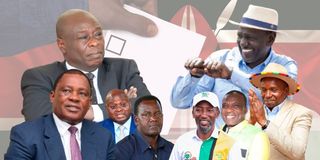
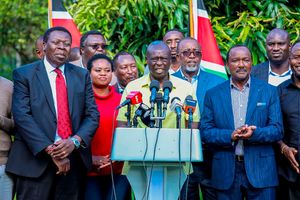
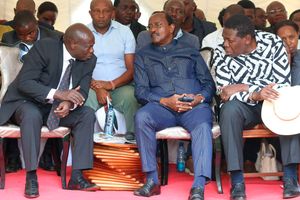
A few weeks to the by-elections, the stars appeared aligned for the Democratic Action Party of Kenya (DAP–K) candidate in Malava, Mr Seth Panyako.
Similarly, anti-Kenya Kwanza narratives had gained currency in Mbeere North, consequently creating a perception that the seat was for Democratic Party’s candidate, Mr Newton Karish, to lose.
But when voters cast their ballots on November 27, the two candidates lost narrowly to President William Ruto ’s United Democratic Alliance (UDA). The outcome crashed the opposition’s political momentum going into the 2027 General Election.
UDA’s David Ndakwa garnered 21,264 votes, beating Mr Panyako who got 19,306 votes in the hotly contested by-election, a difference of 1,958 votes. In Mbeere North, Mr Leonard Muthende garnered 15,802 votes to defeat Mr Karish who secured 15,308 votes. Former Deputy President Rigathi Gachagua had campaigned for Mr Karish after his Democracy for Citizens Party withdrew its candidate.
The outcome has since triggered debate on what could have gone wrong for the opposition candidates in the mini-polls that are likely to shape public perception going into the 2027 polls.
Deputy President Kithure Kindiki congratulates Leo Muthende of UDA after he was declared the winner in the Mbeere North by-election.
Photo credit: Joseph Kanyi| Nation Media Group
The opposition has since claimed intimidation and misuse of State resources to subvert the will of the people. The camp under Mr Gachagua and Wiper leader Kalonzo Musyoka has since announced court action to challenge the outcome.
But buoyed by the outcome, President Ruto said the win was a confirmation that a majority of Kenyans identify with his economic agenda.
Moments after casting his vote for the Mbeere North MP by-election at Kanyuambora Primary School, former Attorney-General and DP Party leader Justin Muturi claimed that the results “were predictable”, adding that he had voted in the area since 1994.
Not only had he voted, he had also won and lost elections for Mbeere North MP, formerly known as Siakago Constituency. Mr Muturi was well aware of the narrow margins that determine winners in the constituency.
Mbeere North politics is an intricate game that confounds many and hardly reflects the national mood or political party popularity. Clan affiliation plays a major role as well as personal charisma and influence.
Mr Muthende’s win was not the narrowest ever in the constituency. Its first MP, Sylvester Mate, beat Kamwithi Munyi in 1983 with a margin of 183 votes.
He retained the seat in the 1988 infamous mlolongo voting. However, in 1992, he finished fifth when the gap between the winner (Gideon Ireri Ndwiga) and the closest challenger was 486 votes. Mr Ndwiga was the only MP in the National Assembly elected on a Kenya National Congress ticket despite the region overwhelmingly voting for Mwai Kibaki of Democratic Party.
The biggest winning margin (4,291 votes) was registered in the 1995 by-election after Mr Ndwiga defected to Kanu and retained the seat. In the 1997 General Election, Mr Silas Ita won the seat by beating Mr Muturi with 1,147 votes.
Mr Muturi won the seat in a by-election in 1999 following Mr Ita’s death. In the 2002 General Election, he retained it with a narrow margin of just 266 votes against Ephraim Njeru.
He would lose the seat to Lenny Kivuti of Safina Party with 1,826 votes in 2007. In that election, President Mwai Kibaki got 96 per cent of the vote there.
Wiper Patriotic Front leader Kalonzo Musyoka (left) with the United Opposition candidate in the Mbeere North by-election Newton Karish attend a church service at ACK St Kanyuambora Parish.
Photo credit: Pool
In 2013, Mr Kivuti went for the Senate seat, but Mr Muturi lost to Muriuki Njagagua with 284 votes. As per the usual pattern, he lost the seat in 2022 by 647 votes to Mr Godfrey Ruku whose resignation to join the Cabinet occasioned the recent by-election.
To understand Mbeere politics, one needs to understand the clan dynamics.
The Mbeere community – comprising 39 clans – is organised into two loose alliances: Thagana and Irumbi (as they are known in Mbeere North) and Mururi and Ndamata, in Mbeere South.
According to New Gema chairman Mr Isaac Mungai, who is also Mr Gachagua’s DCP Youth Leader, the Karish loss was a result of laxity among in-house loyalists.
“We as the Gachagua camp, disintegrated at the last moment. Mr Gachagua had done a fantastic job helping Mr Muturi to mobilise the ground. Mr Gachagua intervened after the Muturi camp issued a distress call that government machinery was too tough for them,” he said.
Mr Mungai said, “Mr Gachagua established ground teams and placed them under the coordination of several elected leaders loyal to him. Some of these leaders went into bars to make merry and abandoned the ground at the crucial moment”.
“We were supposed to counter intimidation, violence, voter bribery and rogue police officers... Some of these leaders hanging on the coat-tails of Mr Gachagua appear as if they traded Karish’s victory to government agents,” he claimed. Manyatta MP Mr Gitonga Mukunji however, argued the collective vote of all the opposition candidates beat the ruling party’s tally – showing that Mbeere North was still an opposition zone.
“The government won with 15,802. But all the other candidates who were opposing the government candidate garnered 18,185 votes. This tells you that the Mbeere North majority is against the government,” he said.
Population distribution in the three wards that make up Mbeere North also played a part in the by-election. Mr Newton Kariuki comes from the smallest ward, Muminji, which has never produced an MP for the constituency, and he therefore heavily relied on Mr Muturi and Mr Kivuti (both from Evurori Ward) to shore up his numbers. Evurori is the largest ward and also produced the first MP, Mr Mate. All other MPs – Mr Ireri, Mr Ita, Mr Njagagua and Mr Ruku – have come from Nthawa Ward.
In Malava, lack of proper finances raised within a short period, threats and intimidation to the opposition leaders and voter apathy appeared to have frustrated Mr Panyako’s path to victory.
In the 2022 General Election, Mr Panyako garnered 20,133 votes when he vied on a UDA ticket, but lost to the former MP, Malulu Injendi of the Amani National Congress, who got 22,981 in a tight race with a margin of 2,848. Malulu’s death occasioned the recent by-election.
Wiper Patriotic Front leader Kalonzo Musyoka (third left) leads United Opposition leaders in campaigning for DAP-K's Seth Panyako at Malava Grounds in Kakamega on November 22, 2025.
This support base positioned him as the frontrunner in the contest. Initial opinion polls conducted at the start of the campaigns placed him ahead of all the aspirants. At one point, UDA considered recruiting him to run on the ticket. But after months of campaigns, the tide seemed to have flipped against him.
For DCP deputy party leader Mr Cleophas Malala, the by-elections were marred by voter bribery, violence and intimidation of opposition leaders and therefore were not fair, free and credible.
“UDA used a lot of money and influence to win all the seats, but the people of Khwisero decided that DCP was the party to associate with. Going into the 2027 General Elections, we will have taken our roots deep, and people will be in for a rude shock,” said Mr Malala.
Mr Kennedy Echesa shares the same sentiments, saying the UDA party and the entire Kenya Kwanza brigade might want to look keenly at the return on investment, having put in a lot to win the elections.
“The government should take stock of the by-election in Malava, because the return on investment is not commensurate with the resources deployed to get the seat only to lead by a slim margin against a poorly funded opposition,” said Mr Echesa.
He also felt that Kenya Kwanza deployed all the available unorthodox means, which included threats, intimidation of leaders and residents to suppress the votes, leading to voter apathy and eventually handing the win to Mr Ndakwa.
“The opposition needs to challenge the results in court and ensure they get a ruling forcing IEBC to pronounce itself on how they will deal with voter bribery and State-sponsored violence used to suppress the will of the people. This will help in dealing with the same in future elections,” said Mr Echesa.
This included the campaign war chest deployed in the constituency, the government machinery, goodies thrown at the electorate as well as the backing by Orange Democratic Movement (ODM).
Malava IEBC returning officer Salim Abdallah declares UDA parliamentary candidate David Ndakwa as the winner as he presents certificate.
Photo credit: Isaac Wale| Nation Media Group
In Ndakwa’s campaign team were Prime Cabinet Secretary Musalia Mudavadi , President Ruto’s aide Farouk Kibet, National Assembly Speaker Moses Wetang’ula, Principal Secretary for Small and Micro Enterprises Susan Mang’eni and Kakamega Governor Fernandes Barasa.
Mr Ndakwa told Daily Nation that his track record as an MCA for Kabras Ward delivered for him the win. He said political strategies have always delivered victory, citing his wins as an MCA in both 2017 and 2022.
He admitted to capitalising on government projects, while promising continuity under his leadership with the support of the government. He claimed that his opponent wasted time talking about President Ruto instead of selling their agenda to the people.
“I avoided talking about my opponent and instead focused on explaining my plan to the people. I went for youth and women. My language was more appealing to the people as opposed to my opponent, who chose strong language.”
Prior to the by-elections, Mr Kibet pitched camp in Malava, conducting economic empowerment forums for women, youth and religious organisations to lure voters into standing with the government’s candidate.
He further consolidated clan elders in Malava into beneficial groups with incentives from the government.
And days to the election date, the government distributed goodies, which included mattresses and blankets to the residents of Malava.
Another carrot dangled by the government operatives was appointing two aspirants who lost in the Malava UDA primaries to diplomatic positions in Uganda and South Africa in exchange for supporting Mr Ndakwa.
This move was meant to retain them alongside Mr Ndakwa and serve as proof to the people of Malava that President Ruto is a caring leader ahead of the by-election.