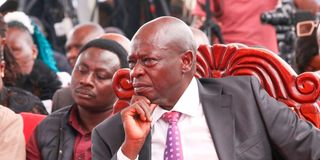
Democracy for Citizens’ Party (DCP) leader Rigathi Gachagua on Monday warned President William Ruto of possible street protests over rising fuel prices, saying he is closely monitoring a cost-of-living crisis that he claims is worsening across the country.
He said that if the situation persists, he could, from as early as next week, issue a protest schedule for his supporters and collaborate with other pressure groups to mount nationwide mass action.
Mr Gachagua argued that fuel prices could be reduced by at least 50 percent if the government stopped what he termed “profit-driven deals” by policymakers and instead prioritised ordinary citizens over what he called “international racketeers.”
Speaking on Kameme TV , he gave President Ruto an ultimatum to scrap the Government-to-Government (G-to-G) fuel procurement arrangement and completely remove Value Added Tax (VAT) on petroleum products, saying this would cushion consumers from continued price shocks.
The former deputy president further called for a review of the securitisation of the fuel levy, arguing that funds collected for fuel development had been committed to loan repayment obligations.
“The seven shillings that the government collects as fuel levy per litre has already been committed to a loan. That is the fund that should now be cushioning consumers through subsidies.What we have is a recklessly managed sector where government officials have turned it into a wheeler-dealer paradise. There is no genuine Government-to-Government fuel procurement because the entire arrangement is shrouded in private interests benefiting a few insiders,” he said.
Mr Gachagua warned that failure to develop an acceptable framework to reduce fuel prices in line with global market trends could trigger public action.
He said Kenya had previously experienced similar unrest, referencing the economic protests that followed the June 2024 Finance Bill.
“We are a reasonable people and through the United Opposition principals, we will give clear direction on how our supporters should engage the government. President Ruto has a choice…do the necessary and avert a full-blown crisis or ignore us and face the consequences. Do not imagine there will be no repeat of the June 2024 Gen Z moment, especially as we approach its second anniversary,” he said.
Mr Gachagua urged the government to avoid what he termed political escapism and downplaying of public concerns.
“They are resorting to cheeky statements that do not reflect the seriousness of the matter. We are not playing politics we are warning the government that it cannot wake up, add Sh40 to fuel prices and then later announce a Sh9 reduction and expect applause, when the net effect is still a Sh31 increase,” he said.
He also accused President Ruto of abandoning earlier principles he held while serving as Deputy President under the Uhuru Kenyatta administration.
“When Dr Ruto was Deputy President, he used to speak strongly about the fuel sector. He would question why Kenya’s fuel prices were higher than those of neighbouring countries and reject explanations tied to global conflicts,” he said.
Mr Gachagua further criticised the government’s economic narrative, saying it was misleading to claim that Kenya had fully transitioned into a middle-income economy.
“We are still pursuing Vision 2030, which aimed to achieve sustained double-digit growth and transition Kenya into a higher middle-income economy. The reality is that we are still a lower middle-income country, and about 80 percent of Kenyans remain dependent on consumer protection mechanisms to survive economic shocks,” he said.
He warned that continued increases in fuel prices would have a cascading effect on the cost of living, given that the economy is largely transport- and diesel-driven.
“Fuel prices determine almost everything in this economy. If you want to mobilise people to the streets effortlessly, make their lives unbearable. The government has a choice in how this ends. We also have options in how pressure is applied,” he said.