The family of Hezekiah Oyugi, the former powerful permanent secretary in President Daniel Moi’s regime, has lost its bid to repossess a prime property in Nairobi’s Lavington area in a long-running court battle.
Environment and Land Court judge Oscar Angote said the court cannot fault the buyer of the property, Ms Timdar Said Sherman, on the ground that she obtained the title and transfer using a forged court order.
“In my view, these are actions of parties (Oyugi family) who want to unjustly enrich themselves with the sanction of the court, a position that a court of equity and justice cannot countenance,” said Justice Angote.
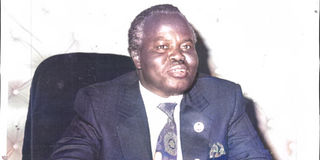
Hezekiah Oyugi.
Photo credit: File | Nation Media Group
Family's forgery accusation
The estate administrators-Job Okuna, Douglas Odhiambo and Joshua Onyango, lodged the case in 1998 alleging that Ms Sherman did not complete purchasing the property and had used forgeries to transfer the asset to herself.
However, the judge said the court was convinced that the administrators of the estate procured the forged court order on December 21, 1993 and used it to transfer the property to Ms Sherman on February 20, 1998.
“It is unfortunate that the administrators of the estate expect the court to condemn Ms Sherman and cancel the title for the reason that it was obtained using a forged court order and transfer, after the family had received the entire purchase price,” said Justice Angote.
The judge observed that it was a deeply troubling scenario in which one party deliberately placed a forged court order and then sought to rely on the very falsity to defeat a transaction, which would have been otherwise valid.
He ruled that there was evidence that the Oyugis sold the property to Ms Sherman, but “are now trying to run away from the transaction they were part and parcel of.”
“This raises fundamental questions not only of law, but of fairness, integrity and abuse of process. The administrators having procured the forged court order cannot rely on it to avoid the consequences of a transaction they had previously affirmed by word and conduct,” said the judge.
The three sons of the late Oyugi blamed the Lands commissioner for allegedly facilitating the fraudulent transfer.
They told the court that in a sale agreement on January 13, 1998, they agreed to sell the property to Ms Sherman for Sh10 million.
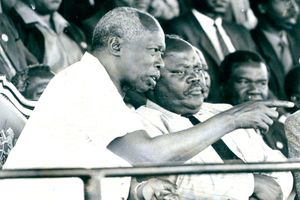
Hezekiah Oyugi.
Photo credit: File | Nation Media Group
Court records show the agreement stipulated that Ms Sherman would pay Sh4.8 million and deposit the balance at the defunct Guilders International Bank.
However, according to the family, Ms Sherman, the former tenant-turned-buyer, allegedly failed to complete the payment as agreed but went ahead and forged transfer documents while the succession matters were pending in court.
Mr Okuna told the court that Mr Oyugi, who died in August 1992, had, between 1993 and 1994, left the property to Ms Sherman with rent payments being made to Ms Betty Oyugi, one of Oyugi’s four wives.
He said the property formed part of the estate at the time of his demise and had not been transferred to any beneficiary.
And after he discovered that Ms Betty Oyugi was collecting rent from the property, the administrators dispatched auctioneers to recover the outstanding rent.
It was at this juncture that they uncovered the tenant’s attempts to purchase the property from Ms Betty, despite her lacking authority to transact on behalf of the estate.
Ms Sherman asserted that she and her family started residing on the property in 1991, initially as tenants paying Sh60,000 rent per month.
She further stated that in 1994, she and her husband, Mr Mzahim Salim Bajaber, met Ms Betty, who represented herself as the owner of the property and that in April or May 1994, she agreed to sell the property to them for Sh11 million. She claimed the house was gifted to her by the husband.
Ms Sherman said she paid Betty Sh4.8 million as a deposit, with the remaining sum being considered as rent paid. Thereafter, the family executed a formal sale agreement on January 13, 1998.
To buttress her case, Ms Sherman produced three petty cash vouchers, two of which were dated May 21, 1998, indicating payments of Sh2.2 million and Sh2 million, paid to Mr Okuna.
Additionally, she produced a petty cash voucher dated June 11, 1998, showing a payment of Sh1 million to Mr Okuna, similarly signed as received.
Ms Sherman said the total amount in the three vouchers signed by Mr Okuna was Sh5.2 million, being the balance of the purchase price. Mr Okuna denounced the signatures.