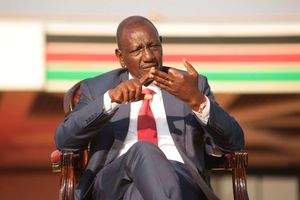
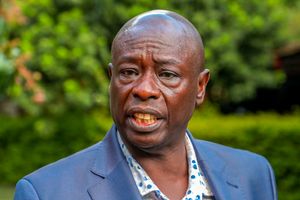
The Democracy for the Citizens Party (DCP) of Rigathi Gachagua is increasingly emerging as a direct threat to former President Uhuru Kenyatta’s Jubilee Party, eating into its bases of Mt Kenya and Nairobi.
With the 2027 polls less than a year away, the former ruling party has suffered major political blows as its leaders ditch it for DCP.
A host of Jubilee elected leaders have publicly declared their intention to defend their seats on DCP, with Kamukunji MP Yusuf Hassan being the latest to ditch Mr Kenyatta’s outfit. The defection by Mr Hassan shows that the contest between Jubilee and DCP goes beyond their traditional Mt Kenya counties.
In Nairobi, all three Jubilee elected MPs have said they will be defending their seats on DCP. They include Mr Hassan, Mark Mwenje (Embakasi Cenrtral) and Amos Mwago (Starehe).
In Mt. Kenya, MP Kanini Kega, who was sponsored to the East African Legislative Assembly (EALA) by Jubilee, has also defected to DCP.
Other Jubilee elected leaders, including nominated MPs Sabina Chege (nominated), Aden Keynan (Aldas), Samuel Arama (Nakuru West), John Waluke (Sirisia) and Racheal Nyamai (Kitui South) have aligned with the broad-based government.
DCP eating into Jubilee bases is likely to weaken Mr Kenyatta’s bargaining power in the 2027 matrix, but is likely to make Mr Gachagua a major player in the broader game plan. Mr Kenyatta has been accused of seeking to bring together opposition politicians so as to deny Dr Ruto a second term in office.
Kamukunji MP Yusuf Hassan.
Photo credit: File | Nation Media Group
In his assessment of Jubilee prospects in the 2027 polls, Mr Kega was blunt that the outfit is dead.
“There is no future for Jubilee in Mt Kenya and Nairobi,” said Mr Kega.
“What is facing Jubilee is lack of leadership. When we tried to make some changes they resisted, and you can see what is now happening. Everyone is leaving,” he said.
Mr Kega and Ms Chege in 2023 staged a coup against Mr Kenyatta. The former president later in 2024 managed to secure control of the party after a protracted court battle.
“The leadership of the party failed to acknowledge the role of elected leaders. Uhuru should have resigned as the party leader because his presence is not allowing other officials to exploit their potential,” he said.
But Jubilee Co-Deputy Party Leader Jeremiah Kioni downplayed the defections, saying some of the leaders were never committed to the outfit.
“It is not a new loss to us because they have never identified with Jubilee. In fact, it is an opportunity for us to identify youth people who are committed to the ideals of the party,” said Mr Kioni.
He claimed that DCP appears interested in fighting Jubilee, more than it does to Dr Ruto’s United Democratic Alliance (UDA).
“It is amazing that parties within the opposition are busy scavenging from each other. DCP’s main purpose is to embarrass Jubilee. They are happy fighting Jubilee, more than they do to UDA,” he said.
Mr Kanini Kega gestures during the interview at his office in Nairobi.
Photo credit: Lucy Wanjiru | Nation Media Group
He claimed that Mr Gachagua was not keen on the unity of the opposition to send Dr Ruto home, but was more interested in winning more parliamentary seats from Mt Kenya.
He also questioned the rationale of those joining DCP, claiming it was a vehicle to nowhere since its leader cannot run for office, having been impeached.
“He (Gachagua) may be gifted in grassroots mobilization, but to go where? The voters will soon start asking some of these questions,” said Mr Kioni.
Formed in September 2016 after the merger of 12 parties, Jubilee Party became a political behemoth commanding majorities in both Houses of Parliament, besides bagging the presidency in 2017.
In the run-up to the 2017 polls, the newly-minted political party created a wave that swept across the country, with significant presence in Mt Kenya and Rift Valley, the political bastions of Mr Kenyatta and then Deputy President William Ruto.
When the polls were called, it won 171 seats in the National Assembly (140 in the 290 constituencies, 25 of the country’s 47 Woman Representatives and six of the 12 nominated MPs), coming just 62 shy of a two-thirds majority.
The party also won 25 governor seats, and occupied 34 of the 67 senate seats, 25 of them elected.
Jubilee Co-Deputy Party Leader Jeremiah Kioni.
Photo credit: File | Nation Media Group
On Tuesday, the former Deputy President declared that his party had effectively taken over Nairobi politics after Mr Hassan formally joined the DCP.
Mr Gachagua, who has increasingly positioned himself as a central figure in the opposition to President Ruto since being ousted from his position as Deputy President, said Mr Hassan’s defection marked the culmination of a broader political realignment in Nairobi.
“I want to announce today, the DCP takeover of Nairobi,” the DCP party leader said, adding that President Ruto and his Orange Democratic Movement (ODM) Oburu Oginga-led faction, which he dismissed as politically insignificant, do not stand a chance to beat him.
The development also gives DCP a stronger foothold in a city where political alliances are likely to be critical in determining the outcome of the 2027 presidential and parliamentary contests.
Nairobi has traditionally gravitated towards the opposition, voting against the government of the day in the 2013, 2017 and 2022 elections. If that pattern holds, galvanising the capital under a single party in the United opposition outfit, which DCP is a member, could prove a decisive force in shaping Nairobi’s political landscape in 2027.
Democracy for the Citizens Party (DCP) leader Rigathi Gachagua.
Photo credit: Lucy Wanjiru | Nation Media Group
While explaining that DCP was opposed to the political zoning of regions, Mr Gachagua presented DCP as a national political vehicle rather than a party confined to his traditional central Kenya base.
The DCP deputy party leader Cleophas Malala, on his part, offered a more combative assessment of the party’s expansion, saying the entry of Mr Hassan was evidence that the outfit was becoming a national political force.
He said DCP had previously been subjected to various descriptions but argued that its growing support outside Central Kenya was changing that perception.
While DCP has a strong base in Central Kenya, Mr Malala said its influence was extending to other parts of the country, including Nairobi, Narok and Kakamega counties, where he said DCP had won various posts in by-elections.
Mr Malala said the opposition would seek to prevent any development that could give President Ruto an advantage in 2027.
Despite the defections, the DCP Secretary-General John Methu sought to reassure prospective aspirants that the party would not use its growing political influence to favour particular candidates during nominations.
He said the party was committed to conducting transparent nominations as it prepares to field candidates across the country.
“It is our commitment that we shall conduct a free, fair and credible nomination,” Mr Methu said, adding that there would be no preferential treatment.
Mr Hassan, who has represented Kamukunji for four terms, said he had chosen DCP because he believed it offered a platform for political change.
“I have joined DCP because it is the party that seeks real change. (Nimejiunga na DCP kwa sababu ni chama inayotaka mabadiliko halisi),” the Kamukunji MP said.
Mr Hassan’s entry was immediately embraced by DCP politicians, who portrayed it as evidence that the party was gaining momentum in Nairobi.
Mr Mwenje described DCP as the political home for Nairobi, while saying Gachagua was the force capable of bringing together the city’s diverse communities.