In this first instalment of the book Illusions of Democracy: A Political Memoir, former Cabinet minister, lawmaker and governor Kiraitu Murungi revisits the troubled Azimio la Umoja presidential campaigns in the 2022 General Election — especially in the Mt Kenya region -- and his own loss in the Meru governor’s race.
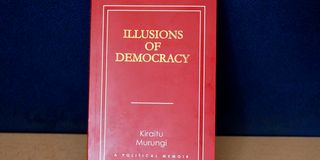
The book Illusions of Democracy: A Political Memoir by Kiraitu Murungi pictured at Nation Centre in Nairobi on October 10, 2026.
Photo credit: Bonface Bogita | Nation Media Group
The August 2022 General Election was one of the most hotly contested in Kenya’s history. For me, it was a disaster. I had done everything possible to win the gubernatorial election in Meru, but I lost. What led to my catastrophic defeat?
Since the election, our political rumour mill has been awash with numerous reasons and “rational explanations” as to why I lost. Some have pointed out the political confusion in the Azimio coalition, organisational disarray, rampant voter bribery, and betrayal by friends.
It is easy to blame others. After my initial shock and disbelief, I slowly accepted that I had lost, but an inner voice kept asking me one question: Why did you lose the election?
Many explanations kept running through my mind. I was not sure, but all the same, I wrote an article which was published in the Daily Nation , in which I let my emotions flow freely. Writing it was therapeutic. It was a kind of closure to that dark chapter. I looked at the election, not in its narrow sense, but in its broad social context.
Despite many years and millions of dollars spent on civic education by donors and civil society actors, there was no significant change in our village political culture. The villagers’ beliefs and their local demands continued to be the principal determinants of electoral outcomes. We had to do what the villagers wanted. I had failed to listen to their wishes, and I paid a heavy price for it.
Political campaigns in the Mt Kenya region revolved around what the late Wamalwa Kijana once described as Railaphobia . I had a difficult time campaigning for Raila Odinga (who was the Azimio candidate). Most of our people had deeply entrenched historical prejudices against him. The mere mention of his name rekindled the embers of ethnic hatred inherited from the Jomo Kenyatta/Jaramogi Oginga Odinga days.
The campaign was not about logic. It was about emotions. Raila had done nothing wrong to them. They just did not like him. I had underestimated the psychological impact of the lies, vilification, and propaganda against Raila. Many villagers actually believed that he was an atheist and a witch doctor.
I was also part of the collateral damage of a strong wave of antipathy against the then President Uhuru Kenyatta . Uhuru had been popular in the Mt Kenya region. He was friendly and informal. His legendary firm, warm handshake was infectious. During the 2013 and 2017 elections, our people had overwhelmingly voted for him. However, after he had won his final term, he became cold, distant, and insensitive to them. Unlike his then Deputy President Ruto (now president), whose presence was felt in every village in Mt Kenya, Uhuru rarely visited the region. Even Members of Parliament could not access him.
A deep ‘jilted lover complex’ developed against him. Our people helplessly stood by in anger and envy as they watched Uhuru frequently commissioning development projects and issuing title deeds to communities which had voted against him. The deepening rural poverty, severe shortage of money, harsh economic times, and even drought were blamed on him. Our people felt rejected and shortchanged. They loved him, but he was not there for them.
From left: Azimio bigwigs Wiper leader Kalonzo Musyoka, the late Raila Odinga, and former President Uhuru Kenyatta during an Interdenominational prayer service for victims of police brutality at SKM Centre in Karen on July 28, 2023.
Photo credit: File | Nation Media Umoja
The historical subterranean ethnic suspicions between the Meru and the Kikuyu flared into the open when Uhuru excluded Meru from the 500-kilometre Mau Mau Road project which was being implemented in Kikuyu-dominated counties. This caused intense resentment against Uhuru and his supporters in Meru. Uhuru’s closed and informal leadership had ignored the traditional social roots of power in Mt Kenya region: The Gikuyu, Embu, Meru Association (GEMA) leaders, clerics, and local politicians. They vowed to teach him a lesson. I was a victim of this communal punishment.
For the first time in Kenya’s history, the class became the dominant mode of political mobilisation. Born at the height of the Mau Mau struggle, I grew up in great poverty in a detention camp, attended rural schools and lived with my peasant parents among other villagers, I have always considered myself a champion of peasant interests. I had joined politics to liberate them from political oppression, poverty and social backwardness.
During my 30 years in politics as a Member of Parliament, Cabinet Minister, Senator, and Governor, I tried my level best to improve the lives of the people in our villages. I could not have imagined that the same villagers, who had celebrated me earlier, could reject me at the ballot.
I found out that there was a strong undercurrent created by my opponents which painted me as a ‘dynasty’. Villagers were told that we rich men were only interested in our own self-interests, and we did not care about them. Rumours were spread among the mama mbogas, the boda boda operators, and the small traders that I had abused them and called them chokora (street urchins), although this was not true.
I was a victim of a sustained campaign of vilification, disinformation, lies, and propaganda daily spewed from some local TV stations and social media platforms owned by my opponents. They created a false narrative that I was arrogant and conceited. When I pointed out that my opponents had questionable academic credentials, they accused me of academic arrogance, contemptuously dismissing the villagers as illiterate and ignorant and being an outsider who did not understand the daily suffering of the masses.
Former Meru Governor Kiraitu Murungi during a past interview at his Nairobi office on November 30, 2021.
Photo credit: Evans Habil | Nation Media Group
I had a great social vision for Meru County, but village politics is not about abstract, grand ideas about the future. Our Vision 2040 flagship projects for making Meru great meant nothing to the impoverished villagers. They were only interested in immediate, tangible benefits. Cynical attitudes towards politicians had reduced politics, just like in the old KANU days, into only one thing: money. Most villagers are in politics for cash. They have perfected the art of political deceit and have devised numerous clever tactics for extracting money from an unsuspecting political elite. All our stories about empowerment fell on deaf ears. Our villagers were more interested in the gumboots, blankets, and mattresses which were being given out by my opponent, Kawira Mwangaza.
The villagers had felt abandoned. It was now their turn to take revenge, cheat us, and eat our money. Our cash handouts could not buy their minds. As they said, they had to remove the tusks before burying the elephant. My political rallies were attended by crowds of between 6,000 to 10,000 people, most of whom I believed came to collect money. Some of them could attend up to three rallies in a day. Despite my heavy investment, most of the villagers did not vote for me. I had become part of the ‘Dynasties’. I had to be milked dry and discarded.
It was a mistake for me to join the Azimio One Kenya Coalition Party. It was a shell without grassroots presence or effective campaign structures. As Barrack Muluka wrote on September 25, 2022, in The Standard newspaper, Azimio lost the election because of its internal disorganisation, managerial gaps, and mismanagement of funds.
The Azimio campaign machinery was largely dysfunctional. We did not receive any funds to support the coalition’s campaign in Meru. Peter Munya, who was given the funds, used them to campaign for Kawira Mwangaza. Azimio did not provide pastoral care for its ground troops either. It did not pay sufficient attention to the nuts and bolts of the campaign. Uhuru’s miracle political tour, which was expected to turn tables in the Mt Kenya region, did not happen. We ended up waiting for Godot, he never arrived. We were abandoned in the political battlefield. It was no wonder that we were outnumbered, outfoxed, and outperformed by Ruto.
I rationalised my loss. It is natural for every politician to lose an election at one time or another. Politics is not a permanent job. Why whine and cry over a loss? However, though my loss was very painful, in a way, I was lucky. I regained my freedom. No politician is truly free. I was everywhere in chains, psychologically captured by the electorate and my campaign financiers. Over the last 30 years, I have accumulated mountains of debts of gratitude to all those who supported and voted for me. I have too many social debts which I cannot possibly pay. These debts have to be written off.
I will never have the appropriate words or vocabulary to sufficiently thank all those family members, friends, campaign teams, and all the ‘comrades in the struggle’ who sacrificed their time and resources for me. They, too, have undergone untold loss, pain and suffering. It is very sad that such political debts will never be fully repaid.
We have to accept the impermanence, uncertainty, and the surprises of life. Nothing is permanent. Even success and failure are temporary. No one can be a hero for all time. Muhammad Ali, the greatest boxer on earth, had to exit the ring at one point. As politicians, we too must accept exiting the game when our time comes.
Politics is an environment of eternal noise, conflict, and chaos. Those tumultuous times are now behind me. I am happy to have made whatever history, the history of my time allowed me to make. I have left others to make their own history. I no longer struggle to be seen. I don’t go out of my way to impress. I just live my life; eat, spend time with my wife, family members, and friends, read, play golf, and try to make myself happy. I have found joy and inner peace.
My political friends have, as expected, quietly melted away, but I still think about them, and cherish the moments we shared together in the struggle. I still follow, think, and sometimes write about politics. Sometimes I try to imagine and wonder what the future will look like. That’s life. It is human to think.
RAILA’S DEATH AND THE SPLIT OF ODM
Historical photographs documenting the political journey of the late former Prime Minister Raila Odinga adorn the walls inside his mausoleum at Kang’o ka Jaramogi in Bondo on October 11, 2026. The displays chronicle his decades-long contribution to Kenya’s political and democratic development.
Photo credit: Alex Odhiambo | Nation Media Group
It is too early to tell the full ramifications of Raila’s death on Kenyan politics. It marks a major turning point in our politics. As his longtime friend Salim Lone wrote in The Weekly Review on the day of his burial, “Kenya will be a radically different country... In the past 30 years, there has been no remotely comparable figure with the political strength to bring about significant change”.
Raila will remain a permanent symbol and the father of constitutional reforms, multiparty democracy, devolution, the politically dispossessed, and the economically marginalised. Beyond the rhetoric of hero worship, he will be remembered as the guru of realpolitik.
Raila was a politician, and like all politicians, he loved power and prestige. He unsuccessfully vied for the presidency five times. After losing the elections, he made it difficult for any president to govern without his support. His political dexterity in penetrating successive administrations and attempts to push for reforms from within remains legendary.
He was a man burdened by deep convictions and internal contradictions. Over the years, his politics slowly evolved from revolution and reform to accommodation and complicity with the status quo. He was equally captured by both the tribe and the practical necessities of power politics. He was subject to the passion of his convictions, the imperatives of his class interests, and the pull of ethnic gravity. From his revolutionary days in the underground movements in the 1980s, he was progressively co-opted, eventually integrated into the very systems that he had tirelessly fought to overthrow.
Notably, the merger of NDP and Kanu in 2001 marked the turning point of Raila’s politics. The allure of power, prestige and comforts of high office lured him into Kanu and Moi’s government. The ‘Grand Coalition’ with President Kibaki, the ‘Handshake’ with President Uhuru Kenyatta, and the “Broadbased Government” with President Ruto trapped Raila into the cobwebs of the deep state, which perpetuated the status quo, while still maintaining the dreams of transformation. While we shall legitimately continue to celebrate Raila as the hero of multiparty democracy in Kenya, his dual legacy of revolution and complicity, as the enigma of Kenyan politics, will continue to intrigue and confound Kenyans for many decades to come.
Raila was, literally speaking, the Baba of the Orange Democratic Party (ODM). He formed ODM after his Orange campaign team defeated the Kibaki government’s Banana team in the 2005 referendum for a new constitution, as a pro-reform social democratic opposition party. It is the largest political party today. However, despite its progressive credentials, ODM has largely remained under the long-term founder capture by its heroic and charismatic leader, and a small clique of loyalists, who have controlled the decision making, resources, nominations, and the political direction of the party. Raila exercised unfettered personalized dominance and control of the party. Key decisions and disputes within the party were ultimately determined through his personal intervention and authority. His decisions were final and not subject to any organ of the party.
Raila’s death has therefore created a serious leadership vacuum which has plunged ODM into an uncharted political territory. Without a clear succession plan, the party leadership became quasi-hereditary, and Oburu Odinga was quickly sworn in to take over from his brother.
The political trajectory of post-Raila ODM is yet to fully unfold. The controversy is still raging as to who will lead it, and in what direction. Political logic points to Ruto’s invisible hand in redefining its political terrain and playing a key role in shaping its trajectory into the future.
Like all the mega parties before it, ODM runs the risk of governmentalism: executive-driven party capture, disconnection from the masses, and ultimately its inevitable political oblivion.
The book, published by Queenex Publishers, will be launched on Friday.
Tomorrow in the Daily Nation: The long way opposition and Gen Zs have before they can mount a challenge against Ruto