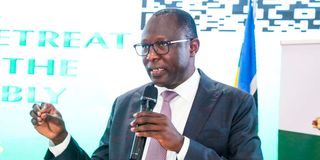
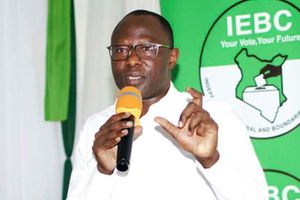
The Independent Electoral and Boundaries Commission (IEBC) has presented to the National Assembly what it considers a prescription to delivering a free and fair election next year, and calls for, among other things, changes to existing laws and guidelines.
In their bucket list, the IEBC wants changes made to the Elections Act as well as the Elections Offences Act to have more teeth to bite those who breach the code of conduct.
“Following the launch of its 2022 Post-election Evaluation report, the Commission commenced electoral legal reform through various stakeholder engagements. The initiative sought to identify what worked, what did not work well and generate proposals for legal review,” IEBC chairman Erastus Ethekon told MPs at a retreat in Naivasha on Wednesday.
In the Elections Campaign Financing Act, the commission wants MPs to delete and replace section 11 of the Act to restrict contributions and donations to election campaigns and clarify permissible donors.
Further, Mr Ethekon told the lawmakers to amend section 14 of the act in order to prohibit donations for election campaigns directly from foreign governments.
The move, if undertaken by MPs and implemented, will be a blow to most politicians whose source of campaign money has been questionable.
Some politicians have been getting their campaign money from questionable Non-governmental organisations, he said.
“The absence of clear, enforceable rules on who can fund campaigns, how much they can contribute and from where those funds originate weakens our democratic processes and opens the door to undue influence,” Mr Ethekon told MPs.
Mr Ethekon warned that failure to have rules on campaign financing will make the credibility of the 2027 elections vulnerable.
Although the Elections Campaign Financing Act was enacted in 2013 to regulate political spending, it is not yet fully operational, as the regulations are yet to be adopted by Parliament.
On the recall clause of MPs , the commission wants the lawmakers to anchor sections 27, 28 and 29 of the County Government on the recall of Members of the County Assemblies in order to have a clear path in law of recall of an MP.
“Exporting the provision of Section 27, 28 and 29 of the County Government Act on recall with the necessary modifications to the provisions to Part IV of the Elections Act on a Member of Parliament),” reads the IEBC proposal to Parliament.
Article 104 provides that Parliament shall enact legislation that provides for the grounds upon which a member may be recalled and the procedure to be followed.
The court in 2017 declared section 45 (2) of the Election Act, which provided for grounds for removal as unconstitutional, hence the same cannot be applied for recall purposes.
In 2017, a three judge bench comprising of Kanyi Kimondo, George Odunga and Chacha Mwita declared the law on recall of MPs as meaningless, discriminatory and unconstitutional.
The High Court declared sections 45 (2) (3) and (6), 46 (1) (b), (ii) and (c) and 48 of the Elections Act (Cap 7) and sections 27 (2) (3) and (6) and 28 (1) (b) (ii) and 9c) of the County Governments Act (Cap265) unconstitutional in its judgment in a case of Katiba Institute and Another vs Attorney General and Another (2017) Eklr1.
In the Elections Offences Act, the electoral commission is seeking to have more teeth to bite in addressing matters related to offences of electoral misconduct.
In particular, the commission says section 20 of the Elections Offences Act should be repealed in order to give them a mandate to discipline those who have breached the electoral code of conduct.
Mr Ethekon told the lawmakers that following a court ruling in 2022 by the Supreme Court in a petition No 23. (E026) Of 2022 Hon. Sabina Wanjiru Chege V IEBC, the disciplining bit should be done by the commission and not the Office of the Director of Public Prosecutions.
“The court affirmed the mandate of the Commission’s Code of Conduct Enforcement Committee, the offence of breach of the electoral conduct under Section 20 of the Elections Offences Act be repealed as the same is the Commission’s mandate and not ODPP’s,” Mr Ethekon said.
Mr Ethekon told MPs that even currently, when an IEBC official commits an offence, the person will be prosecuted by ODPP and not the commission.
“Even within IEBC, when the IEBC officials commit an offence, they can only be prosecuted by the ODPP. We need to discuss some of these things so that we have some teeth to bite,” Mr Ethekon said.
Still on the amendments of the Elections Act, the commission wants MPs to ring-fence symbols that will be used by independent candidates within a county.
On Election laws, the chairman proposed that a review of the definition of nominations and registration of candidates for election be done, and a clear definition of a Forensic Image be provided so as to provide clarity during the scrutiny of election technology.
“The Commission stresses that, in line with international best practice, election laws should be enacted at least one year before a General Election, as late enactments hinder preparedness,” Mr Ethekon told the lawmakers.
The commission also wants MPs to review the Referendum Bill in order to provide for a process of conducting a referendum.
On adequate budgeting, the commission urged the House to help in getting the Sh22 billion budget shortfall that is currently facing in order to be prepared for the 2027 polls.
In total, the commission told MPs it needs Sh63 billion to adequately prepare for 2027, but the National Treasury only gave them Sh41 billion.
“While the Commission recognises the broader fiscal constraints facing the Government, this gap significantly limits preparations at a critical stage and may affect compliance with constitutional timelines and standards,” Mr Ethekon told MPs.
“The current funding gap limits the Commission’s ability to implement these interlinked activities effectively,” he added.
Mr Ethekon told MPs that it’s time for the country to look at elections as an investment that is necessary for political and economic prosperity. “Elections must be funded adequately for the commission to conduct free and fair elections.”
On political violence witnessed during campaigns, Mr Ethekon said political parties should bear the greatest responsibility and not IEBC.
“Political parties must bear responsibility for the members they clear to contest. No party clears a candidate with the aim of going to cause violence. This is a responsibility of all stakeholders,” Mr Ethekon said.
Speaker of the National Assembly Moses Wetang'ula, makes his address during the Legislative Retreat for lawmakers in Naivasha on January 27, 2026.
Photo credit: Bonface Mwangi | Nation Media Group
Speaker Moses Wetang’ula directed the Justice and Legal Affairs Committee (JLAC) led by Tharaka MP George Murugara and Constitutional Implementation Oversight Committee (CIOC) chaired by Suba south MP Caroli Omondi to in the next one week have a meeting with IEBC to fast-track their demands.
In the meeting, the two committees will agree on the specifics of the proposals for consideration by the House.
“I direct CIOC and JLAC to sit with IEBC to deal with all issues in their wish list in the next four months so that as National Assembly, we can dispense with laws and allow those who want to go to court,” Mr Wetang’ula said.