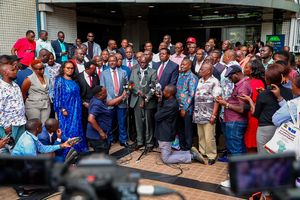
The united opposition handed a memorandum to the electoral commission over the questionable extension of a contract for a multibillion-shilling polls system, one week to the exit of chief executive Hussein Marjan.
The memo was delivered to the Independent Electoral and Boundaries Commission (IEBC) on January 28 during a meeting at the commission’s Anniversary Towers offices, attended by all the commissioners led by Chairperson Erastus Ethekon.
It, among others, questioned the extension of the contract for the Kenya Integrated Elections Management (Kiems) supplied by Smartmatic, a Venezuelan firm.
Mr Marjan also attended the meeting that the media, including the IEBC press unit, was not invited.
The memo, seen by the Nation , exposes how the multibillion-shilling contract, a strategic procurement project that requires the approval of the commissioners sitting at the plenary, was extended in November 2024.
At the time, IEBC did not have commissioners after members of the previous commission had either been hounded out of office or retired after serving their full term. Only the secretariat headed by the chief executive was running operations at the commission.
Dr Ethekon and the other six commissioners -Ann Nderitu, Moses Mukhwana, Karen Sorobit, Hassan Noor Hassan, Francis Odhiambo, and Fahima Abdalla- were sworn into office in July last year.
Independent Electoral and Boundaries Commission chairperson Erastus Ethekon (centre), ex-CEO Marjan Hussein Marjan (left) and Vice Chairperson Fahima Araphat Abdallah address the media at Pride Inn Paradise in Shanzu, Mombasa County on July 19, 2025.
Photo credit: Wachira Mwangi | Nation Media Group
Electoral technology procurement
Smartmatic, which has been associated with election fraud claims related to the 2020 US presidential election, is a global technology company that provides hardware, software and services for electoral processes including voter registration, voting, and counting and results transmission.
At the time of the extension, the electoral agency did not have commissioners, which raises doubt over who sanctioned the decision given safeguards provided in law.
The opposition figures say procurement of electoral technology “is not an ordinary transaction as it goes to the heart of Kenya’s constitutional democracy and national stability.”
“As a strategic procurement, the procurement actions should have been sanctioned by the plenary. At the time of the extension in November 2024, there were no commissioners in the office to approve the procurement or extension,” reads the opposition memo.
Mr Marjan did not respond to inquiries sent to his known phone number despite all indications that he had received them.
The opposition memo demands that the seven-member IEBC acts with “urgency” to investigate the matter and take appropriate legal and administrative action and that they “publicly account for how such a strategically critical procurement escaped their constitutional oversight responsibilities.”
The united opposition team that presented the memo to the IEBC commissioners included party leaders; Kalonzo Musyoka of Wiper Patriotic Front (WPF), former Deputy President Rigathi Gachagua (Democracy for the Citizens Party) and Martha Karua (People’s Liberation Party).
The others were Mr Eugene Wamalwa (Democratic Action Party- Kenya), Dr Fred Matiang’i (Jubilee Party) and Lenny Kivutu of Devolution Empowerment Party (DEP).
DP party leader Mr Justin Muturi did not accompany his colleagues as he was gracing his party’s National Delegates Conference (NDC) that officially re-elected and endorsed him as its leader and presidential flag bearer in the 2027 general election.
Democracy for the Citizens Party Leader Rigathi Gachagua (Centre) flanked by other opposition leaders address Journalists at Anniversary Towers, Nairobi on January 28, 2026 after a meeting with IEBC.
Photo credit: Lucy Wanjiru | Nation Media Group
“Taxpayers money was lost because the extension of the contract is both illegal and irregular. It is deemed that the technology used in the November 27, 2025 by-elections was based on illegal extension,” said Mr Muturi while agreeing with the contents in the memo.
Part 5 of the second schedule of the IEBC Act states that the quorum for the conduct of business at a meeting of the commission shall be at least half of the existing members of the commission, “provided that the quorum shall not be less than three members.”
Part 7 of the schedule states that unless a unanimous decision is reached, a decision on any matter before the commission shall be by a majority of the members present and voting.
Section 10 (7) (d) and (e) of the IEBC Act states that the CEO shall be the custodian of all the commission’s records and “shall be responsible” for among others, “executing the decisions of the commission.”
EX-IEBC CEO Marjan Hussein during the launch of the Anti-Corruption Strategic Guiding Framework for Kenya's Justice Sector at Safari Park Hotel in Nairobi on March 25, 2025.
Photo credit: File | Nation Media Group
Irregular contract extension
The term of the immediate former IEBC commissioners led by Wafula Chebukati and members- Abdi Guliye and Boya Molu, ended in January 2023. Chebukati died in February last year.
The contract, for the supply, delivery, installation, testing, commissioning, support and maintenance of Kiems kits and related hardware, was a framework contract starting on November 25, 2021.
Under the procurement law, such contracts are subject to a maximum duration of three years and are not extendable beyond the statutory limit.
Opposition leaders, according to the memo, cited credible information that the contract was “irregularly extended beyond the lawful three-year limit.”
As a framework contract, “it was incapable of lawful extension, yet the extension allegedly proceeded, exposing the public to potential losses amounting to billions of shillings.”
The memo cites Article 227 of the constitution, which states that public procurement must be conducted in a manner that is fair, equitable, transparent, competitive and cost-effective.
This is given effect through the Public Procurement and Asset Disposal (PPAD) Act and the Public Procurement and Asset Disposal Regulations 2020, which “strictly” regulate framework contracts, contract variations, extensions, approvals and reporting.
The procurement law requires that any contract variation or extension be justified by the vendor, reviewed by the Contract Implementation Team (CIT) or a duly constituted evaluation committee and reported quarterly to the Public Procurement Regulatory Authority (PPRA).
The reporting is to be done through the Public Procurement Information Portal in line with section 139 of the Act and PPRA Circular No. 04/2022.
“These safeguards appear to have been deliberately bypassed,” the united opposition says in the memo adding that there are serious indications that the extension was not reported to the PPRA and that it was undertaken without mandatory vendor justification.
“The extension may have been backdated to serve undisclosed interests and was allegedly approved unilaterally without the involvement of the Contract Implementation Team (CIT), in clear violation of procurement law and procedure,” the memo reads.
Smartmatic and irregular elections
The memo notes that “these actions are especially troubling given the vendor’s documented performance deficiencies” for instance in the US where President Donald Trump and his allies have targeted Smartmatic with claims of election fraud related to the 2020 US presidential election.
President Trump lost in the election and together with his allies, accused Smartmatic of participating in a “disinformation campaign” to rig votes thereby denting his re-election.
In response to the claims, Smartmatic launched a $2.7 billion defamation suit against Fox News, a US TV channel, several of its hosts and President Trump’s former attorneys.
As reported by ABC News in a separate development, the US Department of Justice indicted three Smartmatic executives in 2024 and 2025 “for allegedly bribing officials in the Philippines to secure voting machine contracts in 2016.
It is these bribery charges that President Trump and allies used to argue that the company’s business struggles were due to its own conduct rather than any alleged defamation.
“The current system exhibits weaker biometric data capture capabilities compared to the previous solution, relies on an inefficient iris capture methodology that requires absolute stillness and operates on offline-only data capture, creating risks of duplication, double registration, and compromised data integrity,” reads the memo.
The United Opposition leaders further noted that the contract “explicitly” required comprehensive technical knowledge transfer to IEBC staff on Biometric Voter Registration (BVR), Electronic Voter Identification (EVI) and Results Transmission Systems (RTS).
Independent Electoral and Boundaries Commission (IEBC) Chair Erastus Edung (centre, podium) joined by fellow commissioners briefs media at the commission offices on January 27, 2026.
Photo credit: Francis Nderitu | Nation Media Group
The opposition noted that the failure to deliver “this knowledge transfer” therefore, “constituted a material breach of contract, yet no enforcement action appears to have been taken.”
Instead, the opposition revealed, “vendor was allegedly rewarded with an unlawful contract extension.”
“Taken together, these actions raise serious concerns of a calculated subversion of procurement law, with far-reaching implications for electoral integrity, public finance accountability and public confidence in democratic institutions.
In pursuit of justice, the united opposition demanded that the investigative agencies expand the scope of inquiry to establish whether similar procurement breaches may have occurred in the printing of ballot papers contract that was awarded to Inform Lykos, a Greece firm in the 2022 general election.
They noted that should these allegations be substantiated, all implicated officers must “step aside immediately” and that “any public funds lost through these irregularities be fully recovered.”
The opposition notes that this matter transcends institutional boundaries and political affiliations.
“It is about the rule of law, the protection of public resources, and the credibility of Kenya’s electoral processes. Silence or inaction would amount to complicity.”