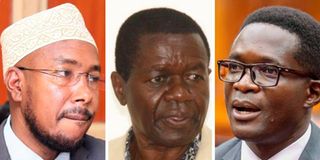
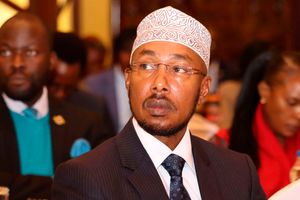
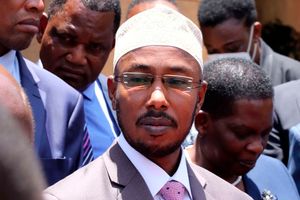
Described as “termination of services by mutual consent”, the exit of Independent Electoral and Boundaries Commission (IEBC) chief executive officer (CEO) Hussein Marjan has raised eyebrows as he becomes the third CEO to leave the position which is fast becoming a revolving door.
Coming less than two years to the 2027 elections, scrutiny will follow the decision to move on from the man who was the last man standing from the team that delivered the controversial 2022 elections.
But the fact remains that Mr Marjan follows the footsteps of his predecessors Ezra Chiloba and James Oswago, who were all hounded out of office with the opposition baying for their blood.
It was only last week when Wiper Patriotic Front party leader Kalonzo Musyoka led a push by the United Opposition to have Mr Marjan removed from office before the end of his term.
The former vice president claimed the 2027 elections will not be free and fair if Mr Marjan continues to be in office.
“Mr Marjan cannot be trusted to preside over the 2027 General Election. He should be paid the one-year remaining in his contract. Elections won’t be free and fair if he is there,” said Mr Musyoka.
But the allegations by Mr Musyoka lifts the lid on a troubled office that has seen previous office holders exit unceremoniously.
Although not restricted to a single six-year term that applies to commissioners, none of the IEBC CEOs have lasted long enough to even consider their contracts being renewed.
Acting as the Secretary to the Commission, a contract of a CEO is not explicitly capped by the Constitution at one term, allowing for contract renewals.
Mr Marjan assumed the position in March 2022 after joining the Commission as deputy CEO in April 2015.
Former Independent Electoral and Boundaries Commission Chief Executive Ezra Chiloba.
Photo credit: File
But before him, Mr Chiloba’s exit – which was as dramatic as his short stay in office – played out in public after he was first suspended by the late IEBC Chairperson Wafula Chebukati and former Commissioners Abdi Guliye and Boya Molu.
The fallout between Mr Chebukati and Mr Chiloba was so acrimonious that the latter was locked out of his office with a lock to his office door after word got out he might be back in office.
The suspension letter indicated that Mr Chiloba was suspended pending the completion of a comprehensive audit of all major procurements relating to the August 8, 2017 General Election as well as the repeat election held on October 26, 2017.
He was first sent on compulsory leave in April 2018 before being suspended two months later on June 14, before eventually being sacked on October 12, 2018. He had assumed office in 2015.
Mr Chiloba, however, contested his suspension in court arguing that his employment was wrongfully terminated, demanding at least Sh52.5 million as compensation for the decision to sack him.
In his statement dated October 12, 2018, Mr Chiloba said the termination of his employment with the IEBC “does not come as a surprise to Kenyans who have been monitoring the events at IEBC in the last six months’.
“The outcome was already pre-determined and the process was a mere formality. My employment termination should not be seen as an issue of my person but that of the holder of the office. It brings to focus the major governance crisis at the IEBC; an issue that will affect even the next office holder if the matter is not addressed,” he said.
Oswago and Chickengate scandal
Former IEBC chief executive James Oswago.
Photo credit: File
The exit of Mr Oswago was more pronounced as he was dragged to court in what came to be known as “the Chickengate” scandal. Mr Oswago had assumed office as IEBC interim CEO in November, 2011 before being confirmed to the position.
The scandal involved British security printing firm, Smith & Ouzman, being found guilty of paying bribes amounting to Sh47 million to secure a tender for provision of ballot papers for IEBC’s predecessor, the Interim Independent Electoral Commission.
Mr Oswago was accused of flouting procurement laws in the procurement of electronic voter identification devices (Evid) that were used in the 2013 General Election, a process that the court said was neither transparent nor accountable.
He was accused of using his office to improperly confer a benefit on Face Technologies Limited by approving payment of Sh1.39 billion for the supply of Evids without ascertaining that the devices supplied were inspected, accepted and met the technical specifications in the contract.
Nonetheless, IEBC has been dogged by scandals every election cycle. In the run-up to the 2017 General Election, the electoral agency was embroiled in procurement scandal where it was alleged it bought some items at three times the market rate even as it paid for materials that were delivered long after the election had ended.
At the centre of the saga was Al Ghurair Printing and Publishing LLC, a Dubai-based company, which printed and delivered ballot papers despite a myriad of court cases.
The tender wars pitted the late Chebukati and Mr Chiloba. The Al Ghurair contract was signed just days after IEBC’s then head of procurement Lawy Aura was sent packing “with immediate effect” for declining to give a favourable opinion on the proposed award to Ghurair.
At the end, the contract for printing of ballot papers went through open tender, restricted tender then direct procurement.
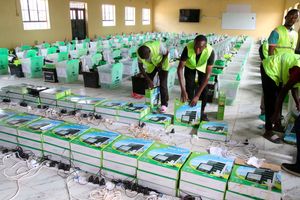
IEBC has in the past single-sourced most of key election materials. For instance, Smith & Ouzman, Al Ghurair and OT Morpho (Idemia) were all single sourced, often at the last minute, thus giving no room to carry out sufficient checks on the beneficiary firms.
In the 2013 elections, the procurement of biometric voter registers and the Evid was disrupted by tender wars that consumed IEBC staff and commissioners.
In the run up to 2017 elections, again Safran Morpho which had rebranded to OT Morpho got the tender for Kiems kit and overall technology works again through direct procurement following vicious bidder rivalries.
Meanwhile in the tender for ballot paper printing, several fights at the Public Procurement Administration and Review Board and the courts ended up with the commission controversially settling on Dubai’s Al Ghurair Printing and Publishing LLC for the Sh2.5 billion tender.
Audit reports following the 2017 elections also revealed a number of tenders that were directly awarded to firms. For instance, Africa Neurotech Systems Ltd was paid Sh165.8 million through direct procurement for expansion of the storage infrastructure for primary and secondary data centres by 50 terabytes. Even though the tender was for the 2017 elections, the company delivered in January 2018, five months after the elections.