Details of a report on the political pact between President William Ruto and former ODM leader Raila Odinga have emerged, with a senior member of the implementation team giving the deal an 85 per cent score one year later. The clean bill of health is likely to pave way for the formal 2027 General Election coalition talks.
The report, to be presented to President William Ruto and new ODM leader Oburu Oginga, is part of the one-year anniversary of the March 7, 2025, agreement anchored on an ambitious ten-point agenda meant to guide reforms five months after Mr Odinga’s death.
The ten points signed last year, which cemented the broad-based political arrangement between UDA and ODM, touch on governance, economic inclusion, electoral credibility and institutional accountability. The MoU was designed to calm a nation shaken by protests, economic frustration and a bitterly contested 2022 electoral aftermath.
The roadmap was anchored in recommendations from the National Dialogue Committee (NADCO), formed to address the political tensions that followed the 2022 General Election.
According to a draft report seen by the Nation, despite key measures taken to address the agenda, “challenges remain, including the need for full enforcement of the two-thirds gender rule in parliament, ensuring police independence from the executive, and addressing unconstitutional legislative attempts such as the National Government Constituency Development Fund (NG-CDF) Act.”
“Continued focus is placed on enhancing accountability in public finance and strengthening the independence of key institutions,” the document states.
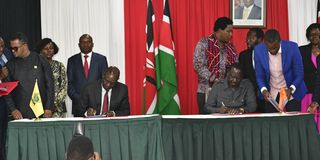
President Willam Ruto and ODM party leader Raila Odinga during the MoU signing event at KICC on March 7, 2025.
Photo credit: Francis Nderitu | Nation Media Group
Committee on the Implementation of Ten-Point Agenda vice chairperson Javas Bigambo, in an interview, noted that the implementation process has advanced substantially.
“I can authoritatively say that after extensive engagements, audit and consultations with implementing agencies, the lay of the land and panoramic view of the 10-point agenda’s implementation reveals that the status of implementation is 85 per cent or more,” he said.
Deeper political cooperation
Mr Bigambo added that the progress could pave the way for deeper political cooperation between ODM and the ruling UDA.
“The more than 85 per cent implementation status of the ten-point agenda is a door opener for confident coalition negotiations and will easily accelerate the process,” he said.
Dr Oginga holds that the focus should remain on ensuring full implementation of the reforms before the next election.
“We are in the broad-based government where we have the ten-point agenda, which we want to see implemented fully before the 2027 elections.”
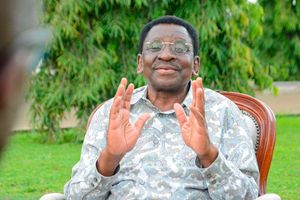
Siaya Governor James Orengo says the government had failed to fulfil the promises set out in the MoU and that the Linda Mwananchi group he is part of would be presenting an assessment carried out by members of ODM and other stakeholders.
“We (the Linda Mwananchi group) are having a meeting of chairmen of ODM across the country to look at and review the MoU and come up with a document. And on March 8, we will report to the people of Kenya in a mega rally at Jacaranda in Nairobi the outcomes,” said Mr Orengo.
Embattled ODM secretary-general Edwin Sifuna, who has fallen out with the party’s leadership, this week said Kenyans deserve a full report on March 7.
He singled out the implementation of the two-thirds gender rule, which has remained elusive over a decade since the promulgation of the 2010 Constitution.
“On the 7th of this month (Saturday) we are expecting a final comprehensive report on the implementation of the ten-point agenda,” he said.
Mr Sifuna added that Kenyans expect concrete proposals rather than prolonged consultations: “On Saturday, we are expecting a framework of implementation, not stories.”
“The MoU signed between President Ruto and Raila Odinga was just a political gimmick devised to deceive the ODM electorate into accepting a political partnership. In my opinion, the ten-point agenda is buried in Bondo with Raila,” political activist Tony Gachoka said.
According to the draft report seen by Nation, the committee holds that the agenda has initiated significant institutional reforms and lowered political temperatures despite criticism that the promises have largely remained symbolic while political realignments intensify ahead of the 2027 elections.
The pact between the two political rivals emerged after months of street protest by Azimio la Umoja One Kenya supporters in 2023 and the Gen Z protests of 2024 — political standoffs that threatened to destabilise the country. Opposition leaders and the youth had accused the government of ignoring the rising cost of living, pushed for various reforms and demanded the exit of President Ruto from office.
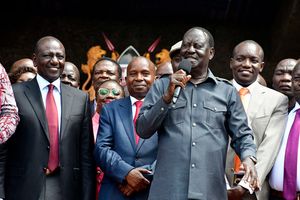
Azimio leader Raila Odinga holds a copy of a copy of Nadco report flanked by Wiper Party Leader Kalonzo Musyoka, Majority leader Kimani Ichung’wah and other leaders at Capital Hill.
Photo credit: File | Nation Media Group
The NADCO process — co-chaired by National Assembly Majority Leader Kimani Ichung’wah and Wiper leader Stephen Kalonzo Musyoka — was tasked with identifying structural weaknesses in governance and proposing reforms.
Its final report outlined changes in electoral management, political inclusion, economic reforms and institutional accountability. To oversee the implementation of the reforms, the two parties created the Committee to Oversee the Implementation of the 10-Point Agenda and the NADCO Report, known as COIN-10.
Committee to Oversee the Implementation of the Ten-Point Agenda and National Dialogue Committee report leaders Agnes Zani (centre), Javas Bigambo (right) and Kevin Kiarie address journalists at KICC, Nairobi, on January 22, 2026.
Photo credit: Lucy Wanjiru | Nation Media Group
The five-member team is chaired by political scientist Agnes Zani and includes analysts and political actors drawn from both the ruling coalition and the opposition. The 10-point agenda outlined broad areas of reform, including: full implementation of the NADCO report, inclusivity in public appointments and budgeting, protection and strengthening of devolution, economic empowerment for youth, integrity and responsible leadership and protection of the right to peaceful assembly.
Others were audit of the national debt, a strengthened fight against corruption, reduction of wastage in public spending and protection of constitutionalism, sovereignty and press freedom.
One of the most visible outcomes of the reform agenda, according to the draft report seen by the Saturday Nation is the restructuring of the Independent Electoral and Boundaries Commission (IEBC).
Parliament passed legislation aimed at reforming the commission’s appointment process, eventually leading to the swearing-in of a new team of commissioners in July last year.
“The reconstituted commission has since conducted by-elections and is preparing for mass voter registration ahead of future polls,” states the report.
Legislative reforms have also been introduced to improve electoral transparency and review election timelines, while several governance-related bills are currently under debate in Parliament. The reports also states that the government has pursued policies aligned with the agenda’s broader objectives.
These include the roll-out of the Social Health Authority to expand healthcare coverage, expansion of digital government services through the e-Citizen platform and renewed investment in infrastructure projects.
The COIN-10 team has also held public forums and consultations with stakeholders across the country, including county governments, civil society organisations and religious leaders.
The aim, according to its chairperson Dr Zani, in an earlier interview, is to ensure the reforms reflect national consensus.
“Several reports were to be given from the time we were instituted on August 6. The first report was in October, another in December and February,” Dr Zani said, noting that the committee will present another report on March 7 — coinciding with the anniversary of the agreement.
“It doesn’t set us any date that this is the last report. This has been a consultative process with the principals.”
ODM chairperson Gladys Wanga said the reform agenda remains ongoing and should not be seen as a time-bound political deal. “The ten-point agenda is moving this nation forward the way it was discussed,” she said. “It cannot have an end date.”
She said a joint parliamentary group meeting on Tuesday, between UDA and ODM is expected to review progress.
“The spirit of this was how do we, together, move this nation forward and address the issues that bedevil this country.”
Criticism have however, reflected wider scepticism among some political commentators, who believe the deal weakened opposition oversight of government.
Analysts say the true test of the agenda lies in whether its proposals translate into tangible outcomes for citizens.
The reforms include economic initiatives aimed at youth employment, improved public financial management and measures to combat corruption.
Government officials say several programmes — including youth entrepreneurship initiatives and expanded access to digital public services — are already aligned with the agenda’s objectives. However, questions remain about the pace of implementation and the extent to which the reforms will address the underlying causes of political discontent.
As Kenya marks the first anniversary of the pact, the reform process remains ongoing.