As the March 7 deadline for the implementation of the 10-point Memorandum of Understanding (MoU) between President William Ruto and former Prime Minister Raila Odinga draws near, a major political clash has erupted.
Rival camps in the Orange Democratic Movement (ODM) are giving different interpretations on the deadline. Critics feel it is the end of the broad-based government arrangement.
ODM leader Dr Oburu Oginga and proponents of the broad-based arrangement say the date only signifies the first anniversary since the signing of the pact on the footsteps of the Kenyatta International Convention Centre (KICC) on March 7, 2025.
In the deal, President Ruto and former ODM leader Raila Odinga agreed to make the final report detailing the status of the MoU’s implementation public.
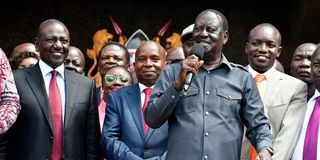
President William Ruto, Deputy President Kithure Kindiki and former ODM leader Raila Odinga during the signing of a Memorandum of Understanding between ODM and UDA at Kenyatta International Convention Centre in Nairobi on March 7.
Photo credit: File| Nation Media Group
“Some people are misleading our supporters that on March 7, we will part ways with the government. But on that day, we will receive an interim report on the 10-point agenda and celebrate the first anniversary,” Dr Oginga said on Saturday in Migori County.
But ODM Secretary-General Edwin Sifuna — speaking during an interview on a local TV station — said the agreement had no provision for extension.
“I have said this before, if anybody wants to extend this MoU, they must go to Bondo and get Baba’s signature. No other signature can be appended to extend the MoU because Baba, in his wisdom, did not ask for a provision for extension,” said Mr Sifuna.
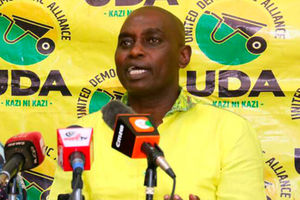
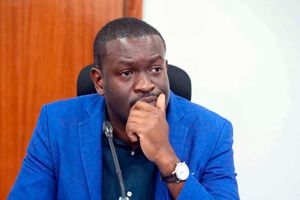
Edwin Sifuna addresses the media at Parliament Buildings in Nairobi on February 18, 2026.
Photo credit: Dennis Onsongo | Nation Media Group
ODM co-deputy party leader Godfrey Osotsi, who is another critic of President Ruto’s re-election campaign, accused the Kenya Kwanza Alliance of frustrating the implementation of the deal.
The Vihiga senator said that no single victim of police brutality has been compensated, while the State continues to interfere with the running of political parties in violation of the agreement.
“The MoU on the 10-point agenda expires on March 7 and has no room for extension. President Ruto and his pro-Ruto group in ODM are responsible for its non-implementation. They have engaged in a conspiracy to kill the spirit of the MoU as envisaged by Raila,” Mr Osotsi told Daily Nation.
“The latest claim that they will be releasing an interim report is not covered anywhere in the agreement. In fact, the agreement is clear that the final report shall be released on March 7, 2026.”
The senator said the broad-based government was anchored on full implementation of the MoU, and non-compliance means the arrangement collapses.
“Ruto and his support cast in ODM led by Oburu have betrayed Raila in death,” he said.
The deal between ODM and UDA came months after the youth-led Gen Z protests had rattled the political establishment, forcing leaders across the divide to reconsider the costs of prolonged confrontation. The agreement was meant to ease hostilities, advance reforms and create structured dialogue.
In the arrangement, ODM donated some of its members to the government. They joined President Ruto’s Cabinet.
President William Ruto (left) confers with ODM party leader Oburu Oginga during the Piny Luo Festival in Senye Beach in Nyatike, Migori County on December 17, 2025.
Photo credit: Alex Odhiambo | Nation Media Group
But as the clock ticks down, questions linger about what the MoU truly achieved and whether its promises were realised, diluted or deferred. But what even complicates the math is the absence of Raila Odinga who stood at the heart of the accord. But he did not live to see the end of the pact. Raila died on October 15, 2025 while receiving treatment in India.
Dr Ruto and Raila agreed on the full implementation of Nadco (National Dialogue Committee) report, inclusivity in budgetary allocations and public appointments, and economic investment in the youth.
They also agreed to protect and strengthen devolution, fight corruption, stop wastage of public resources, and the audit of national debt.
As part of the MoU, the leaders resolved to protect sovereignty of the people, stop abductions, respect constitutionalism and rule of law and respect press freedom.
The MoU read like a sweeping governance reform charter, touching on issues that have long defined Kenya’s political reform discourse.
Governance expert Prof Gitile Naituli said the 10-point agenda “has achieved nothing because it wasn't intended to achieve anything.”
He says, it was just a way of allowing ODM to save face in joining the government after “basically what amounted to a betrayal” of the Gen Z's demonstrations of 2024.
His critique reflects a broader scepticism among sections of the public who viewed the agreement less as a reform vehicle and more as a political compromise between rival elites.
Prof Naituli said that it was just a coincidence that what the Gen Zs wanted was “the same thing ODM has always wanted”.
“They wanted good governance. They wanted transparency in management of public affairs. They wanted accountability. And they wanted integrity in management,” he said
The don said that this has been ODM’s philosophy. It is exactly what the 10-point agenda was based on.
In fact, he said that because the pact has not achieved anything, in the people's mind the struggle continues.
Prof Naituli advised the team to insist on the MoU’s full implementation, warning that whatever they do right now may easily be interpreted as a campaign ploy.
“For the sake of the country, I would advise them to insist on its implementation fully,” Prof Naituli said.
For many young protesters, the agreement did little to address the deeper frustrations around governance, taxation and public accountability that had fuelled the demonstrations.
Dr Ruto and Raila appointed former Nominated Senator Agnes Zani to chair a team tasked with supervising the implementation of the pact. Ms Fatuma Ibrahim, Mr Kevin Kiarie, Mr Gabriel Oguda, and Mr Javas Bigambo are members of the team.
Mr Bigambo said that there is much to demonstrate that the 10-point agenda issues are being implemented.
“We must appreciate that the implementation of the 10-point agenda issues are not limited to the six-month period when the committee overseeing the implementation was established,” he said.
National Assembly Chairperson on Budget Committee Samuel Atandi.
Photo credit: Jared Nyataya | Nation Media Group
“Some of the issues under the 10-point agenda should not be tied to the period from the time the MoU was signed. Because some are perpetual governance issues,” Mr Bigambo said, citing fighting corruption.
“If you were to ask me about the percentage rate of implementation of the pact, I would place it at 55 per cent so far.”
The National Assembly Budget and Appropriation chairperson and Alego Usonga MP, Mr Samuel Atandi, said most of the agenda items have been implemented.
He said that previously, some regions received skewed allocations for development, but they have started getting their fair share.
The MoU recommended Sh450 billion as equitable shareable revenue for counties. Mr Atandi said that in the current budget, counties have been allocated Sh415 billion and the plan is to meet the set figure in the next financial year.
He also cited budget allocations for road projects, which he said reflect equitable sharing of national resources.