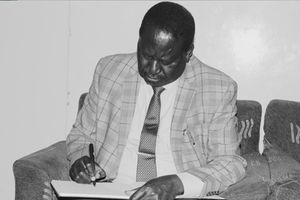
When Raila Odinga sang The Jamaican Farewell on a national television, few could have imagined how closely that song would mirror his life's journey.
It was January 27, 2020. Relaxed and at home in his residence in Karen, the veteran politician, then in his mid-seventies, shared moments of laughter and reflection with NTV’s Joseph Warungu.
As the interview drew to a close, he hummed the familiar lines of the timeless Harry Belafonte ballad, his eyes glinting with nostalgia.
Raila sings his favourite reggae song - Jamaican Farewell
“When we were growing up. Harry was up there. We had Cliff Richards, Elvis Presley, Jim Reeves, Ray Charles, and there was also Louis Armstrong. But Harry was my favourite, and my best one (song) was the Jamaican Farewell,” he recalled fondly.
Then, in the gentle baritone voice that had endured decades of rallies, protests, tear gas, imprisonment and political upheaval, Mr Odinga began to sing softly.
Down the way where the nights are gay,
And the sun shines daily on the mountain top,
I took a trip on a sailing ship,
And when I reached Jamaica, I made a stop…
Those lyrics, wistful and melodic, spoke of partings, of longing, of journeys that must be made even when the heart wishes to stay behind.
“But I'm sad to say, I'm on my way, won't be back for many a day,” he continued, almost prophetically.
Harry Belafonte performs Jamaica Farewell live
In that moment, it wasn’t just a song, it was a glimpse into the spirit of a man who had known departures all his life.
Three years earlier, in another interview with Betty Kyallo on KTN News, Mr Odinga had sung the same tune. He chuckled as he remembered how the song became so beloved that it was even translated into Kiswahili.
ODM party leader Raila Odinga speaks to the Sunday Nation at his Karen home, Nairobi on August 05, 2020.
Photo credit: Joan Pereruan | Nation Media Group
To him, it was more than just music; it was memory of youth, of movement, of resilience. The son of a freedom fighter, Raila’s life had always been a series of sailings, some triumphant, others turbulent, but all marked by a restless pursuit of freedom and justice.
Now, as Kenyans mourn his passing, the Jamaican Farewell tune feels like a fitting anthem for his departure, a lyrical reflection of the man who, in his own way, spent a lifetime “sailing” through the tempests of politics and the tides of history.
Like the sailor in Belafonte’s song, Raila’s journey was one of constant motion.
Last few years of his life
He was the eternal voyager, leaving ports behind in pursuit of distant horizons. His path took him from the lecture halls of East Germany to the torture chambers of Nyayo House, from the opposition trenches to the grand podiums of State power. Each chapter ended with a kind of farewell, to comrades lost, to causes unfinished, to dreams deferred. Yet, through it all, he never ceased to sing his song, never ceased to hope.
Those who were close to him often said he carried music in his soul. He loved old classics — melodies that told stories of struggle and endurance.
But Jamaican Farewell held a special place. It was, in a sense, his metaphor. The sunlit imagery of the Caribbean coast seemed to echo his own optimism, that even after the darkest political storms, the sun would still rise somewhere beyond the mountain top and most recently, to Canaan, he would say frequently.
ODM party leader Raila Odinga during interview at his Karen home in Nairobi on November 27, 2020.
Photo credit: File | Nation Media Group
In the last few years of his life, Raila had begun to speak more reflectively about time, legacy, and peace. He joked less about politics and more about life’s simple joys, a cup of tea, an old record, time with family. Those who visited his Karen home recall how music often played softly in the background — classics from his youth, the soundtrack of a life spent in perpetual motion.
When the news broke of his passing this morning, many Kenyans turned to that song again. Across social media, the lyrics of Jamaican Farewell resurfaced, shared with grief, but also with gratitude. It was as though the man who had marched through decades of political upheaval had finally taken his last voyage, sailing into eternity with Belafonte’s melody as his compass.
My heart is down, my head is turning around,
Perhaps, in the language of symbolism, “Kingston Town” was Kenya itself, the land he could never fully leave, even in death. His heart remained here, in the soil of his struggles and triumphs, among the people whose hopes he carried for more than half a century.
And just as the sailor promises to return someday, Raila’s story, too, will keep returning, in the songs sung at rallies, in the chants of liberation, in the memories of those who believed in his dream of a just nation.
In the Jamaican Farewell, there is no bitterness, only a gentle melancholy, the kind that follows a life lived fully. It is the same mood now enveloping the nation: sorrow laced with gratitude, pain softened by pride.
ODM party leader Raila Odinga speaks to the Sunday Nation at his Karen home, Nairobi on August 05, 2020.
Photo credit: Joan Pereruan | Nation Media Group
Raila Odinga’s voyage may have ended, but his melody lingers; the echo of a freedom song carried on the wind.
For a man who spent his life chasing light across uncertain waters, perhaps there could be no more fitting goodbye than Belafonte’s refrain:
But I'm sad to say, I'm on my way,
And so, as Kenya lowers her flags and raises her voice in remembrance, the music drifts once more through the quiet corridors of memory, a Jamaican Farewell for the son of Jaramogi, the eternal sailor of Kenya’s political seas.