Like the mythical phoenix that rises from its own ashes, the late former Prime Minister Raila Amolo Odinga’s political life was a tale of endurance, reinvention, and unyielding faith in a dream that often seemed just beyond reach.
Despite detentions, betrayals, defeats, and reconciliations, he refused to fade into political oblivion—instead, he transformed each setback into a new beginning.
By the time of his death on October 15 2025, Mr Odinga had become Kenya’s most enduring political figure — the power behind the throne, a man who never became president but shaped every presidency since 2002.
Born on January 7, 1945, in Maseno, Kisumu County, he was destined for politics long before he ever cast a vote.
His father, the late Jaramogi Oginga Odinga, was Kenya’s first Vice President and a key figure in the country’s independence struggle.
After studying engineering in East Germany, the ODM leader returned home in the early 1970s to teach at the University of Nairobi before venturing into business and, eventually, politics.
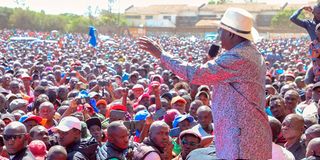
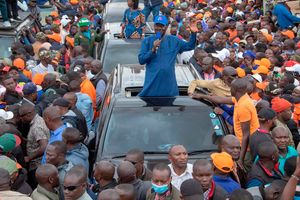
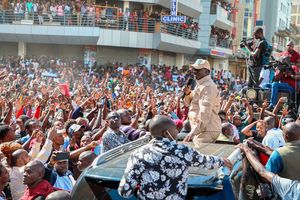
Azimio la Umoja leader Raila Odinga addresses a political rally at Jacaranda grounds in Nairobi County on January 29, 2023.
Photo credit: File | Nation Media Group
“Raila Amolo Odinga is truly a once-in-a-generation leader; a man whose ideals transcended politics and whose legacy will shape the destiny of Kenya for generations to come. A giant who towered for decades over our democratic landscape,” President William Ruto said of the fallen ex-premier.
“He was a colossus of Kenya’s modern politics, an indomitable warrior in our struggle for freedom and prosperity, and a statesman of boundless selflessness.”
In 1982, junior servicemen from the Kenya Air Force attempted a coup against President Daniel arap Moi’s government. Mr Odinga was then, arrested and accused of being part of the plot—a charge he denied but which cost him his freedom for six years without trial.
Narrating his ordeal, Mr Odinga told then High Court judge Kalpana Rawal that he was arrested on August 11, 1982 and taken to the GSU headquarters where he found University of Nairobi lecturer Prof Alfred Asanyo and Mr Mak’Onyango at the camp.
Mr Odinga recalled that he was terribly beaten by visibly drunk police officers led by the then police boss Ben Gethi and Peter Mbuthia.
He said Mr Gethi went to his cell munching a piece of meat and tried to compel him to write a confession. According to him, he wrote four statements but all of them were torn to pieces by the officers.
“They beat me ruthlessly yet we had not been found guilty,” Mr Odinga asserted.
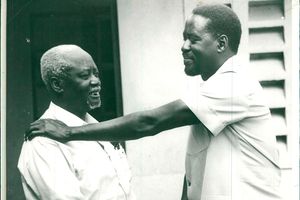
Father and son meet at the elder Odinga’s Bondo home for the first time since Raila was released from detention after five years in February 1988. Raila inherited the phobia that was generated for his father by the CIA and MI5.
When he was released in 1988, Kenya was still under a one-party “leadership.”
Advocate Chris Omore argues that then, many would have retreated into silence or exile.
“But Raila joined his father in the movement pushing for multi-party democracy, a struggle that saw him jailed again in 1989 and 1990.”
His release in 1991 coincided with the reintroduction of multi-party politics, a victory for the pro-democracy crusaders who had risked everything for political pluralism.
He became a key figure in the Forum for the Restoration of Democracy (FORD), a coalition that brought together freedom icons like Jaramogi, Kenneth Matiba, and Charles Rubia.
However, internal divisions soon tore FORD apart, leading to the creation of FORD–Kenya, led by Jaramogi. When Jaramogi died in 1994, Mr Odinga sought to inherit his father’s mantle but was outmanoeuvred by Kijana Wamalwa.
It was another crushing blow—but he was not one to stay down. In 1996, he quit FORD–Kenya and formed the National Development Party (NDP), marking his second major political rebirth.
By 1997, the ODM leader had established NDP as a formidable force. Running for president, he finished third behind President Moi and Mwai Kibaki, a strong showing that analysts say forced Kenya’s political establishment to take him seriously.
He managed 667,886 (10.79 percent) against Mr Kibaki’s 1,911,742 (30.89 percent) and Mr Moi’s 2,500,865 (40.40 percent).
Then came the move that shocked friend and foe alike: he entered into a cooperation pact with President Moi—the very man whose regime had detained him for years.
Many saw it as betrayal; others viewed it as a political masterstroke. He was appointed Minister for Energy and later merged NDP with KANU, Mr Moi’s ruling party.
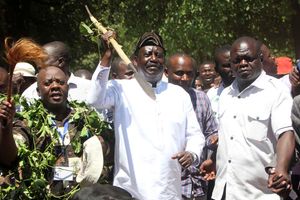
Azimio la Umoja Coalition presidential candidate Raila Odinga with his running mate Martha Karua campaign in Kawangware, Nairob, on July 16, 2022.
Photo credit: Pool
But when Mr Moi anointed Uhuru Kenyatta as his preferred successor in 2002, Mr Odinga led a mass exodus from KANU, uniting opposition forces under the National Rainbow Coalition (NARC) that swept Kibaki to power.
His famous declaration, “Kibaki Tosha!” , became the turning point of that election and confirmed Mr Odinga as a kingmaker—a man who could make presidents, even if he was not one himself.
Soon after NARC’s 2002 victory, Mr Odinga and Kibaki fell out.
In a recent interview with the Daily Nation , Mr Odinga’s 2022 presidential running mate Ms Martha Karua, the People’s Liberation Party (PLP) leader recalled how the 2022 Azimio presidential flag bearer would be locked out of State House by Kibaki’s inner circle.
She recalled how she made a frantic call to Mr Moody Awori, a senior figure in the opposition National Rainbow Coalition (Narc) that formed the government in 2003.
Ms Karua was worried that a simmering power struggle was unfolding away from the eyes of Kenyans, who were still in an ecstatic mood after Narc ousted the authoritarian Kanu from power after 40 years.
A disagreement between President Kibaki and Mr Odinga over the formation of the cabinet, as agreed before the elections, dampened the celebrations just days after the landmark victory in the December 2002 polls.
“Right from day one, on the appointment of cabinet, there was a disagreement between Raila and Kibaki despite coming to power as a united entity,” said Ms Karua, who had a front-row seat to the unfolding power play in the new administration.
The Memorandum of Understanding Mr Odinga has signed with Mr Kibaki in the run-up to the 2002 elections—promising him the post of Prime Minister—was abandoned.
Feeling betrayed, he once again led a faction that opposed the 2005 draft constitution, symbolised by the orange in the “Yes-No” referendum. The “No” side triumphed, birthing the Orange Democratic Movement (ODM).
That would mark Mr Odinga’s third phoenix moment—transforming political betrayal into a populist movement that would define Kenya’s next two decades.
In the 2007 election, he came close to power again, leading ODM in a fiercely contested race against Kibaki. When the disputed results declared Kibaki the winner, the country descended into post-election violence. Over 1,000 people died and more than 650,000 others were displaced.
International mediation led by Kofi Annan birthed the Grand Coalition Government, with Mr Odinga being appointed Prime Minister—a position that gave him executive authority for the first time.
It was vindication, but not victory. Yet even then, Mr Odinga used the moment to stabilise the country and push through key reforms, including the 2010 Constitution, which decentralised power and gave birth to Kenya’s system of devolution.
In 2013, he ran for president against Uhuru Kenyatta but lost narrowly. He challenged the results in court and lost again. For many politicians, that might have been the end. Not for Mr Odinga.
He remained politically relevant, organising opposition coalitions, galvanising youth, and shaping national discourse.
In 2017, the ODM chief made another attempt under the NASA coalition, running against Mr Kenyatta again.
The election was marred by controversy and irregularities. When the Supreme Court annulled Uhuru’s victory—a first in Africa—Mr Odinga stood vindicated.
But after the repeat poll, which he boycotted citing unfair conditions, he was declared the loser again.
Mr Kenyatta on Wednesday, in an emotional message of condolence, said the news of Mr Odinga’s death had struck him with profound sadness, calling it “a silence where once there was a voice of thunder and conviction”.
“To me, Raila was more than a political colleague; he was a defining part of my own journey, in public service and in life,” said the former President.
“Raila and I were navigators on opposing currents, charting different courses for the nation we both loved.”
Uhuru reflected on their political rivalry, noting that though they were once fierce opponents, they later found common ground through the 2018 Handshake that united the country after a divisive election.
“That journey from fierce political opponents to partners in the pursuit of unity taught me the true measure of the man,” he said.
“He was a formidable opponent, but he was an even more invaluable ally in the cause of reconciliation.”
The former Head of State remembered Raila—fondly known as “Baba” —as a patriot driven by an unshakable belief in justice and peace. “I have lost a friend and a brother,” Uhuru said.
The tension that followed Mr Kenyatta’s victory after the 2017 repeat elections which Mr Odinga boycotted was intense.
Many thought he had crossed the point of no return. But in yet another twist of fate—probably his fourth “resurrection”—Mr Odinga emerged months later shaking hands with Mr Kenyatta in a historic truce that calmed the nation and redrew Kenya’s political map.
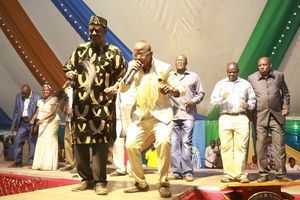
Then president Uhuru Kenyatta and ODM leader Raila Odinga at the KICC in Nairobi during the Jubilee Party's National Delegates Conference on February 26, 2022.
Photo credit: PSCU
It ended political hostilities, unified rival camps, and gave birth to the Building Bridges Initiative (BBI)—an attempt to address historical injustices and power imbalances.
Although BBI was later invalidated by the courts, the truce redefined the ODM leader’s political persona.
No longer just the opposition firebrand, according to Mr Kenyatta, he became a statesman —the elder reformer who prioritized peace over power.
His newfound closeness with Mr Kenyatta paved the way for his 2022 presidential bid under the Azimio la Umoja One Kenya coalition. President William Ruto, then Deputy President, narrowly beat him.
Dr Ruto narrowly won in the first round, securing 7,176,141 votes (50.49 percent) against Mr Odinga’s 6,942,930 votes (48.85 percent) in the results announced by then Independent Electoral and Boundaries Commission (IEBC) chairman, the late Wafula Chebukati.
Yet he continued to influence national politics, becoming the moral and ideological anchor of the opposition and an elder voice in continental affairs.
Even without the presidential title, the ODM leader remained a man whose word carried immense weight in State House corridors. Every administration since 2002—from Kibaki to Ruto—had to contend with his influence, his movement, and his ability to mobilise the masses.
His alliance with President Ruto in his final year—particularly on the continental stage—showed a leader who had transcended partisanship, seeking legacy rather than office.
“When death came on October 15, it found a man at peace, admired even by former adversaries. The nation and continent mourned not just a politician but a reformer whose shadow stretched across generations,” says Mr Dismas Mokua.
His life reads like a series of political deaths and rebirths—each marked by suffering, courage, and extraordinary endurance.
From the dungeons of Nyayo House to the steps of Parliament, from exile to handshake diplomacy, to the failed African Union Commission bid, his was a journey of a man who refused to be broken.
“He never became president, but his imprint is everywhere: in the Constitution, in the devolved counties, in the freedom to assemble, and in Kenya’s vibrant democracy. Raila’s greatest triumph was not winning the presidency—it was in surviving every fall, reshaping every defeat, and proving, again and again, that resilience is the purest form of victory,” argues his 2017 presidential campaign manager Willis Otieno, now Safina deputy party leader.
And like the phoenix of legend, Mr Odinga rose from every political fire—“reborn, renewed, and unforgotten”.