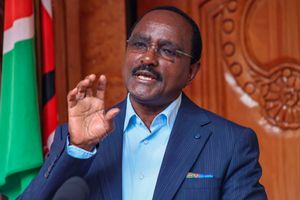
Safina Party Leader Jimi Wanjigi has advised opposition leaders to abandon “boardroom alliances of legacy politicians” and instead build a united front anchored on issues affecting ordinary Kenyans.
The businessman, who has also declared interest in the country’s top seat, says removing President William Ruto cannot be the only organising principle of the opposition ahead of the General Election in 2027.
“We talk a lot about uniting to remove President Ruto. That is not a purpose,” Mr Wanjigi said, adding that a coalition that fails to address the economic grievances that have driven public anger and protests would lose legitimacy.
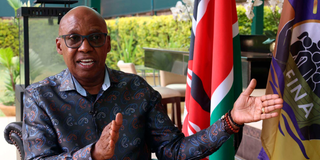
Safina Party Leader Jimi Wanjigi during an interview at his Kwacha House offices in Nairobi on October 8, 2025.
Photo credit: Evans Habil | Nation Media Group
In an interview with the Daily Nation , Mr Wanjigi said Kenyans want solutions to joblessness, high taxation and the high cost of living, but political leaders remain trapped in personality-driven calculations instead of listening to voters.
According to Mr Wanjigi, the 2027 presidential contest will narrow to a runoff between two camps defined by competing economic agendas rather than ethnic or regional blocs.
He dismisses attempts by former Deputy President and Democracy for Citizens Party (DCP) chief Rigathi Gachagua to organise an opposition he describes as a “region-based”, calling it a dead ideology.
Mr Wanjigi says the politics and ideas of Safina are rooted in shared economic pain, not tribal arithmetic.
“Gachagua has chosen a tribal path. That’s not Safina’s politics,” he said.
“If Mt Kenya voters believe their salvation lies in ethnic parties, good luck to them.”
According to the presidential hopeful, the coming election should mark the third liberation – a revolt not of guns or slogans but ideas.
The 2017 National Super Alliance (Nasa) strategist under Raila Odinga says he is offering himself to lead the “economic liberation” of the country, arguing that Kenya’s post-independence political class has enslaved citizens through debt, runaway corruption and a kind of false unity built around personalities and ethnic communities.
Mr Wanjigi believes President Ruto lost the confidence of Kenyans during the countrywide Finance Bill, 2024 street demonstrations, which he calls a mid-term referendum on his rule.
“We have never seen such a revolution. It was organic, patriotic and was led by young Kenyans who vowed not to take any more pain. The President lost the mid-term contest,” he said.
According to Mr Wanjigi, the protests – largely driven by Gen Zs – were a social awakening. He says President Ruto is clinging to power but the legitimacy of his administration is gone.
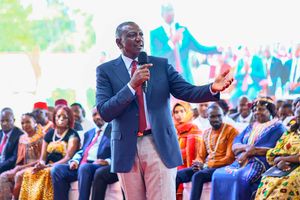
President William Ruto addresses the media at State House, Nairobi on November 24, 2025.
Photo credit: Dennis Onsongo | Nation Media Group
“He’s just hanging on and wasting our time. Kenyans have decided,” Mr Wanjigi said.
“The question for the opposition is not whether Ruto will go, but why Kenyans want him out – and how we fix the issues.”
Mr Wanjigi blames Kenya’s recurring political instability on the refusal by successive governments and leaders to confront the country’s structural economic problems.
“People didn’t go to the streets because Ruto is a liar or corrupt. They demonstrated because of the economy. They cannot breathe under heavy taxes whose benefits they don’t see,” he said.
The Safina boss describes the country’s ballooning public debt – now consuming more than 70 per cent of the tax revenue – as “a default on development”.
“The government may not have defaulted on debt repayment, but it has defaulted on pensions, counties, development and people’s lives,” he said.
“Unless we address this, every regime until 2038 will suffocate.”
Asked about calls for a united opposition, Mr Wanjigi dismisses “boardroom alliances of legacy politicians”.
“We talk too much about uniting to remove President Ruto. That is not a purpose,” he said.
“Even if we got power tomorrow and failed to address the problems that took people to the streets, we will also be thrown out.”
He insists that meaningful unity must be built around issues, not personalities or ethnicity.
“Legacy politicians have lost it. People are speaking about the issues affecting them – the country’s economy, jobs and taxation – but leaders are not listening. Let’s unite around people’s issues, not around names,” he said.
The Safina leader’s blueprint, dubbed The FIST Agenda, includes no payment of odius debts; universal healthcare; free primary and secondary education; replacement of 16 per cent Value Added Tax (VAT) with five per cent sales tax and no domestic borrowing by government.
Safina party presidential candidate Jimi Wanjigi (right) unveils his running mate in the August 9 General elections Wilis Evans Otieno at Ufungamano house in Nairobi on May 17, 2022.
Photo credit: Evans Habil I Nation Media Group
He says implementing the FIST Agenda will rely on public participation, accountability and transparency.
“These things are in people’s hands, not the government’s,” he said.
“If we say you will not pay 16 per cent VAT and you still pay, our credibility dies immediately. It is the people who must enforce that.”
The Safina leader cites Mwai Kibaki’s 2003 decision to roll out free primary education soon after he became president.
“Many people said there were no teachers or facilities. Kibaki told Kenyans to take their children to school, even if the lessons would be held under trees. That is the courage we need,” Mr Wanjigi said.
“The Constitution already provides for a two-horse race in the runoff,” he noted.
“I just don’t see President Ruto getting 50 per cent plus one. If credible candidates run, he may not even make it to the second round,” he said.
Safina Party Leader Jimi Wanjigi during an interview at his Kwacha House offices in Nairobi on October 8, 2025.
Photo credit: Evans Habil | Nation Media Group
Mr Wanjigi sees a second round of the presidential vote, defined by economic ideas.
“The convergence will be about the economic agenda. That is where the interest of Kenyans lie,” he said.
“If they still choose lies, then they know what the future holds.”
“I asked, what is uniting us? They said ‘Ruto must go.’ That’s not a purpose,” he said.
“When Jaramogi Oginga Odinga, Kenneth Matiba and Charles Rubia stood up in 1989, they didn’t just say ‘(Daniel arap) Moi must go.’ They fought to repeal Section 2A of the constitution. That was a matter many people could understand and rally behind.”
Mr Wanjigi argues that the opposition risks repeating old mistakes if it fails to articulate a clear economic alternative.
“President Ruto is just a symptom. The disease runs deep. If we don’t treat it, the next leader will face the same revolt,” he said.
Mr Wanjigi, once close to ODM leader Raila Odinga who died in October, says he does not support the Orange party’s cooperation with President Ruto.
“I don’t know why ODM joined forces with Ruto. I cannot be party to it. If ODM distances itself from Ruto, we can talk,” he said.
“Our politics is about uniting Kenyans. Tribal politics is old school, useless and boorish.”
Safina’s agenda, he says, includes an overhaul of the police service to make it directly answerable to citizens.
“The force was created by colonial watchmen to dominate, not to serve. We want policing to be accountable to the people,” he added.
In the Safina administration, divisional commanders will be renamed sheriffs – civilian or police – elected directly by residents of a division.
“If your sheriff depends on you for his continued stay, he will never order juniors to shoot the very people who elected him,” Mr Wanjigi said.
He cites Safina Deputy Party Leader Willis Otieno, who is pursuing a court case over the 2017 killing of Baby Pendo, as proof that the party takes accountability seriously.
Safina Deputy Party leader Willis Otieno speaks during the leadership transition ceremony at Ngong Racecourse in Nairobi on September 18, 2025.
Photo credit: Bonface Bogita | Nation
Some critics have dismissed Mr Wanjigi as part of the old system and a political wheeler-dealer seeking reinvention.
“They should debate me on content, not history,” he said.
“I was an insider, but I’ve never held elective office. Deng Xiaoping was part of Mao Zedong ’s system, yet he transformed China. Forty-five years ago, China’s GDP was lower than Kenya’s. Today it’s 700 per cent higher because one man saw the future,” Mr Wanjigi said.
“Jomo Kenyatta became prime minister soon after leaving prison. So did many leaders. Our credentials prepare us to revolutionise this country for the next phase – economic liberation,” he said.
Responding to claims that the Judiciary has been captured by the Executive, Mr Wanjigi says his vision of a small government eliminates the motive for capture.
“Our governance is people-driven. The biggest lobbyists will not be the government. They will be private-sector groups pushing their causes. That is healthy democracy.”
He says Safina’s approach will empower citizens and enterprises, not bureaucracies.
“At that time you’ll come to me complaining that private companies are lobbying Parliament. That is fine. We will debate and regulate it. Government capture will end,” he said.
Safina, he adds, will criss-cross the country to build issue-based networks.
“I want to have representation in Pokomoland and Bungoma on the basis of issues, not tribe,” he said.
“Gen Z showed us that Kenyans have moved on. Don’t hijack their struggle and reduce it to tribal games.”
Mr Wanjigi says Safina’s mission echoes its founding spirit when Mr Paul Muite and other reformers launched it in 1995 to fight authoritarianism.
“The second liberation was political. Safina leads the third – economic liberation. Kenyans are looking for thought leadership, not personality cults. That is what Safina represents,” he said.
He believes the 2027 election will be determined by young voters disillusioned with major coalitions.
“In 2022, about eight million registered voters – mostly the youth – did not take part. It was the single largest bloc. They will vote in 2027 after shedding blood for change in 2024 and this year,” he said.
According to Mr Wanjigi, President Ruto has lost more than half of his 2022 support. He says the alliance with ODM has not replaced those numbers.
“Even if there are three or four major candidates, Ruto will not be among the top two,” he said.
As Safina prepares for grassroots campaign, Mr Wanjigi says Kenya is on the cusp of transformation.
“This is about restoring power to the people over their taxes, credit, education and freedom,” he said.
“We are diving into the deep end. The next liberation is economic, and it begins now.”