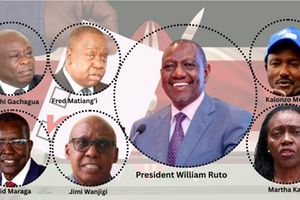
President William Ruto is facing a defining moment in the New Year as he races against time to actualise his ambitious programmes aimed at winning over the youth ahead of the 2027 General Election.
With the polls fast approaching, President Ruto enters the year under pressure as he continues to court the crucial youth vote, which could prove decisive at the ballot.
In 2025, the President renewed his outreach to young people, reviving narratives that resonated with the downtrodden and helped propel him to victory in the 2022 election.
From empowerment programmes championed by Deputy President Kithure Kindiki targeting boda boda riders and mama mboga, to State House meetings with grassroots mobilisers, President Ruto appears to be regaining traction among the demographic that catapulted him to power.
Since assuming office, the Kenya Kwanza administration has rolled out a raft of initiatives targeting young people.
Although most of these programmes have been launched, they have faced numerous bottlenecks. President Ruto is expected to focus on sealing these gaps this year as he seeks to deploy them as campaign tools while the 2027 race enters the home stretch.
While it will pit political heavyweights against one another — President Ruto’s camp and a united opposition led by former deputy president Rigathi Gachagua — the real battleground is the youth vote.
Gen Z, born into a digital and economically precarious world, has become the most unpredictable force in Kenyan politics.
Youthful protestors demonstrate against the Finance Bill 2024 on Kimathi Street, Nairobi on June 20 2024.
Photo credit: Francis Nderitu | Nation
“Its influence was laid bare during the 2024 anti-Finance Bill protests, when young people mobilised rapidly through social media, bypassed traditional political structures, and shook the foundations of the political establishment,” says Multimedia University don Prof Gitile Naituli.
That awakening has not gone unnoticed. Across the political divide, parties have launched youth-focused initiatives, rebranded their messaging, and restructured their leadership structures in a bid to court a demographic that is large in number but historically inconsistent at the ballot.
According to the 2019 Kenya National Bureau of Statistics census, more than 75 per cent of Kenya’s population is under the age of 35. The youth population aged between 18 and 34 stood at about 13.7 million — nearly a third of the country.
Yet youth participation in elections has remained stubbornly low. IEBC data shows that in the 2022 General Election, voters aged 18–35 accounted for only 39.8 percent of registered voters, a decline from 2017. Millions of young Kenyans remain disengaged, disillusioned, or unconvinced that the political system works for them.
Human rights activist Boniface Mwangi argues, “young people are the strongest opposition in this country, and when they organise, they are unstoppable.”
Activist Boniface Mwangi speaks to the media at Mageuzi Hub in Nairobi on October 12, 2025.
Photo credit: Evans Habil | Nation Media Group
“If we want better leadership, we must build it together. No one is coming to save us. We save ourselves by choosing integrity, speaking truth, and standing with each other,” says Mr Mwangi, a 2027 presidential hopeful.
Arguably, President Ruto’s most calculated move toward 2027 has been his aggressive focus on youth employment, digital innovation, and labour mobility.
In speeches across the country, the President has consistently returned to youth empowerment as both a policy priority and political shield.
He has cited the Affordable Housing Programme as a major job creator, claiming it has generated over 250,000 jobs. Beyond construction, the government has rolled out labour-intensive initiatives such as ClimateWorx, expanded internships, and increased support for technical training institutions.
At the centre of the administration’s youth strategy is the National Youth Opportunities Towards Advancement (NYOTA) programme, backed by a Sh20 billion fund and targeting over 800,000 young people for skills training, enterprise support, and job placement.
The programme is meant to bridge the transition from education to employment — long identified as a weak link in Kenya’s labour market.
Another flagship intervention is the Hustler Fund, initially marketed as a lifeline for young entrepreneurs locked out of traditional credit. While millions have accessed small loans, critics have questioned whether the fund promotes sustainable enterprise or traps borrowers in cycles of micro-debt.
The President has also leaned heavily into digital jobs and ICT hubs, promising one in every constituency. More than 284 digital hubs have been established in TVET institutions, with hundreds more planned.
The digitisation of over 20,000 government services on eCitizen has been presented not just as an efficiency drive but as a pathway to tech-enabled youth employment.
Labour mobility remains another pillar. Under the Kazi Majuu programme, the government says over 400,000 Kenyans have secured jobs abroad, with around 12,000 placements monthly — a figure the President frequently cites as evidence of delivery.
Yet beneath the numbers lies a more complex reality. Youth unemployment remains high, underemployment widespread, and the cost of living continues to squeeze young households. For many Gen Z Kenyans, empowerment remains aspirational rather than lived.
Job seekers fill out their forms at the Kenyatta International Convention Centre, Nairobi on October 25, 2024, during a mass recruitment drive for various job opportunities in Qatari companies.
Photo credit: Wilfred Nyangaresi | Nation
Analysts insist that the success of youth programmes is judged not just by scale, but by access, transparency, and impact.
But questions persist over who benefits, how beneficiaries are selected, and whether programmes are aligned with real market demand — questions that President Ruto has to confront head-on in 2026.
Asset and equipment support events, youth-linked public procurement opportunities, and internships have expanded, but uneven implementation has fueled scepticism. For a generation shaped by instant feedback and online accountability, delays and opacity erode trust quickly.
As 2026 begins, the challenge for President Ruto is not announcing new programmes but proving that existing ones work — at scale and sustainably.
Sensing the mood, ODM, a UDA broad-based partner, has also embarked on a renewed push to court Gen Z. They launched the Young Captains chapter — a wing within the ODM Women League comprising young women from institutions of higher learning.
At the launch in Nairobi, attended by Secretary General Edwin Sifuna, Women’s League President Beth Syengo, and Youth League leader John Ketora, the message was clear: the party intends to reconnect with a generation that has historically viewed traditional opposition politics as stale.
“They are very eager to register as voters so that their voice can be heard,” Mr Sifuna said, describing a surge in youth political interest.
Nairobi County Senator Edwin Sifuna during an interview in his office.
Photo credit: Billy Ogada | Nation Media Group
Before his death in October, then ODM leader Raila Odinga had gone further, fronting a proposal for an Intergenerational National Conclave — a youth-driven national dialogue aimed at resetting Kenya’s governance culture.
Anchored on Article 1 of the Constitution, the initiative envisioned a bottom-up process culminating in a national gathering of grassroots delegates, MPs, and civil society.
“This is the true expression of ‘we the people,’” Mr Odinga had argued in an interview with the Daily Nation in July, positioning dialogue as a means for young people to exercise sovereignty beyond the ballot.
However, many young activists remain wary of political overtures. A group of university students under the banner Viable Alternative Republic (VAR) demanded that any national dialogue structures be youth-led, not tokenistic.
“We demand 50 percent youth representation,” said national coordinator Ivy Muchoki, arguing that young people bear the full consequences of failed leadership. The group called for economic justice, ownership opportunities, and an end to police brutality, including the establishment of an independent, civilian-led oversight authority.
Democracy for the Citizens Party (DCP) leader Rigathi Gachagua addresses the congregation during a church service at Christian Dominion Ministries in Kasarani on December 7, 2025.
Photo credit: Billy Ogada | Nation Media Group
Mr Mwangi argues that the youth demands reflect a deeper shift: youth no longer want to be consulted — they want power.
Former deputy president Rigathi Gachagua has also moved aggressively to brand himself as youth-inclusive. In his Democracy for the Citizens Party (DCP), he has elevated young leaders to prominent positions, citing their energy and perspective.
He has taken this message abroad as well, engaging Kenyan youth in the diaspora under the 625 Movement during his US trip in July.
Yet even there, Gen Z scrutiny followed him. In one gathering, Valentine Wanjiru Githae challenged his rhetoric on ethnicity, warning that divisive narratives would alienate young voters seeking national unity.
Her confrontation underscored a defining feature of Gen Z politics: leaders are questioned openly, in real time.
By 2026, the youth question will no longer be theoretical. It will be measurable — in jobs created, businesses sustained, skills matched to markets, and voices genuinely included.
For President Ruto, it is the final year to demonstrate that youth empowerment was not merely a campaign slogan, but a governing philosophy. For his challengers, it is the year to persuade young Kenyans that alternatives exist.
“Ultimately, the youth will decide not just who wins in 2027, but what kind of country Kenya becomes thereafter. And in that verdict, 2026 will matter far more than any manifesto launch or rally chant,” says Fred Makajos, a former Maseno University student leader.
However, young people will have to pull up their socks, as the Independent Electoral and Boundaries Commission (IEBC) has already decried their low turnout, especially among Gen Z, who have attained voting age during the recent voter listing.
“While we commend this progress, turnout among the targeted youth remains lower than expected. With a national target of 6.3 million new voters, the commission urges all eligible Kenyans, particularly the youth, to take the opportunity to register and make their voices count in the 2027 General Election,” IEBC Chairman Erastus Ethekon said.
The low turnout has persisted despite IEBC’s strategies to lure eligible youth into registering as new voters ahead of the 2027 poll.
The introduction of Huduma Centres spread across the country as additional registration points and the provision of universal registration kits in all the 290 constituencies were intended to ramp up registration of Gen Z voters.