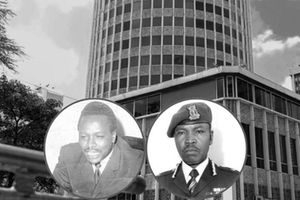
At his peak, JM Kariuki was the embodiment of wealth and flamboyance—a larger-than-life politician whose fortune and charisma made him one of post-independence Kenya’s most captivating figures.
Known for his impeccable fashion sense, JM favoured well-tailored suits, often complemented by a double-sided shirt scarf and a neatly folded pocket square, exuding both confidence and sophistication. His attire reflected not just a keen eye for elegance but also a deliberate effort to craft a distinguished public image.
But by the time of his brutal assassination in 1975 , the tides had turned. Once a man of immense means, he had become a financial shadow of his former self, his wealth eroded by political battles and calculated sabotage.
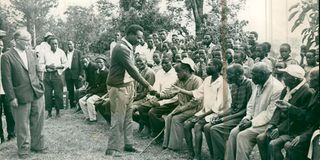
Politician Josiah Mwangi Kariuki, who was popularly known as JM Kariuki.
Photo credit: File | Nation Media Group
On June 29, 1974, the Daily Nation carried a chilling headline: The National Bank of Kenya was moving to have JM declared bankrupt over outstanding loans. It was a stark fall from grace, orchestrated by forces that sought to cripple him financially and silence his defiant voice. Yet, even in the throes of economic ruin, JM remained unbowed. Against all odds, he contested and reclaimed the Nyandarua North parliamentary seat—an audacious victory that sent shockwaves through the ranks of those determined to erase him from Kenya’s political landscape.
JM’s dwindling fortunes were public. At the entrance of his Castle Inn Hotel in Nairobi’s Garden Estate stood an incomplete structure—a cemented reminder of his struggling business empire. In 1971, JM secured a loan from the Kenya Tourist Development Corporation, then under Kenneth Matiba, to expand Castle Inn into a premier conference facility with an attached nightclub. However, the project faltered, leaving his dream unfulfilled.
Castle Inn was originally part of the expansive Jewish-owned Joreth Limited, controlled by real estate mogul Jacob Hirschfeld. The property had previously been managed by Nairobi pilot Alan Arthur Coulson on plot LR 4894/2. When Hirschfeld sought to shield his land from compulsory government acquisition for Nairobi’s housing expansion, he strategically distributed various plots to senior Cabinet ministers and influential figures. JM received LR 4894/188, a 5.6-acre parcel, while other beneficiaries included Paul Ngei, Lawrence Sagini, and Dr. Gikonyo Kiano’s wife, Ernestine Hammond Kiano.
Additionally, JM acquired significant shares in Abraham Block’s Block Hotel and forged a close relationship with Hirschfeld, one of Kenya’s wealthiest Jewish real estate investors. His brother-in-law, Harun Muturi, later became the face of Joreth Limited, which controlled vast tracts of land stretching from the General Service Unit (GSU) headquarters through Thome Estate and Muthaiga North to the Muthaiga police station.
JM was a shrewd businessman long before he stepped into the political arena, and his post-independence connections swiftly elevated him to the heart of power. In 1966, he established Kanyamwi Trading Co. Ltd—a name crafted from an acronym of his own, Kariuki, and those of his two wives, Nyambura and Mwikali. The company’s headquarters stood in Ol Kalou town, housed within a commercial building he owned. This building was more than just a business hub; it was a testament to J.M. 's growing empire, incorporating his constituency office, a wholesale shop, a bar, and a restaurant.
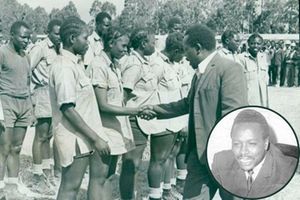
The late politician Josiah Mwangi (JM) Kariuki.
Photo credit: File | Nation Media Group
Kanyamwi flourished as a dominant beer distributor, supplying multiple bars across Nyandarua. But JM’s business acumen stretched beyond this venture. He was a director at East African Breweries and co-owned three lucrative beer distribution companies in the Rift Valley—Nyandarua Samburu Agencies, Laikipia Distributors, and Rift Valley Agencies—alongside Vice President Daniel arap Moi. His ability to navigate the corridors of power while maintaining a firm grip on business made him a formidable force in both arenas. J.M. knew where to invest, and he made millions.
Ironically, despite his deep entanglement in the liquor trade, JM was not what he termed an “international drinker”—a phrase he once quipped to a journalist. He indulged selectively, preferring Pilsner or Pernod Absinthe, a nod to refined yet measured indulgence. But on the floor of the International Casino, where he owned shares, J.M. was a master. He loved gambling.
JM Kariuki at a game reserve in Samburu in the early 1970s.
Photo credit: File | Nation Media Group
In 1969, JM Kariuki was appointed Assistant Minister for Tourism and Wildlife, placing him at the heart of Kenya’s lucrative and shadowy ivory trade. At the time, hunting elephants was still legal—until 1973—creating a gold rush for political and security elites eager to cash in. The ivory and skin merchants saw J.M. as a key player, but in doing so, he made formidable enemies within the security apparatus. Virtually all senior security officials and members of the Kenyatta family were involved in the racket. After the ban, a British paper alleged that former Nairobi Mayor Wambui Kenyatta had exported the stocked ivory.
This era also saw the rise of Nairobi’s first gambling establishment, the International Casino. In the days leading up to its grand opening, the management announced a controversial policy barring “undesirable people, prostitutes, and journalists.” But behind the curtains of exclusivity, a high-stakes power struggle was brewing. J.M. held substantial shares in the venture, pitting him against the formidable Kenyatta family and their close Korean associates who also owned, the Njiru Country Club which later became Casino de Paradise. According to The Concord, this battle for control of the casino space was anything but civil.
Ever the master of optics, JM leveraged his position at the National Youth Service (NYS) to craft grand spectacles of power. Archival letters reveal his penchant for theatrics—he would insist on NYS servicemen lining up to welcome him back from overseas trips, parading in choreographed displays of allegiance. With media invitations every moment had to be captured, all choreographed to bolster his image. Hubris, perhaps—but undeniably effective.
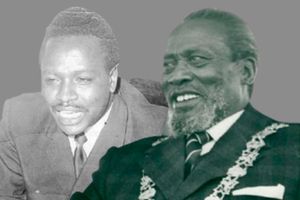
At the zenith of his business empire in 1969, JM acquired a 200-acre farm in Gilgil, a sprawling estate crowned with a whitewashed farmhouse. In its halls, he prominently displayed a photograph of himself alongside Jomo Kenyatta—a deliberate, almost theatrical gesture that signaled his proximity to the highest echelons of power. It was during this period that he added an automatic Bentley to his collection, one of the few in Kenya at the time, further solidifying his image as a man of both means and ambition.
He also confessed in an interview with the Sunday Nation , that he owned a small aircraft at Wilson Airport. He was also a member of the Jockey Club of Kenya, and owned a racing horse, to complete his penchant for gambling. In 1970 or thereabouts, J.M. was also driving around in a BMW 2800, a six-cylinder coupe and symbol of elegance.
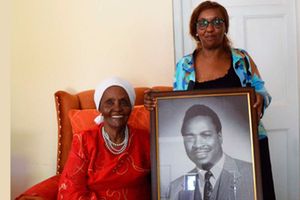
Ms Doris Nyambura Kariuki (left), the first wife of the former Nyandarua MP Josiah Mwangi Kariuki and her daughter Anne Mumbi holding a portrait of 'JM' at their home in Nairobi City on February 26, 2025.
Photo credit: Francis Mureithi | Nation Media Group
He also drove a Jaguar - very rare collections at that time – which he sold a few days before he died. For his two wives, they drove a BMW 1800 and a Citroen. A close associate says that J.M. bought a Toyota Sprinter for a State House-based girlfriend, who was set to be wife number three.
Beyond commerce, JM was a man of land and legacy. He owned an 800-acre Riverside Farm overlooking Ol Kalou township, a prized estate carved from the Ol Kalou Salient complex—a government-sanctioned redistribution that rewarded Kenyatta’s inner circle. By the late 1960s and early 1970s, his influence was unmistakable. His Mercedes-Benz 300, registration KKV 1, became an added symbol of affluence, gliding through the Rift Valley like a royal chariot. His two wives, meanwhile, navigated their daily affairs in Toyota Corollas—a calculated contrast that spoke volumes about J.M.’s understanding of wealth, power, and perception.
Ms Terry Wanjiru Kariuki, the third wife of the former Nyandarua MP Josiah Mwangi Kariuki, popularly referred to as 'JM, ' holding a portrait of her husband at her house in Nairobi City on February 20, 2025.
Photo credit: Francis Mureithi | Nation Media Group
On the vast 800-acre expanse, JM had, in a strategic masterstroke, “leased” a portion of the land to the Nyandarua Nyakinyua Women Group in 1974—a calculated move to charm the electorate. Yet, fate would render the arrangement a ticking time bomb. Upon his untimely demise, the land’s ownership became a fierce battleground. The Nyakinyua women, steadfast in their claim to 300 acres, stood their ground, while JM’s family, unwavering in their stance, contested the occupation, citing the absence of any formal sale agreement.
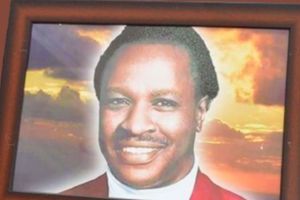
A portrait of Nyandarua MP Josiah Mwangi Kariuki, popularly known as JM Kariuki.
Photo credit: Francis Mureithi | Nation Media Group
But JM was no ordinary politician—he was a luminary of generosity and a key driver of the harambee culture. In philanthropy, JM knew no rival. His acts of largesse were the stuff of legend, eclipsing all who dared compete, including Jomo Kenyatta. In a grand display of benevolence, he embarked on a whirlwind mission, bestowing roofing mabati (iron sheets) upon women’s groups across the vast expanse of the Mt. Kenya region. It was philanthropy on a scale so grand, it bordered on myth.
By 1974, the benevolence that had defined JM Kariuki’s public persona began to fade, giving way to an era of turbulence and uncertainty. Shadows of danger loomed ever closer—he reported that his car had been shot at, a chilling omen of the forces conspiring against him.
Whether it was fear or financial strain that led him to rely on Kenatco taxis in his final years remains an enigma. What is certain, however, is that the corridors of power had turned hostile, and creditors including the formidable National Bank of Kenya, had come knocking with a bankruptcy suit.
Stripped of a government permit to campaign, JM took matters into his own hands, crafting a personal manifesto and distributing it defiantly to the masses. Meanwhile, the Kiambu faction, ever watchful, had thrown its weight behind Evans Ngugi, a political transplant from Elburgon. Their chosen enforcer in Nakuru was none other than Mayor Mburu Gichua, a man whose clashes with J.M. had become the stuff of political theatre. The stage was set for a showdown, and in the high-stakes game of power and survival, the odds were stacked against JM.
Having eluded every political snare laid in his path, it was the spectre of the Maskini Liberation Organisation and the Nairobi bombings that ultimately sealed JM Kariuki’s fate. The reasons why the feared trio—Ben Gethi, Patrick Shaw, and Ignatius Nderi—hounded him remain shrouded in secrecy, lost in the murky depths of state intrigue. Yet, it is the brutal torture he endured that speaks louder than any conspiracy.
Three missing teeth. Severed fingers. It appears that J.M’s body was broken long before the final gunshot rang out. JM did not simply die; he was silenced in agony. He was a rich man championing the voiceless.
His death was not just an assassination but a chilling warning to those who dared dream of a more just Kenya. Some 50 years later, the State was unable to point fingers at the killers. The very inequalities he sought to end persist.