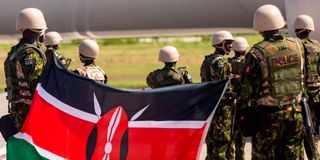
Kenya has taken the defence of its police officers deployed to Haiti before the UN Security Council, choosing, for the second time, to fight a report that suggested the officers had violated civilians.
Erastus Lokaale, Kenya’s Permanent Representative to the UN, told a Security Council session that the Kenyan officers had followed every piece of law while serving in Haiti under the Multinational Security Support (MSS) mission, to which Kenya deployed some 999 troops.
The Council was gathering on Thursday to discuss the humanitarian situation in Haiti, where gang violence has placed civilians in a perpetual cycle of violence and humanitarian crises.
And the meeting was also centred on the UN Secretary-General’s latest report, which highlighted a security landscape of both intensified enforcement and rising civilian risk.
Yet that report had also suggested that Kenyan officers sexually violated a minor and a woman in incidents reportedly confirmed by investigators.
“Under Kenya's leadership, the Mission strictly adhered to its guiding frameworks and upheld the highest standards of professionalism, accountability and transparency,” he said.
He was responding to claims that the Kenyan officers under the MSS mission were responsible for four cases of sexual violence in the country, including the rape of a 12 -year-old girl and two 16-year-olds.
As soon as the UN released its findings and accused officers under MSS of sexual exploitation and abuse, Mr Lokaale said that the top leadership of the mission acted promptly by establishing a board of inquiry, whose findings were communicated to the Haitian National Police and relevant UN human rights structures in Haiti.
“Those findings (of the board of inquiry) are inconsistent with the averments in the Secretary-General’s report,” he said. However, Kenya said it is prepared to cooperate fully with the Office of the UN High Commissioner for Human Rights (OHCHR), including in consideration of any subsequently emerging relevant and credible information.
The experience of Kenyans in Haiti under the MSS has been a mixed pot. In June 2024, Kenya started deploying troops to fight gangs in Haiti, under a UN Security Council-endorsed MSS. The mission was supposed to operate under UN international humanitarian rules, even though it wasn’t a UN peacekeeping mission.
Kenya deployed some 999 troops. In spite of the accusations, some civilians gathered in Port-au-Prince last week to protest against the departure of the Kenyan troops, who are set to be replaced by officers from Chad under the new mission, Gang Suppression Force (GSF). Kenyan officials say the civilian support is a signal enough that their operations in Haiti were within the law.
Kenya had already protested to the UN Secretary General in an earlier letter in April, by Prime Cabinet Secretary Musalia Mudavadi, who also directed Kenyan envoys to speak candidly on the subject before the UN and other forums.
“The MSS experience, and successes attained, provide a strong foundation on which the GSF should build,” the Kenyan argued.
“The progress achieved by a contingent of 999 personnel demonstrates that stability in Haiti is possible,” emphasised the representative of Kenya, whose country led the Force’s predecessor. Kenya says that MSS struggled so much from a lack of finances and equipment that the GSF must be given adequate backing. Lokaale urged for stronger international support for Haiti. He said that the Force must be fully operational and sufficiently resourced.
“This moment is particularly critical as the last fighting contingent of the [Multinational Security Support mission] departs from theatre at the end of April,” he added.
The GSF had actually commenced from October last year, and Kenyan troops stayed on in the transition. The last batch of officers was to return home before the end of April.
The MSS mission formally ended in March, with a new one dubbed Gang Suppression Force (GSF) kicked off. GSF is a UN-backed, 5,500-member multinational security mission authorised in October 2025 to combat rampant gang violence in Haiti.
Such a demonstration has never been held in Haiti, where people are opposed to the departure of a peace-keeping mission within its boundaries.
During Thursday’s Security Council meeting, Michel Xavier Biang, the Permanent Observer for the International Organisation of la Francophonie, said the new GSF will also train officers before deployment.
“With France, Canada and the United Nations Institute for Training and Research (UNITAR), La Francophonie is offering pre-deployment training for Francophone staff that is “fully in sync with demands in the field,” he said, adding that the training also included a civilian protection component.