Kenya has rejected claims that its police officers sexually exploited women and children while serving in the Multinational Security Support (MSS) mission in Haiti.
The mission was formally terminated by a UN Security Council resolution in October and replaced with the Gang Suppression Force (GSF). But Kenyan police troops who led the mission are just completing their return.
Yet their departure from the Caribbean country has come under a cloud of allegations the police officers engaged in sexual exploitation incidents. The report was first raised by Haitian news outlet Ayibo Post last week, citing a UN Secretary General’s report that said four incidents of abuse were reported in 2025.
The Special Measures for Protection from sexual exploitation and Abuse Report of the Secretary-General said the incidents of sexual exploitation and abuse involving personnel from the MSS “were found to be substantiated by investigations conducted by the Office of the United Nations High Commissioner for Human Rights.”
“The cases were referred to the commander of the Gang Suppression Force and the Multinational Security Support Mission for appropriate investigation and remedial measures.”
On April 7, Musalia Mudavadi, Kenya’s Prime Cabinet Secretary and Cabinet Secretary for Foreign and Diaspora Affairs, said Kenya rejects the allegations because the police troops had been investigated and found blameless.
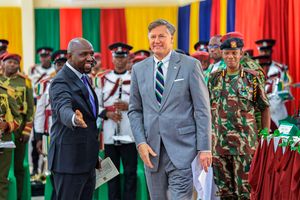
Prime Cabinet Secretary and Cabinet Secretary for Foreign and Diaspora Affairs Musalia Mudavadi.
“Allegations of sexual exploitation and abuse reported in August 2025 were promptly investigated through a Board of Inquiry and found to be unsubstantiated. No formal complaints were filed with any authority, and findings were shared transparently with both Haitian and UN bodies,” Mudavadi wrote to the UN Secretary General Antonio Guterres on Tuesday.
Ayibo Post had reported that one case involved a police officer on MSS and a minor, which it said the local joint team involved in investigating the case had confirmed the incident. Mudavadi, however, said outcomes of investigations were shared with stakeholders, showing no ill deeds.
“Investigations conducted were impartial and shared with all relevant stakeholders, including UN human rights offices and Haitian authorities. These actions reaffirm Kenya's commitment to accountability and due process.
“It is therefore concerning that the Secretary-General's report A/80/644 does not accurately reflect these findings. Kenya has instructed its Permanent Missions in Geneva and New York to engage relevant UN offices to correct these inaccuracies and protect the integrity and sacrifices of MSS personnel.”
The MSS was not a UN peacekeeping mission, but it operated under the mandate provided by the UN Security Council. As such, it operated under rules shared by most peacekeeping missions, even though the responsibility to guard its integrity rested with troop-contributing countries and Haitian authorities.
Long before Kenya deployed the officers in June 2024, Nairobi and Port-au-Prince signed a series of documents on the operational discipline of the MSS, which also included police officers from other countries. One provision said Kenya retained the right to discipline errant officers it had sent there and the officers would be immune from Haitian prosecution unless waived by Nairobi. As such, errant officers would be recalled to Nairobi to face disciplinary steps.
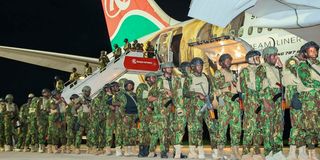
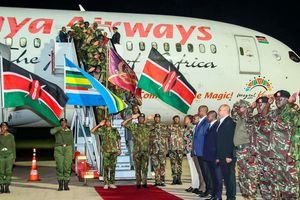
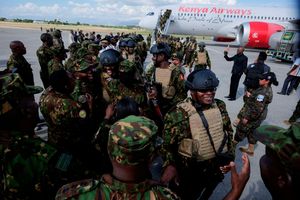
Kenyan police officers who served under the Multinational Security Support mission in Haiti celebrate upon arrival at the 75 Battalion base in Embakasi, Nairobi, on March 17, 2026.
Photo credit: Wilfred Nyangaresi | Nation Media Group
Nairobi also said MSS was guided by United Nations Security Council Resolutions 2699 (2023) and 2793 (2025), particularly on the protection of civilians, including women and children, prevention of sexual violence, and adherence to the Human Rights Due Diligence Policy (HRDDP). MSS personnel received continuous training in human rights and civilian protection in collaboration with UN Human Rights Officers, ensuring high standards of accountability and professionalism.
“Throughout its deployment, the MSS strictly adhered to all operational frameworks, including the Concept of Operations and the Status of Forces Agreement. Notably, no reports have identified any misconduct, underscoring the mission's discipline and respect for human rights,” Mudavadi wrote to the UN on Tuesday.
Kenya’s decision is partly informed by the challenges the MSS faced before and during deployment, such as lack of money and equipment after donors stayed away from the project that Nairobi had seen as a way to promote its peacebuilding credentials to the world. Kenya also wanted the MSS to be different from previous peacekeeping missions, which were accused of sexual exploitation, lack of hygiene and corruption.
Still, three officers, Samuel Tomoi Kaetuai, Benedict Kabiru, and Kennedy Nzuve, died in the line of duty. Many others sustained injuries.
Nairobi says the MSS should be commended, not condemned and that it will be ready to support a smooth transition from the MSS to the GSF.
“Through its leadership, Kenya continues to uphold high operational standards, accountability, and respect for human rights, thereby contributing to credible and effective peacekeeping and international stabilisation efforts.
“We reaffirm our commitment to Haiti's stability and to a seamless transition to the GSF. Kenya continues to believe that the international community has a responsibility to support Haiti in achieving lasting peace and security.”