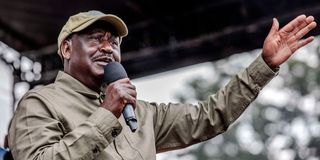
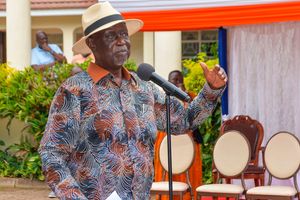
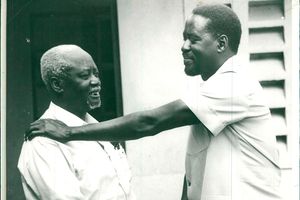
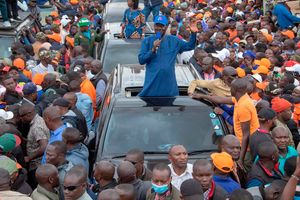
Ten or 11 days on, depending on your time zone, Kenya is trudging on, but the rhythm is off.
Markets hum, matatus elbow through traffic, Parliament argues in its familiar register—and still there is that hollow in the nation's chest. Raila Odinga is gone , and the country is learning how much of its political pulse had been set by a single voice.
His bedrock was never in doubt: Nyanza and Western, the Coast, the restless precincts of Nairobi — and increasingly parts of the country he added on to his political cap each of the five times he ran for president. But the current ran wider.
In the foothills of Mt Kenya—the heartland of some of his fiercest rivals—there were households that argued with him in public and admired him in private, that watched his news conferences for the sheer craft of political engineering, that could predict the cadence of his wit before he delivered the line.
For those in the news business, he was a headline that wrote itself, a figure whose presence forced allies and adversaries into sharper relief.
The loss is as monumental as it is architectural. Remove that beam and the building groans, even where it once braced against him.
“Thank you to the Council of Governors for coming together to pay your last respects to our departed leader at Kang’o Ka Jaramogi. The ‘Father of Devolution’, Baba, must surely be smiling where he rests,” Siaya Governor James Orengo said on Saturday.
Just two days after Raila’s demise, the Orange Democratic Movement (ODM), the party he led—thick in the fog of grief—chose to appoint Senator Oburu Oginga as interim leader . Lost for direction, seeking sage wisdom to steady the ship at a time of monumental loss, the movement turned to family, to history, to the bloodline that carries institutional memory. Dr Oburu has set a steadying hand on the wheel while the movement regathers in its heartland halls.
Senator Oburu Oginga during the ceremony to install Raila Odinga Junior as the head on of Raila Odinga'sd family at Opoda Farm in Bondo, Siaya County.
Photo credit: Alex Odhiambo | Nation Media Group
Yet the real test lies beyond titles: whether anyone—or any arrangement—can hold together the eclectic circuitry Raila kept live across regions and classes.
It was a delicate thing, his coalition, sustained by memory and motion: Nyanza's loyalty, Western's bargaining confidence, the Coast's long patience for reform, Nairobi's feverish demand on delivery, and those scattered pockets elsewhere that signed on because he seemed, every time, to make politics feel like a public service.
The alliance era complicates the inheritance. Months before his death, Raila moved ODM into a working arrangement with President William Ruto. Temperature down, bandwidth for delivery up—that was the sales pitch.
President William Ruto and the opposition leader, the late Raila Odinga, sign an agreement between UDA and ODM in the presence of their party members.
Photo credit: Pool
With Raila gone, the pact now strains both sides. ODM must decide whether to live as a shareholder in government and risk thinning the brand, or reclaim a sharper opposition posture and risk losing proximity to the levers that change daily lives. State House, for its part, tests how much of ODM's organisational muscle can be drawn into co-governance without snapping the cord that ties the party to its energetic base.
Inside ODM, the lanes of succession are visible: continuity through institutionalists; insurgency through a youth-driven wing; and pragmatic governance through those now at the Cabinet table. Around them, familiar national figures redraw their lines.
From left: ODM Secretary General Edwin Sifuna, Interior PS Raymond Omollo, Embakasi East MP Babu Owino and Winnie Odinga have all been mentioned in Raila Odinga's succession debate.
Senator Oginga, the scion of the country’s first vice president Jaramogi Oginga Odinga and Raila’s elder brother, is alive to the jostling and impatience from within and without the party’s inner sanctum.
“Some people have been asking me that since I'm more than 80 years old, how I'm I going to steer this party. They have also been asking me how we shall handle this succession. I told them that any of the existing ODM leaders have the capacity to steer the party. They all have capacity, but there's a saying which goes that leaders emerge just like mushrooms grow. You just wake up one morning and find them grown. So that's how God works by elevating leaders. Even Raila Odinga, there's nowhere the Luo community convened a meeting and elected him as their leader. He just emerged as a leader and that was it,” Dr Oburu said on Friday.
For the succession in Luo Nyanza—where Raila hailed from, a place that has since attracted the young turks keen to inherit Odinga’s empire, Multimedia University of Kenya lecturer Prof Gitile Naituli holds that the region has always been Kenya’s political conscience — unyielding, defiant, and morally awake, hence those touted for its leadership must be ready to keep that fire burning.
“Nyanza is the region that has taught Kenya to question authority, to resist oppression, and to defend justice even at great personal cost,” Prof Naituli says.
Wiper Patriotic Front boss Kalonzo Musyoka steps forward with the poise of a veteran who has circled the summit more than once. Martha Karua of the People’s Liberation Party holds a flinty brief for rule of law that can rally urban and professional classes. Democracy for the Citizens Party’s Rigathi Gachagua , suddenly on the far side of the State House fence, gropes for an opposition register that can translate Mt Kenya grievance into a national argument.
“My boss and I had agreed we set up traps so that Raila does not join the government through the back door, I would check the traps every morning and evening," Mr Gachagua once said.
Beyond personality, the map is moving. In Western, the calculus shifts between the quiet certainties of development money and the old centripetal pull of an opposition brand. Along the Coast, the test remains unromantic: land, livelihoods, visible gains.
In Nairobi, the election will be counted in receipts—food prices, matatu fares, water bills. In the lake region, where grief sits closest to the bone, the question is whether mourning can be transfigured into organisation without the man who once set the tempo with a hand wave and a timetable.
The presidency faces a shorter runway. The emphatic Mt Kenya margins of 2022 have softened; the alliance offers a cushion if ODM's machinery leans toward shared delivery. But the same cushion can smother if it looks like capture. Kenya knows how quickly patience curdles when programmes stall and announcements float free of outcomes. Stability will depend less on rhetoric than on the weekly grind: devolved funds landing, clinics stocked, roads passable, prices steady and politics right.
Security planners read the moment as cooler than past crescendos. The post-2008 guardrails—petitions, a more professional electoral umpire, thicker early-warning networks—have matured. Yet micro-risks remain: county and constituency rivalries, a strained job market, the tinder of large crowds. They will require the dull heroism of competent administration.
About a man who is still receiving delegations even in death, it is tempting to ask from whence cometh another—to search Mt Kenya's slopes and the lake's shores, the port cities and the capital's estates, for a singular figure to fill a singular space. But Kenya after Raila is unlikely to crown a substitute—at least anytime soon.
Many people have visited his grave so far, with many more planning a political pilgrimage to Raila’s final resting place. Some socialites have elected to shoot their content from Kang’o Ka Jaramogi to gain followership on social media.
It will distribute what he carried alone: mobilisation to one set of actors, negotiation to another, conscience to a third, coalition craft to a fourth. If the pieces coordinate, the system may gain what a single star rarely offers—resilience. If they don't, the void will not be dramatic so much as corrosive, showing up as thin turnouts, stalled budgets, and politics that sounds loud while doing little.
The ache is real because the figure was real: a household name who could steal the front page with a phrase, bend a week's agenda with a press conference, and summon a crowd that knew exactly when to chant and when to listen. Even those who bristled at him now move in the field he shaped: Mr Musyoka measuring the lane where negotiation still counts; Ms Karua testing whether iron law can be a rallying cry; Mr Gachagua trying to translate grievance into grammar. They are all actors in a drama he helped write.
Ten, 11 days on, the country does not pause. It shifts gears.
If ODM hardens process into discipline, if the alliance turns ceremony into delivery, if the new opposition lines find a register that is principled without being incendiary, Kenya can make of the silence a space—not for drift, but for order.
And if, on some evening, a headline seems thinner than it used to, the nation will remember that for a long season a single name could fill a page—and that pages, like countries, must learn to carry many hands.