When the Finance Bill 2024 was rejected by President William after sustained pro-reforms protests led by young Kenyans generally referred to as Gen Zs, the government knew it was going to be a tough financial year ahead.
The rejected Finance Bill was expected to raise an additional Sh346 billion in revenue to the government. It had to be shelved.
A flurry of activities then followed as the government had to plug the deficit by ensuring that all essential services continued uninterrupted, and loan obligations secured by the government had also to be honoured on time.
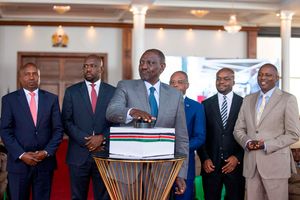
While rejecting the Financing Bill controversially passed by Parliament in defiance of public pressure, President Ruto called for spending cuts to cover the expected shortfalls in revenues, including allocations to the Executive.
The National Treasury building.
Photo credit: Dennis Onsongo | Nation
A circular was dispatched from the National Treasury to all accounting officers directing them to limit spending by 15 per cent of the appropriated budget until a mini-budget is developed. Critics have, however, questioned the implementation of the directive and other austerity measures.
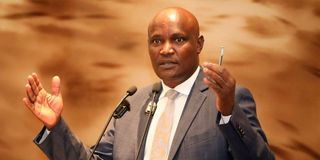
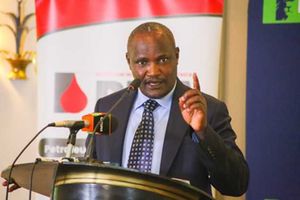
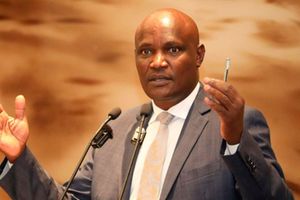
In an interview with the Nation, National Treasury Cabinet Secretary John Mbadi summed up that year as ‘tough’
“It was a tough one. A number of loans were maturing, we had Collective Bargaining Agreements (CBAs) that were also maturing, we had to pay salaries for all the civil servants as usual and we as a government had to tame the high cost of living,” Mr Mbadi said.
He added: “All these had to be done without raising even a single cent in form of taxes because the public was poisoned against hearing anything called tax coming from the government.”
Mr Mbadi, who inherited a cash-strained exchequer facing high debt repayment amidst low tax revenue, said they had to deal with all the emerging situations and keep the economy afloat; painful decisions had to be made, and they had to be made urgently.
“We started by cutting expenditure on non-essentials in government and started rationalising our expenditure across all government entities, this saved us some billions that we used in other pressing areas,” Mr Mbadi said.
To deal with the repayment of Eurobond that Mr Mbadi expressed fear that the government was almost defaulting last year, the CS said the government had to float another Eurobond in order to mitigate the risk of defaulting.
Increased tax revenue in the Finance Bill 2024 was aimed at narrowing the government’s budget deficit, thus reducing the country’s debt vulnerabilities.
“With the Eurobond test now behind us, we started having some space to organise ourselves financially,” Mr Mbadi said.
The next step the CS revealed was to take back to Parliament some of the non-contested clauses in the rejected Finance Bill.
The CS highlighted clauses such as those seeking to reduce tax expenditures and extension of tax amnesty as some of the progressive clauses that were contained in the rejected Finance Bill, which Mbadi says were good for the economy.
“We lost the Finance Bill 2024 but took back some of the non-contested clauses to recover the lost Bill because they were good for the economy. We just improved our communication as a government this time because I remember it was the main issue in the rejected Finance Bill,” Mr Mbadi said.
National Treasury CS John Mbadi when he appeared before the Senate Finance and Budget Committee at the County Hall Nairobi on March 18, 2025.
Photo credit: Dennis Onsongo | Nation
Mr Mbadi also pointed out that the government intervention in critical areas such as manufacturing, construction and mining led to remarkable outcomes in the overall performance of the economy.
In the construction sector, Mr Mbadi said the government settled most of the pending bills for the contractors that have seen growth of the sector from 2.9 per cent to 10 per cent.
In the banking sector, Mr Mbadi said the interest rates have significantly reduced in the last two years, a move he pointed out has given the government some fiscal space on borrowing.
According to the CS, due to the government intervention in the mining sector, it has realised significant growth from the previous -2.9 percent to five percent
Mr Mbadi also cited expenditure consolidation, such as the treasury single account and the launch of e-procurement is also expected to cut down on unnecessary government expenditure.
The CS also pointed out that the government has already settled pending bills totalling Sh70 billion, with the remaining on course to be cleared.
“It is our hope as the government that all the pending Bills will be paid before the end of this year because these are already verified bills. We want to inject money to the economy so that we boost consumption,” Mr Mbadi said.
In this financial year 2025/2026, the government again presented to Parliament what it termed as a zero-based budget in order to attract the wrath of the people going to the streets again.
Zero-based budgeting requires government departments to justify all expenses for each new fiscal year, rather than basing budgets on previous allocations.
The shift is intended to enhance transparency, improve spending efficiency, and ensure that public funds are directed toward priority areas.
National Treasury Cabinet Secretary John Mbadi displays his briefcase before the reading of the National Budget on June 12, 2025.
Photo credit: Sila Kiplagat | Nation Media Group
During the reading of the budget estimates in Parliament this year, Mr Mbadi told the country that the new approach is part of broader fiscal reforms designed to improve budget credibility, reduce deficits, and promote responsible resource management.
He pointed out that previous budgets had drawn criticism for being overly ambitious and out of touch with economic realities.
“There has been public perception and concern in the past that our budgets tend to be unrealistic,” said Mbadi.
“We are looking at a promising 2026, our finances are looking good from where I sit,” Mr Mbadi concluded.