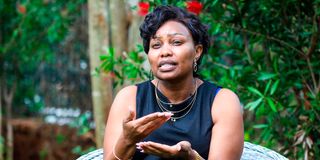
Former nominated Senator Millicent Omanga during an interview at her home in Karen, Nairobi, on March 28, 2026.


Former nominated senator Millicent Omanga has broken her silence on her dramatic political shift, blaming her exit from President William Ruto’s camp on broken promises and what she calls a steady erosion of principles within the government.
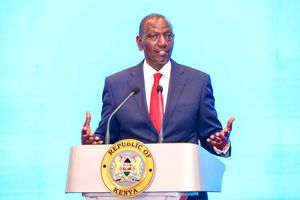
Ms Omanga, a prominent figure in the Kenya Kwanza campaign during the 2022 General Election, says she left President William Ruto’s camp three years ago over what she terms broken manifesto promises.
In an exclusive interview, she claims President Ruto went off course soon after the election, abandoning commitments to women and burdening Kenyans—especially low-income earners—with heavy taxes that eroded their incomes.
She recalls that among the most significant developments were the Women's Charter and the County Economic Forums held across all 47 counties as part of the 'Bottom-Up' economic campaign strategy in the lead-up to the 2022 General Election.
“We had a women’s charter which was signed. During that charter, the President agreed that it would be a 50-50 sharing in his government. He also signed that every girl in a public school would get free sanitary towels. Women delivering in public hospitals would get free diapers. All this was supposed to be done in the first six months, but none of it has been realised," she says.
“Whatever we signed was just for election purposes,” she continues.
“He forgot everything. Linda Mama was removed, and yet it enabled women to get free maternity services.”
She says the government has sidelined women after relying on them for electoral support.
She defended her decision to join Rigathi Gachagua’s Democracy for Citizens Party (DCP) despite being one of the founders of the party that propelled the current administration to power.
She denied that her exit from UDA was driven by nomination politics or fear of competition.
“I don’t think UDA would even have any competition, but this is about principle. I am one of the founders of UDA. The President and I have come from very far. From URP, where I was vice chair, to Jubilee, to UDA. We formed this government together,” she said.
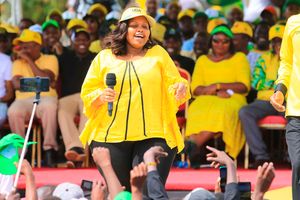
Ms Omanga was a key mobiliser and a visible figure in the Hustler Nation movement and a key player in rallying women behind the Kenya Kwanza coalition.
When asked whether her disagreement with the President was related to the speculations that her contract to supply materials to the State House had been terminated, Ms Omanga said she had never entered into such deals with the government.
“I have never done any business with this government,” she said.
In Nairobi, she emerged as a formidable political force, securing almost 600,000 votes in the race for the position of Woman Representative. This placed her as the first runner-up, a result which she still cites as evidence of her connection to grassroots politics.
“I campaigned for the Hustler Nation,” she says.
“Before the 2022 General Election, we made many promises as a party. I was one of the frontrunners in the elections,” she added.
She describes declining an appointment to the Nairobi Rivers Regeneration Commission as a defining moment that affirmed her commitment to “principle over position.”
“I looked at the mandate of that commission,” she says. “One of the things it involved was demolishing markets and houses along the river banks. I got almost 600,000 votes, and about 40 percent of my voters live in those areas. Sixty per cent of our markets are along that river. So I asked myself, how can I be part of something that will displace the very people who elected me?”
On her assessment of the Kenya Kwanza administration’s performance, Ms Omanga says, “If you ask me to rate it out of ten, I would give it maybe three or four; it does not deserve a re-election.”
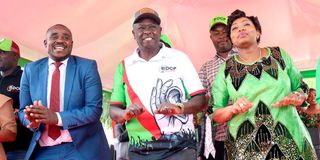
DCP leader Rigathi Gachagua (centre) dances with former nominated Senator Millicent Omanga (right) and deputy party leader Cleophas Malala at the party headquarters in Nairobi on March 19, 2026.
“Kenyans are worse off than they were in 2022; everyone is crying,” she added.
She says economic pressure has intensified across Kenya, hitting civil servants and low-income households hardest.
At the heart of her critique is the housing levy, which she questions over its design and who truly benefits.
She says that advising the President to build affordable houses in rural towns and centres was misguided. She argues that the houses cost more than buying land and building one independently.
In Nairobi, her political focus is taking shape, blending empowerment, accountability and social support, even as she acknowledges the limitations of the Woman Representative’s office.
“There is so much to do, but the office is underfunded. This government does not support women. If you compare the funds allocated to a Woman Representative with those of an MP, the difference is stark,” she said.
Follow our WhatsApp channel for breaking news updates and more stories like this