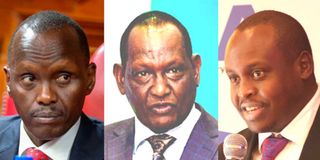
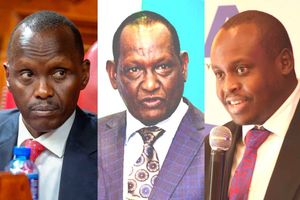
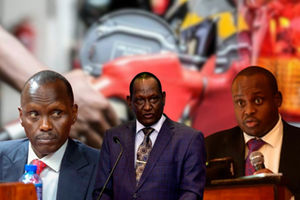
Detectives are racing against the clock to unravel what they suspect could be one of Kenya's most notorious white collar crimes following the arrest of three top energy chiefs.
At stake is more than just criminal culpability; the scandal threatens to destabilise President William Ruto’s flagship Sh106 billion Kenya Pipeline Company (KPC) privatisation and the mechanical integrity of the nation's transport fleet.
The ball started rolling on the night of Thursday, April 2, 2026, while much of Kenya prepared for the Easter long weekend.
Former Energy Principal Secretary Mohamed Liban
The arrests, executed by the Directorate of Criminal Investigations (DCI) and the elite Operations Support Unit, have transformed Mazingira House on Kiambu Road into the epicentre of a national crisis.
Inside the interrogation rooms, detectives are working to dismantle what sources describe as a "Poisoned Well" scheme: a white-collar criminal enterprise allegedly designed to flood the national supply chain with substandard, adulterated fuel.
“Due to volatility occasioned by the conflict (US/Israel war against Iran), the nominated oil marketing companies have been forced to reroute cargoes or undertake ship-to-ship loading to meet the delivery commitment and timelines. Thus, in some instances, the requirement of pre-export verification of conformity may not be feasible within the prevailing situation.
“Therefore, the cargo inspection may not have been done by agents authorised in the Kenya Bureau of Standards (KEBS) system to do a certificate of conformity) at the load port/points,” PS Liban tells Kebs Managing Director Esther Ngari in a March 26 letter.
The men the sleuths targeted for arrest are not faceless bureaucrats: they are the primary gatekeepers of a fuel empire that manages over Sh2 trillion in annual petroleum throughput.
Yet, for each man, the path to the DCI headquarters was marked by institutional warnings that many now argue the nation may have ignored.
Former Kenya Pipeline Company Managing Director Joe Sang.
Photo credit: File | Nation Media Group
Mr Sang is no stranger to the scrutiny of the DCI. In 2018, he resigned amid the Sh1.9 billion Kisumu Oil Jetty scandal.
Though he was acquitted in 2022 — after the court cited a failure to trace specific funding tranches — his reinstatement as KPC chief in early 2023 was met with immediate litigation from the Law Society of Kenya (LSK), which argued the appointment bypassed constitutional merit-based competition. But he surmounted the legal challenge.
Mr Mohamed, the PS who resigned on Saturday, was the lead architect of the Government-to-Government (G2G) fuel deals. While marketed as a solution to dollar-shilling volatility, the G2G framework has faced sustained criticism for jacking up pump prices and empowering handpicked distributors to capture outsized margins.
Finally, there is Mr Kiptoo at EPRA. In June 2023, Auditor-General Nancy Gathungu flagged his appointment as "rotten" during a session with Parliament’s Public Investments Committee.
Former Epra Director-General Daniel Kiptoo during an event in November last year.
Photo credit: File | Nation Media Group
Parliamentary minutes reveal that Mr Kiptoo allegedly presided over the very board meeting that confirmed his own appointment — a move termed "irregular" and a breach of the State Corporations Governance Code.
The question now facing the DCI is whether these gatekeepers were installed to reform the system or to bypass its defences.
In the wake of such high-profile arrests, the public appetite for immediate conviction is high.
However, the legal reality among investigators is one of careful segregation. Under Kenyan law, Sang, Mohamed, and Kiptoo are presumed innocent until proven guilty.
Law enforcement now faces the daunting task of "separating the wheat from the chaff"— determining who among the suspects was a mastermind, who was an enabler, and who may have been an administrative bystander.
Defence teams have already begun framing the crisis as an "operational fog." They contend that the DCI’s "criminal cabal" is actually a technical dispute over fuel specifications in a complex global supply chain.
They argue that a disputed consignment with high sulphur levels is an administrative non-compliance issue rather than a heist.
The investigators, however, are racing against the clock to prove the intent behind vessels allegedly diverted to Mombasa to bypass standard quality checks.
White-collar crime at this level operates through "protocol pirouettes" rather than overt theft. By utilising the G2G framework, billions of shillings in petroleum products flow through a narrow bottleneck managed by the Ministry, regulated by EPRA, and transported by KPC.
Detectives are currently investigating vessels that "mysteriously" diverted from international routes to discharge 60,000 metric tonnes of unscrutinised product into the KPC system.
The "sophistication" of the alleged scam lies in how this "dirty" diesel — often stretched with low-tax kerosene — passed through KPC’s seven ISO-accredited laboratories.
According to insiders, it stems from a level of institutional capture where quality certificates become digital forgeries. If the regulator and the transporter are in alignment, the lab reports cease to be a defense and instead become a mask for the fraud.
While the boardroom arguments focus on "basis points," the physical reality of this scam hits the ground as a "mechanical heart attack."
Adulterated fuel is a slow poison for internal combustion engines. It gums up injectors and scores piston rings, leading to catastrophic engine failure in cars and machines.
For a matatu driver or a rural teacher, a ruined engine is not just a repair bill; it means crippling debts.
A single long-haul truck sidelined on the Northern Corridor can cost an operator Sh500,000 in lost revenue and repairs. This is the "hidden tax" of the cartel: it is collected at the pump and paid for by the poor through inflated grocery prices and lost livelihoods.
The timing of these arrests is a significant blow to the Presidency. In March 2026, the KPC IPO was hailed as a global success—105% oversubscribed, with 70,000 ordinary Kenyans purchasing shares at Sh9 each. President Ruto touts privatisation as the engine of his "Bottom-Up" transformation and a magnet for foreign capital.
However, the IPO data contains a haunting detail: while local retail investors rushed in, non-EAC foreign investors took only 0.02% of the shares.
If the architects of the IPO are now in handcuffs for poisoning the company's core product, the Sh106 billion valuation of KPC is under immediate threat.
For a President who has staked his reputation on luring private investment, this is a moment of reckoning.
As Kenya moves through this Easter weekend, the fuel scandal serves as a litmus test for the nation’s direction. Is the "Economic Lifeline" truly hijackable by its sworn guardians?
“The President notes with grave concern that primary duty bearers responsible for administering the petroleum supply chain may have manipulated data on in-country fuel stocks,” Head of the Public Service Felix Koskei said in a statement on Saturday.
Chief of Staff and Head of Public Service Felix Koskei.
Photo credit: File| Nation Media Group
The investigations at DCI’s Mazingira House will have to do more than build a case; they must illuminate the entire chain of command, from the ministry desks to the private depots.
For the motorist stuck on the highway and the investor watching their shares, the price of failure is absolute. White-collar crime is a betrayal of the "ignition pact"—the silent vow that when a citizen turns the key, the state has ensured the machine will run. If that well remains poisoned, the engine of the nation doesn't just stutter; it seizes.