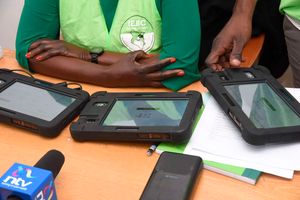
As political alliances begin to take shape, it is the evolving voter arithmetic—across counties and regions — that is emerging as the most critical factor in determining Kenya’s next president.
Data aligned with targets set by the Independent Electoral and Boundaries Commission shows that several counties are poised to register significant growth in voter numbers, potentially altering long-standing political calculations.
If the commission meets its current mass voter registration goals, analysts say, the next election will be decided by how effectively candidates navigate these emerging population centres.
At the heart of this new arithmetic are four “mega counties”—Nairobi, Kiambu, Nakuru and Kakamega — each projected to surpass one million voters. Together, they form a decisive electoral core that could have a bearing on the outcome of the 2027 race.
Nairobi alone is expected to hit over 3.1 million voters, making it the country’s largest and most competitive battleground. Its diverse, youthful and increasingly issue-driven electorate places it at the centre of any serious presidential strategy.
Kiambu and Nakuru, which played a critical role in the 2022 victory of President William Ruto, are also expected to see substantial growth. Any shifts in voter sentiment within these counties could significantly impact the incumbent’s re-election prospects.
President William Ruto speaks during the opening of the 19th Ambassadors Conference at Safari Park Hotel in Nairobi on March 28, 2026.
Photo credit: Bonface Bogita | Nation
Meanwhile, Kakamega anchors the Western region’s growing numerical strength, reinforcing its importance in Dr Ruto’s calculations in the wake of his coalition plans with ODM Party.
Combined with neighbouring counties such as Bungoma and Busia, the region presents a formidable voting bloc capable of shaping national outcomes should president Ruto’s camaraderie with ODM, and working relationship with Musalia Mudavadi, Moses Wetang’ula stand.
Beyond these mega counties, traditional regional blocs remain influential. The Mt Kenya region, Rift Valley, Nyanza, Coast and Northern counties continue to hold significant voting power, but their internal dynamics are evolving amid new political alignments.
Crucially, Political analyst Prof Gitile Naituli says, the influx of new voters—particularly young Kenyans registering for the first time—adds an unpredictable dimension to the race.
These voters, he says, are less bound by historical loyalties and more responsive to contemporary issues, making them a key target for all candidates.
Fresh voter projections, if realised by the IEBC, point to a dramatically expanded and redistributed electorate that could redraw the country’s political battlegrounds and redefine the path to State House.
A look back at the 2022 contest between Dr Ruto and the late Raila Odinga offers critical insight into how these new numbers could tilt the scales.
The 2022 presidential election was one of the closest in Kenya’s history. Dr Ruto won narrowly, securing 7,176,141 votes (50.49 percent) against Mr Odinga’s 6,942,930 votes (48.85 percent) in the results announced by then IEBC chairman, the late Wafula Chebukati.
The victory hinged not only on raw numbers but also on regional dominance and strategic penetration into opponent strongholds.
Dr Ruto’s path to victory was built on overwhelming support in the Rift Valley and Mt Kenya, coupled with significant inroads in regions such as Western and parts of the Coast.
In contrast, Mr Odinga maintained his traditional strongholds in Nyanza, parts of Western, and the Coast, while also making gains in urban centres like Nairobi. But the most decisive factor was Mt Kenya.
The region delivered a near bloc vote for Dr Ruto, with counties like Kiambu, Murang’a, Nyeri and Kirinyaga posting some of the highest margins in his favour. This single voting bloc effectively neutralised Mr Odinga’s dominance in Nyanza and parts of Western.
Fast forward to 2027, and the numbers tell a story of expanding electoral stakes.
Four counties—Nairobi, Kiambu, Nakuru and Kakamega—are projected to each have over one million voters, forming what analysts describe as the “mega bloc core” of the next election. Combined, these counties alone account for over 7 million voters, a figure that rivals entire regional blocs.
From left: Azimio bigwigs Wiper leader Kalonzo Musyoka, the late Raila Odinga, and former President Uhuru Kenyatta during an Interdenominational prayer service for victims of police brutality at SKM Centre in Karen on July 28, 2023.
Photo credit: File | Nation Media Umoja
In 2022, Nairobi was split, with Mr Odinga enjoying a slight edge over Dr Ruto, who was backed by Democracy for the Citizen’s Party leader Rigathi Gachagua. Mr Odinga had the backing of former president Uhuru Kenyatta and Martha Karua as his running mate.
At present, Mr Gachagua, Mr Kenyatta and Ms Karua have joined hands with other opposition figures including Kalonzo Musyoka, Fred Matiang'i, Justin Muturi and Peter Munya in a bid to wrestle the top seat from Dr Ruto.
There are also other players such as Safina Party Leader Jimi Wanjigi, former Chief Justice David Maraga and Busia Senator Okiyah Omtatah, while Nairobi Senator Edwin Sifuna appears to be drifting towards the united opposition.
“We as the United Opposition are yet to name our presidential flag bearer because we are still consulting and there is also a new kid on the bloc—Sifuna and his team. We have to talk to them and see the next steps they are making,” the opposition’s spokesperson Dr Mukhisa Kituyi told Sunday Nation.
Despite falling out with Mr Gachagua, Dr Ruto is leveraging on his deputy Kithure Kindiki among other Mt Kenya leaders like Kirinyaga Governor Anne Waiguru, and maintaining a strong presence in Mt Kenya.
“Today I am the President because of the support you, the people of the mountain, gave me. We agreed on specific programmes that I was to implement, and I want to assure you that I will not let you down,” he told the region in Nyeri this week.
Looking ahead to the next election, Dr Ruto said leaders would be judged on their track records.
“In 2027, every leader will come back to you with what they have done. I will demonstrate that I have built roads, hospitals and improved education for our children. You will decide who deserves another term,” he said.
“Their main focus is one term—‘Kasongo must go’. They have no other agenda. Come 2027, Kenyans will judge leaders based on development, not political rhetoric. Some people are trying to create a wedge between me and the people of this region, but you should not allow them to succeed,” he said.
Kiambu and Nakuru, both key to Dr Ruto’s 2022 victory, are expected to see massive voter growth, and any erosion of support there could weaken his re-election bid.
Kakamega remains a traditional opposition stronghold, though Dr Ruto’s alliance with leaders such as Musalia Mudavadi and Moses Wetang’ula could shift dynamics.
The Mt Kenya bloc—projected at about 5.7 million voters—remains the single most valuable electoral prize. However, the rapprochement between Mr Kenyatta and Mr Gachagua threatens to fracture the region’s previous unity behind Dr Ruto.
“If even a fraction of Mt Kenya vote bloc shifts away from Dr Ruto, the impact could be decisive,” said Prof Gitile Naituli.
At the same time, Dr Ruto’s Rift Valley base, projected at 7.1 million voters, remains formidable, though changing demographics in counties like Kajiado and Narok could introduce new competition.
The Nyanza bloc is projected at 2.78 million voters, while Western stands at 2.85 million. In 2022, Mr Odinga dominated these regions, but his absence introduces uncertainty and opens space for new alignments, with Dr Ruto leveraging on his coalition with Dr Oburu Oginga-led ODM Party.
The Coast and Nairobi are emerging as critical swing zones, with growing voter numbers and shifting loyalties.
One of the most significant variables in 2027 is the influx of new voters. Nairobi alone is expected to add nearly 700,000, followed by Kiambu, Nakuru and Kakamega.
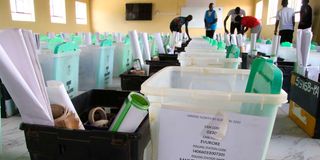
Kenyan voters wait in line to cast their ballots on August 9, 2022.
Photo credit: File | Nation Media Group
These voters are largely young and less tied to ethnic voting patterns, making them a decisive force.
Key battleground counties include Nairobi, Kiambu, Nakuru, Kakamega, Bungoma, Kajiado, Narok, Mombasa and Kilifi.
“These counties are not just large—they are competitive,” said advocate Chris Omore, noting that winning requires not just numbers but also geographic spread.
Kenya’s electoral system demands 50 percent plus one and at least 25 percent of votes in 24 counties—a balance Dr Ruto achieved in 2022.
In 2027, the expanded voter base raises the stakes.
“A candidate cannot rely solely on regional dominance; they must build a national coalition,” Mr Omore said.
While Dr Ruto enters the race with incumbency advantage, the changing voter map presents both risks and opportunities.
For the opposition, unity and strategic targeting of key battlegrounds will be critical, says Prof Naituli.
A December 2025 poll by Infotrak showed public disapproval of potential presidential candidates including president Ruto who polled less than a third.
The survey by Infotrak indicated that Dr Ruto commands a 28 per cent popularity rating, followed by former Interior Cabinet Secretary Fred Matiang’i (13 per cent), Wiper Patriotic Front’s Kalonzo Musyoka (12 per cent), Embakasi East MP Babu Owino (7 per cent), former deputy president Rigathi Gachagua (5 per cent), People's Liberation Party (PLP)’s Martha Karua (2 per cent) and former Chief Justice David Maraga (2 per cent), among others.
The report indicated that 27 per cent of Kenyans polled were undecided on whom to vote for as President, throwing the race wide open, even as a united opposition force poses a huge threat to Dr Ruto, polling over 40 percent, a clear path to a potential run-off if elections were called today.
President Ruto commanded a lead in six out of the eight regions, the highest being in North Eastern (76 percent) with Dr Matiang’i beating him narrowly in Central Kenya after polling 17 percent against the president’s 14 percent, while Mr Musyoka also led the president in Eastern, polling 20 percent against Dr Ruto’s 17 percent.
Presidential hopeful Dr Fred Matiang'i
Photo credit: File | Nation
Interestingly, both president Ruto and Dr Matiang’i of Jubilee party who is being fronted by former president Kenyatta, beat Mr Gachagua in Central Kenya.
The former deputy president managed 13 percent in Central Kenya, his highest support base, in the poll conducted between December 19 and 20, 2025.
The emergence of Babu Owino, a member of the Linda Mwananchi camp, to secure position four in the overall poll after Dr Ruto, Dr Matiang’i, and Mr Musyoka, even beating Mr Gachagua, also elicited debate.
Dr Ruto’s win against Dr Matiang’i in the former Interior CS’s Nyanza backyard also reaffirmed the Head of State’s growing support under the broad based government, where he has received the late Raila’s ODM party backing under Siaya Senator Dr Oburu Oginga.
In Nyanza, president Ruto polled 30 percent against Dr Matiang’i’s 18 percent.
Another poll by TIFA indicated that Kenyans are cautiously optimistic—but deeply divided— about the opposition’s ability to unite behind a single presidential candidate in 2027.
“Voters are watching behaviour, not declarations—alliances will only be believed once formalised,” said TIFA.