Members of Parliament are plotting to re-introduce academic qualifications for aspirants seeking various elective positions in the 2027 General Election, requirements that were quashed by the court four years ago.
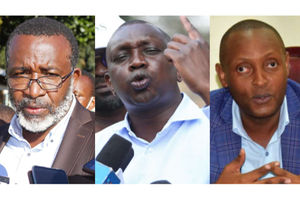
Ugenya MP David Ochieng has vowed to introduce amendments to the Elections Act to set a minimum education requirement for each elective seat.
During the debate on the Elections (Amendment) Bill, 2024, Mr Ochieng argued that it is not discriminatory to require a basic level of education for those seeking elective seats.
In his proposal, the lawmaker wants those seeking to be Members of the County Assembly to have at least a Class Eight level of education and also be subjected to Kiswahili and English proficiency tests before being allowed on the ballot.
Mr Ochieng decried the lack of meaningful debate in many county assemblies across the country, saying MCAs have no capacity to debate.
“We have MCAs who only talk in funerals; they cannot contribute to any debate in the County Assemblies. You can never hear that a county assembly had a robust debate because people at the county assembly have no capacity to debate, speakers are negotiated, and they have no capacity to guide debate,” Mr Ochieng said.
“We must have some basic education requirements for elected leaders. I would be introducing an amendment for this; let someone go to court again. Things have to be done properly in this country,” he added.
Ugenya MP David Ochieng' during a past event.
Photo credit: File | Nation Media Group
Mr Ochieng pointed out that MCAs without adequate education cannot undertake meaningful oversight over the governor.
For those seeking to be MPs, they will be required to have at least a diploma, while governors will be required to have degrees.
“We are running a country where we are told you can be in any elective position without any level of basic education. It’s a terrible situation; that is why sometimes Parliament is empty, because some members have nothing to say, they didn’t go to school. That’s the truth and it’s not fair to the country. We cannot run a Parliament where anybody can walk in,” Mr Ochieng said.
“How do you have a vibrant Parliament that discusses issues affecting the people when everybody can come to Parliament? Even if he didn’t go to Class One. It’s wrong,” he added.
Kinangop MP Kwenya Thuku supported calls to introduce the academic qualification, terming the current situation, where there is no academic requirement, unfortunate.
“We must cap and have a level of education so that we don’t have people in Parliament who don’t understand even the basic procedures of the House,” Mr Thuku said.
Mr Thuku said those elected to any position should also undertake mandatory training on nationalism.
Members of the National Assembly follow proceedings during a past session.
Photo credit: File | Nation Media Group
The Bill is among the proposed legislation that emanated from the National Dialogue Committee (NADCO).
The Bill, as passed by the Senate in 2024, does not introduce any form of academic qualifications.
The new amendments re-introducing academic qualifications are set to generate debate on whether those who possess academic qualifications make better leaders.
The High Court on April 13, 2022, quashed the degree requirement for elective positions, following five consolidated petitions challenging the university degree requirement, which the electoral commission had been preparing to enforce in the August 2022 elections.
Justice Anthony Mrima declared the degree requirement unconstitutional and nullified the law — Section 22(1)(b)(i) of the Elections Act — requiring parliamentary candidates to hold university degrees.
He found that Parliament had not adequately consulted the public before introducing the requirement. He also found that the law violated constitutional rights to equality, political participation and protection of minorities and marginalised groups.
The requirement was introduced through the Elections Laws (Amendment) Act, 2017. Justice Mrima said Parliament had not properly consulted Kenyans, experts and other stakeholders before passing it. He therefore declared the provision invalid and ruled that a university degree was no longer required to contest an MP seat.
The position was confirmed recently by a member of the Independent Electoral and Boundaries Commission (IEBC). Commissioner Ann Nderitu said last month that the commission has no legal basis to demand a degree for those offices.
“We do not have the degree requirement anywhere,” Ms Nderitu said in a television interview. She said the position followed court decisions that invalidated the statutory degree requirement.
The legal battle over the degree requirement centred on Section 22(1)(b)(i) of the Elections Act, introduced through the Elections Laws (Amendment) Act, 2017. It made a university degree a condition for nomination to Parliament.
In 2012, Parliament amended the Elections Act after an earlier court decision struck down a previous education requirement. The 2017 amendment then introduced the university-degree threshold for MPs and MCAs.