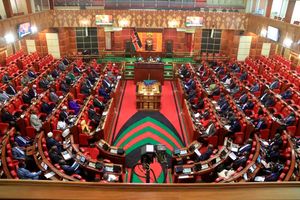
Members of Parliament have called for a reality check on the government’s proposed Sh4.82 trillion budget for the fiscal year 2026/27, warning that the current uncertainty in the Middle East and soaring fuel prices make the financing of the ambitious expenditure plan unsustainable.
Members of the National Assembly Committee on Finance and National Planning noted that failure to scale down the budget will throw Kenyans under the weight of enhanced borrowing.
They noted that the escalating Middle East conflict involving the US, Israel, and Iran has disrupted global supply chains, and skyrocketing fuel costs are hitting Kenya’s revenue streams hard.
The MPs expressed their apprehension during a hearing of budget estimates for the National Treasury.
The legislators’ doubts, amid the Sh1.11 trillion budget deficit and the soaring public debt repayment obligations, among others, are proving a hard nut for the government to crack.
The National Treasury office building.
Photo credit: File | Nation Media Group
Already, the National Treasury has revealed that it has scaled down its economic growth forecast for the 2026/27 period from 5.3 percent, before the Middle East tension, to 4.8 percent after the Gulf situation showed no signs of easing.
“It is possible to have a budget that reacts to the reality of life,” said Molo MP Kuria Kimani, who chairs the committee.
Details from the Central Bank of Kenya (CBK) show that the country’s public debt is almost crossing the Sh13 trillion mark, occasioned by increased borrowing, largely from the local market, to plug budget deficits on account of revenue shortfalls.
Butula MP Joseph Oyula, a former Financial Secretary at the National Treasury before briefly serving as acting Permanent Secretary in May 2004, also weighed in.
“The National Treasury has no choice but to relook into the budget,” said Mr Oyula.
“The situation in the country is gloomy. We cannot pretend by budgeting as usual,” the Butula MP added.
The Strait of Hormuz, a key transit point that transits 20 percent to 25 percent of the world’s fuel supply, is experiencing an acute crisis with shipping traffic reduced to a trickle following its blockade following the war.
The blockade, which has forced oil prices to skyrocket, was a response to the US-Israel military action prompted by the killing of Iran’s supreme leader, Ayatollah Ali Khamenei, on February 28, 2026.
The country’s planned expenditure in the next financial year is an increase compared to the Sh4.6 trillion budgeted for the current fiscal year and exceeds the Budget Policy Statement (BPS) expenditure projections as approved by the National Assembly in March this year, by 64 billion.
The government’s 2026/27 expenditure plans are premised on revenue projections of Sh3.63 trillion in ordinary revenue and Sh644 billion in Appropriation in Aid (AiA).
This leaves a fiscal deficit of Sh1.11 trillion, about 5.3 percent of the GDP, to be financed in a borrowing mix of 995.7 billion in local borrowing and Sh145.6 billion in external borrowing.
The Central Bank of Kenya.
Photo credit: File
Details from the National Treasury and Central Bank of Kenya (CBK) reveal that in the last 13 years, the Kenya Revenue Authority (KRA) has never hit the right targets in terms of revenue mobilisation.
Mr Oyula and his Homabay Town colleague Peter Kaluma noted that KRA is unlikely to meet the revenue targets this year and the next fiscal period, “given the global economic shocks that have affected Kenya.”
“On the two days of strike this week occasioned by transport operators withdrawing their vehicles, the government did not collect revenue because people did not go to work,” says Mr Oyula, adding, “the National Treasury needs to come up with a budget proposal, which the country can manage.”
According to Mr Kaluma, KRA targets are never met, “and certainly not in the foreseeable future.”
“I don’t understand this ambitious expenditure plan,” said Mr Kaluma.
“Despite the global constraints, the National Treasury still increased the budget estimates compared to the BPS that we approved in the House,” said the Homabay Town legislator.
Mr Musa Kathanje, the Director, Macro and Fiscal Affairs at the National Treasury, says that before the situation in the Gulf region erupted, leading to the blockade of the Strait of Hormuz, the economic growth had been projected at 5.3 percent.
This was later revised to 5 percent after the war erupted, but with the hope that the situation would ease.
However, with no indication that the war will come to an end any time soon, despite a fragile ceasefire, the economic growth projection was further reviewed to 4.8 percent.
“The revision in economic growth is largely dependent on the activities in the Strait of Hormuz,” said Mr Kathanje.
Times Tower in Nairobi, the headquarters of the Kenya Revenue Authority (KRA).
Photo credit: File | Nation Media Group
The KRA, which has been undergoing a leadership friction this week, saw former Industrialisation Cabinet Secretary Adan Mohamed appointed its Commissioner-General, replacing Humphrey Wattanga amid petitions filed at the High Court challenging the appointment.
Despite the revenue mobilisation underperformance concerns, KRA says that unless it is well-funded, revenue targets will continue to be mirages.
“Meeting revenue targets is closely linked to funding. We have the energy and the will to meet the targets,” said a KRA officer, who did not want to go on record because he does not speak for the taxman.
In the next financial year, KRA has been allocated Sh37 billion against a resource requirement of Sh50.6 billion that was submitted to the National Treasury. The allocation falls short of the provisions in the law.
Section 16 of the KRA Act states that KRA funds shall consist of such amount, “not exceeding 2 percent of the revenue estimated in the financial estimates for each financial year to be collected by the authority under this Act as may be determined by the Cabinet Secretary in charge of the National Treasury in each financial year.”
The law further states that KRA funds “shall also consist of 3 percent of the revenue actually collected in each successive three-month period in the financial year in excess of the amount estimated to be collected in respect of that period.”
But with KRA rarely meeting its quarterly targets, this provision therefore carries no relevance.