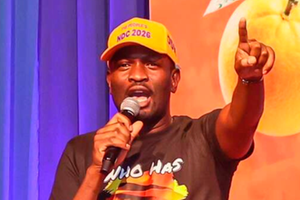
The Orange Democratic Movement (ODM) has demanded a central role in the compensation of victims of police brutality and human rights violations arising from protests between 2017 and 2025, arguing that its supporters and members bore the greatest burden of State crackdowns during years of political agitation.
The party's National Executive Committee (NEC) has resolved that while the compensation exercise should proceed expeditiously and transparently, ODM must be fully involved in identifying and verifying beneficiaries to ensure fairness and accountability.
In a resolution adopted by the party, ODM said the process of compensating victims of excessive police force, as recommended under the National Dialogue Committee (Nadco) framework, should be conducted judiciously and with full disclosure of beneficiaries.
Azimio leader Raila Odinga holds a copy of a copy of Nadco report flanked by Wiper Party Leader Kalonzo Musyoka, Majority leader Kimani Ichung’wah and other leaders at Capital Hill.
Photo credit: File | Nation Media Group
“The ODM Party should be fully involved in the exercise to ensure transparency since it is the most aggrieved in most cases,” the party resolved, directing its parliamentary leadership to play an integral role in the compensation process alongside relevant state agencies.
The demand comes as the government rolled out a Sh2 billion compensation programme targeting victims of human rights abuses committed during demonstrations and political unrest over the past eight years.
The exercise follows recommendations arising from bipartisan talks between President William Ruto and the late former Prime Minister Raila Odinga after the political tensions that rocked the country in 2023.
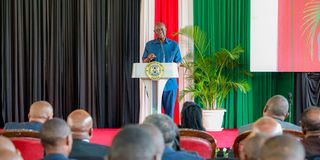
ODM Party Leader Oburu Oginga on Wednesday hosted Prof Makau Mutua and other members of the Panel of Experts on Compensation of Victims, where the team briefed the party leadership on progress made in implementing the programme.
Speaking during the meeting, Dr Oginga described the compensation initiative as a significant milestone in Kenya’s long search for justice and reconciliation.
He recalled his own experiences as a victim of police violence and said many Kenyans had endured similar suffering for decades without acknowledgment or redress.
“It is because of these shared scars that I am profoundly grateful to the President for taking this bold, historic step to finally tackle the issue of national reparations,” Dr Oginga said.
He cited the compensation of the mother of Baby Pendo as one of the first major achievements of the programme, describing it as a step toward healing for victims and their families.
Baby Pendo became one of the most prominent symbols of police brutality after she died following a police operation in Kisumu during the 2017 post-election period.
Her case has since featured prominently in discussions on accountability and justice for victims of state violence.
ODM leaders maintain that many of the people who lost their lives, suffered injuries or endured economic hardship during demonstrations over the years were supporters of opposition movements associated with the party.
The party argues that its participation is therefore necessary to ensure genuine victims are not excluded from the compensation process.
Addressing the ODM leadership, Prof Mutua described the compensation programme as a historic national undertaking aimed at helping Kenya confront decades of unresolved grievances linked to political protests and state violence.
He said the initiative seeks not only to compensate victims but also to begin a broader process of national healing and institutional reform.
“This is a singular occasion for the country. It is historic. It is unprecedented,” he said.
According to Prof Mutua, the roots of the compensation exercise stretch far beyond the recent Gen Z protests and encompass a long history of state violence against citizens exercising democratic rights.
President William Ruto (Centre) leading other government leaders display the Kenya National Commission on Human Rights (KNCHR) report on the Framework for Reparations for Victims of Human Rights Violations during its official presentation at State House, Nairobi, on June 15, 2026.
Photo credit: Lucy Wanjiru | Nation Media Group
He pointed to incidents such as the 1969 Kisumu massacre, the Wagalla massacre and numerous violent confrontations between protesters and security agencies over the years.
Prof Mutua argued that Kenya's democratic journey has often been marked by bloodshed whenever citizens attempted to exercise their constitutional rights to assemble, demonstrate and petition.
Article 37 of the Constitution guarantees Kenyans the right to peaceful assembly, demonstration, picketing and petitioning public authorities.
However, the implementation of those rights has frequently resulted in clashes with law enforcement agencies, leading to deaths, injuries, disappearances and destruction of property.
The scholar said compensation should be viewed as part of a broader transitional justice framework rather than an alternative to accountability.
“Compensation does not vacate accountability. It does not excuse bad conduct by anyone in this country, including our law enforcement,” he said.
He emphasised that State institutions and individual officers responsible for violations must still be held accountable under the law.
At the same time, Prof Mutua noted that citizens exercising their constitutional rights also have a responsibility to avoid criminal acts such as looting, destruction of property and violence.
The compensation programme emerged from recommendations contained in the NADCO report, which sought to address long-standing political grievances and strengthen democratic governance following months of political tensions.
An 18-member panel appointed by President Ruto played an advisory role in developing the framework and guiding implementation.
The Kenya National Commission on Human Rights (KNCHR) had been tasked with receiving, investigating and verifying claims from victims.
KNCHR Chaiperson Claris Ogangah with Javas Bigambo, the vice chair of the Committee to Oversee the Implementation of the Ten-Point Agenda and National Dialogue Committee (Nadco) report, at the KNHRC offices in Nairobi on March 16, 2026.
Photo credit: Lucy Wanjiru | Nation Media Group
According to figures released during the launch of the programme, KNCHR received 1,937 claims covering incidents between 2017 and 2025.
Out of those claims, 1,101 cases have so far been verified.
The violations under consideration include extrajudicial killings, torture, enforced disappearances, abductions, sexual and gender-based violence, illegal evictions, destruction of property and loss of livelihoods.
While receiving the report, President Ruto described it as the beginning of a national journey toward acknowledging historical injustices.
“A nation does not heal by choosing whose pain matters. It heals by acknowledging all suffering, pursuing justice for all and committing itself to doing better,” the President said.
The Head of State announced that the government had allocated Sh2 billion for compensation, while acknowledging that no amount of money could fully compensate families for lost loved ones.
“The Sh2 billion we have committed cannot replace a son or a daughter. It cannot restore years lost to trauma,” he said.
Dr Ruto maintained that the compensation fund should not be interpreted as a reward for violence or criminal conduct sometimes witnessed during demonstrations.
Instead, he said, it represents a recognition that citizens suffered harm while exercising constitutional rights and deserve acknowledgment and support from the State.
Beyond financial compensation, the government is also pursuing reforms aimed at preventing future violations.
Prof Mutua revealed that the panel is working with stakeholders to draft legislation that would operationalise Article 37 and provide clearer guidelines on the conduct of demonstrations.
The team is also preparing a police training manual designed to improve management of public protests and strengthen respect for human rights.
The proposed reforms seek to address one of Kenya’s most persistent governance challenges — the recurring cycle of protests, police crackdowns and political violence.
Supporters of the programme argue that compensation alone will not solve the problem unless accompanied by legal and institutional changes.
For ODM, however, the immediate focus remains ensuring that victims linked to the party’s long struggle for political reform receive recognition.
Party officials argue that from the era of Jaramogi Oginga Odinga through Raila Odinga’s opposition campaigns and recent anti-government protests, ODM and its political predecessors have consistently been at the forefront of struggles for democratic freedoms.
Many of those confrontations left a trail of deaths, injuries and economic losses among supporters.
That history, ODM leaders say, justifies the party’s insistence on participating in the compensation process.
The compensation programme also carries political significance as it forms part of the broader cooperation framework between ODM and the ruling Kenya Kwanza administration.
The initiative is among key deliverables emerging from the working relationship forged between President Ruto and the late ODM leader Raila Odinga following the NADCO talks.
While critics have questioned aspects of the arrangement, supporters view the compensation scheme as one of the tangible outcomes capable of delivering justice to affected families.
As payments begin to reach beneficiaries, attention is now shifting to how transparently and inclusively the process will be conducted.
ODM’s demand for direct involvement underscores concerns that any perceived exclusion or irregularities could undermine public confidence in the programme.
For the families who lost loved ones, suffered injuries or saw their livelihoods destroyed during years of political unrest, the success of the initiative may ultimately be measured not by the amount of money disbursed but by whether it delivers recognition, accountability and a sense of closure.
With the first compensation payments already underway and more claims under review, Kenya has embarked on what many hope will be a historic attempt to reconcile with one of the most painful chapters of its democratic journey.