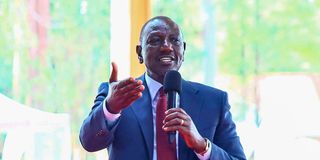
President William Ruto has formally restructured the panel of experts for compensating victims of State excesses into an advisory body following a High Court ruling that declared its original mandate unconstitutional.
The court had found the initiative improperly encroached upon the statutory functions of the Kenya National Commission on Human Rights (KNCHR).
As a result, the government has issued a special Gazette Notice dated January 5, 2026, amending the terms of reference for the Panel of Experts on Compensation of Victims of Demonstrations and Public Protests, revoking its authority to verify victims or design compensation frameworks.
The reconstituted panel will now solely advise the President on reparations based exclusively on KNCHR reports.
The notice states the panel's revised mandate as: "...to advise the President on the lawful and constitutional implementation of the reparations framework for victims of public protests and riots, based upon a report prepared by the Kenya National Commission on Human Rights."
The change follows a December 4, 2025, High Court judgment that faulted the Executive for establishing a parallel structure to handle compensation for victims of protest-related violence.
The court held that while the President has a constitutional duty to promote human rights, he cannot assign that role to a body that duplicates the functions of an independent constitutional commission.
The amended gazette notice also extends the panel’s lifespan by 180 days, signalling the government’s intent to retain a coordinating mechanism even as it retreats from the broader authority initially claimed.
The legal challenge originated from an August 2025 presidential proclamation establishing an 18-member panel during widespread public outcry over police violence during protests, including lethal clashes during June 2024's Gen-Z demonstrations against the Finance Bill.
The panel had been tasked with victim verification, claim categorisation, compensation proposals, and policing reform recommendations.
Civil society organisations, legal professionals, and victims' representatives swiftly contested the panel's creation.
They argued it duplicated KNCHR's role, circumvented the Victims Protection Board, and potentially enabled unconstitutional expenditure of public funds. Petitioners further questioned the Executive's legal authority to administer compensation schemes involving accountability for state-sponsored violence.
In court filings, KNCHR leadership opposed the presidential panel, warning it would "usurp and undermine" the commission's constitutional mandate while creating redundant bureaucracy. The commission emphasised Kenya's existing legal redress framework under the Constitution, KNCHR Act, and Victims Protection Act.
The court partially upheld these arguments, suspending the panel's operations and ordering mandate revisions to respect KNCHR's role.
It directed the commission to "take steps to secure appropriate redress where redress is required," clarifying that victim compensation constitutes a constitutional obligation rather than discretionary executive action.
The judgment distinguished between executive coordination and constitutionally assigned mandates, affirming KNCHR's exclusive authority under Article 59 to receive complaints, verify victims, and secure redress for rights violations. The court cautioned that parallel mechanisms risk compromising Chapter Fifteen institutions' independence.
Head of Public Service Felix Koskei.
Photo credit: File| Nation Media Group
The fresh Gazette Notice issued by the Chief of Staff and Head of the Public Service, Felix Koskei, is the government’s formal response to that directive.
It deletes the panel’s earlier power to design and run a compensation framework, replacing it with a narrower advisory role anchored on KNCHR reports.
It also requires the panel to act “in strict compliance with the Constitution and all applicable laws” and to collaborate with relevant public bodies where necessary.
“It is necessary to give effect to the said Judgment so as to ensure that measures for the reparation and compensation of victims of demonstrations, public protests, and riots are implemented in a manner consistent with the Constitution and other laws,” reads the notice.
By extending the panel’s term, the Executive appears keen to keep a coordinating structure alive, even as it retreats from the more ambitious powers originally claimed.
While officials maintain the objective remains national healing and reparations for post-2017 victims—including civilians and security personnel—the court emphasised constitutional mechanisms cannot be superseded by benevolent intentions. It stressed that redress processes must operate through institutions insulated from executive influence to maintain accountability and credibility.
With the revised framework operational, focus shifts to KNCHR's capacity to conduct timely, credible compensation processes.
For protest violence victims awaiting years-long acknowledgement and relief, protracted litigation has delayed justice. The court's intervention now locates this responsibility within its constitutional framework.