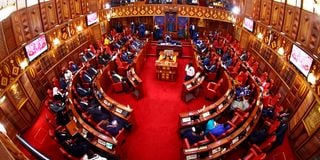
Senators have vowed to resist attempts by the National Treasury to compel all 47 counties to adopt a centralised revenue management system. They cite its ineffectiveness, as well as instances where national government agencies have financially undermined devolved units.
Instead, the Senate's Standing Committee on Information, Communication and Technology, chaired by Trans Nzoia Senator Allan Chesang, has said that it will push for counties to establish their own effective revenue collection systems.
During a fact-finding mission in Kiambu, the senators praised the county's revenue collection system after it grew its collections from Sh2.9 billion in 2022 to Sh5.45 billion in the 2024/25 financial year.
Mr Chesang and his committee admitted that the Senate had initially supported the Treasury's proposal for a unified system, given that many existing county systems were ineffective and prone to abuse.
The proposed Public Finance Management (Integrated County Revenue Management System) Regulations of 2025 seek to introduce a digital platform to automate the collection of fees, levies, charges and taxes in counties, with the aim of improving efficiency and transparency.
“But we are now changing our approach. We will advocate for each county to develop its own secure and foolproof revenue system. With good leadership, counties can run their own systems effectively, and other counties should benchmark with Kiambu,” he added.
Governor Kimani Wamatangi told senators that when he assumed office in 2022, Kiambu was using three privately owned systems to collect revenue on behalf of the county—one for business permits, another for car parking and a third for land rates and physical planning fees.
According to him, the arrangement was porous and facilitated theft at the point of collection.
This prompted his administration to terminate the private contracts and replace them with a county-owned Enterprise Resource Planning (ERP) system that automates all revenue streams and services.
“In one case at the Thika slaughterhouse, a client paid Sh20,000 through the system. But when the report came back, only Sh16,000 had been deposited into the bank. The missing Sh4,000 could not be accounted for since the county had no control over the system,” Mr Wamatangi said.
Following such incidents, the county developed its own comprehensive ERP platform, which will eventually be managed by the county's ICT department.
Kiambu says its reforms have bolstered own-source revenue by 86 percent in two years—reaching Sh5.45 billion—without raising any fees or levies.
The ERP system has automated key county services including revenue management and reporting, unified trading licenses, market cess, parking, slaughterhouse charges and liquor licensing.
It also integrates health services through the Hospital Information Management System (HMIS), human resources management, fleet management, land management, and development approvals.
Nominated Senator Beatrice Ogola warned that the Treasury’s plan to place all counties under a centralised system would undermine devolution.
“Placing own-source revenue under Treasury is akin to killing devolution. Counties will remain at the mercy of the national government, just like under the Kenya Revenue Authority. Whenever KRA demands delayed tax remittances, they often withhold funds, yet counties need that money for salaries and essential services like medical supplies. A centralised system would be detrimental to devolution,” she said.