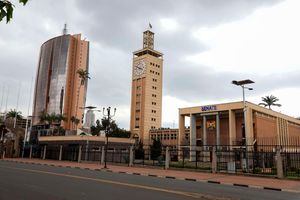
The world is struck mute by President William Ruto’s blistering attacks on Parliament as a den of corruption. The President has gone high-pitch on rhetoric and ridicule. Addressing the Annual Devolution Conference in Homa Bay on August 13, he lampooned Parliament as “chambers of corruption.”
A week later, the President insisted that “corruption was ruling Parliament,” claiming MPs were demanding Sh10 million to pass bills while Senators were demanding as much as Sh150 million from governors facing impeachment.
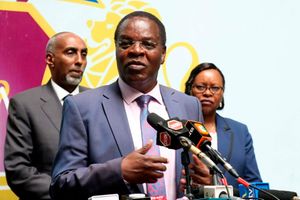
The next day, on August 19, he set up a new Multi-Agency Team on War Against Corruption (MAT), likely to focus on Parliament. But is this a genuine all-out war on graft, or simply a strategic move to weaponise the war of corruption within the wider 2027 election chess-game?
Kenya is at the crossroads. The President’s assault on Parliament reveals the unfinished war against state capture. Twenty-four months ahead of the August 10, 2027 elections, the battle lines in the fierce struggle for the soul of Kenya are drawn.
The vast majority of Kenyans are defending the people-centred state model provided for by the Constitution, which envisages a functioning state impartially delivering public goods and serving the interests of all Kenyans without the stifling control or manipulation by private interests. In this pristine state, all citizens are equal under the law, choose and hold their leaders responsible for their actions and policies and regulations benefit the public rather than serving the interests of a select few.
A small influential power elite is, unwittingly, entrenching the twin menace of ‘state capture’ and ‘elite capture.’ The line dividing the two concepts is visibly thin, highlighting the strategies of various actors. In state capture, actors fall into two main categories. One are ‘the captors,’ including non-state actors such as business tycoons, political interest groups, and professional enablers.
The others are “the captured”—the state institutions such as the Executive, Parliament, Judiciary, and public sector agencies. In ‘elite capture,’ actors are more diverse. They include domestic elites such as politicians, bureaucrats, business leaders, wealthy individuals, securocrats (military, intelligence and police establishments), and even intellectuals in cahoots with international actors.
In Kenya, as elsewhere, actors involved in both ‘state capture’ and ‘elite capture’ have used their immense power and influence to shape laws, policies, regulations, decision-making processes while using public resources for their own priorities and benefit, rather than for the good of all Kenyans. This results in systemic corruption, erosion of the rule of law and public trust, weak institutions, greater inequality and marginalisation of citizens.
High-level corruption linked to state capture and elite capture is an existential threat to development and stability. Kenya has been losing one-third of its budget, over US$6 billion, to corruption every year, according to the Ethics and Anti-Corruption Commission. In 2021, President Uhuru Kenyatta stated that Kenya lost Sh2 billion daily, Sh730 billion annually, equivalent to 7 per cent of Kenya's 2020 GDP.
In the age of populism, Kenya’s political elite has intensely weaponised the war on corruption in their intra-elite competition during high-stakes elections. In July 2022, then Deputy President and presidential candidate, President Ruto volunteered to bell the cat and confront state capture, promising he would appoint a commission of inquiry into state capture within 30 days of coming into office.
Many hoped the promised inquiry would probe the extent of cronyism and political elite influence over public institutions. It would also hold to account perpetrators of mega-corruption heists such as the Arror and Kimwarer dams scandal where Kenya lost about Sh9.5 billion.
But the promised commission of inquiry on state capture has remained a pipe dream. Instead, the problem of state capture escalated, fuelling the youth-led anti-tax revolts in 2024. The immediate trigger for the protests was a proposal in the 2024 Finance bill to increase taxes, which signalled deepening state capture. A captured state could not ease Kenya’s economic burden as the country’s “Hustler Nation” (the working class, unemployed and lumpen youth) hoped.
Kenya’s young people are also outraged by the forceful return of authoritarian undertow as part of state capture. The power elite has subtly shifted away from democratic principles to populism, illiberal trends and authoritarian rule, which has endangered Kenya’s democracy. This is manifested in the on-going theft of public resources, escalating corruption, cronyism, extravagant lifestyles of public servants, criminalization of dissent, abductions, detentions and disappearance of critics.
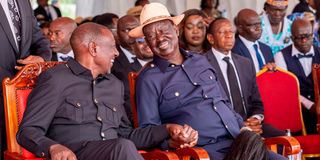
Today, the ‘hustler mystic’ has collapsed. Similarly, Raila Odinga’s ‘big tent politics,’ with its latest incarnation as the ‘Broad-based Government,’ has lost its Midas touch. Few believe his reasoning that: “I am supporting William Samoei Ruto for the sake of the country.” Instead, coalition politics is deepening elite capture. Kenya’s restive Gen-Z view Odinga as a fallen angel, serving private interests. Even as his party’s grandees jostle for influence in Ruto’s government, growing voices of rebellion in his party rend the air. The political future of the grandmaster of succession politics, paying the price of propping up an unpopular incumbent, looks uncertain. But he is potentially still a potent king-maker in 2027.
It is not crystal clear whether Ruto’s new ‘moral turn’ to anti-corruption will restore Raila’s shine. The new taskforce, MAT, has to cast its net wider beyond Parliament to be effective in dismantling state capture and slay the hydra of corruption.
Its formation is seen as duplicating existing capacities, including the Ethics and Anti-Corruption Commission (EACC). On August 20, activists secure the High Court’s orders to temporarily suspend the agency. Social media is rife with speculation that the taskforce is preparing grounds for the President to dissolve Parliament and call for fresh elections.
On August 20, the Independent Electoral and Boundaries Commission (IEBC) was forced to take to social media, dismissing as fake a memo that went viral purporting that there are proceedings in the Supreme Court and if the Chief Justice gave the President the go-ahead to dissolve the house, IEBC would follow the rule of law and run fresh elections for all Parliamentary seats, instead of by-elections.
State capture remains a pervasive and difficult threat to reverse. Focus should now be on promoting citizen participation, strengthening accountability, prosecuting offenders, and rebuild eroded capacity of institutions.