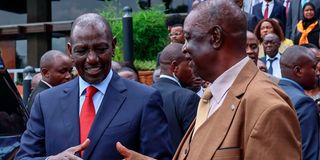
President William Ruto and ODM leader Oburu Oginga have constituted an eight-member joint technical committee to spearhead 2027 pre-election coalition roadmap, even as they announced plans to compensate victims of police brutality by June.
Each of the two parties is set to pick four members, with United Democratic Alliance (UDA) Executive Director Nichodemous Bore and his Orange Democratic Movement counterpart Oduor Ongwen serving as joint secretaries of the team. Names of the eight members were not immediately made available.
President Ruto said Sh2 billion is available in the supplementary budget to facilitate reparation for the families of those killed as well as those injured in protests.
Compensation of victims of protests was one of the 10-point agenda signed between President Ruto and ODM leader Raila Odinga on March 7, 2025. Raila died last October. Court processes have been cited for the delay in implementing the agenda item.
“It is our belief that unless something else happens, we should be able to conclude this exercise by June.”
“While life cannot be compensated, we can provide support to victims’ families. We have already identified victims from as far back as the 2017 demonstrations, allocated resources including Sh2 billion for compensation, and established a court-mandated panel to expedite the process,” said the President.
In its report released yesterday, the Agnes Zani-led Committee on the Implementation of the 10-point agenda also recommended establishment of a multi-agency team comprising the National Treasury, Kenya National Commission on Human Rights, and the Law Society of Kenya and the Office of the Attorney-General to facilitate reparations for victims of police brutality.
“From 2023 to 2025, IPOA handled 820 cases of alleged police misconduct during public order management, securing convictions in 35 cases involving 49 officers, and recommending disciplinary action against 30 officers. The Demonstration Bill, which proposed restrictions on the right to assembly and protest was withdrawn,” the committee said in the report.
The announcements were made during a joint Parliamentary Group (PG) group meeting by UDA and ODM. The meeting marked the first anniversary since the signing of the Memorandum of Understanding (MoU) between UDA and ODM. The meeting also provided a platform for Dr Zani-led team to release its final report on the status of implementation of the agenda items.
The meeting was, however, characterised by drama after UDA chairperson and Embu Governor Cecily Mbarire questioned the team for not having a recommendation on the realisation of the two-third gender principle. Mathare MP Anthony Oluoch also questioned the report released by the team when he demanded that the report be withdrawn and updated to capture the President’s remarks. He said the President seemed to have more information of what had been achieved compared to what was captured in the report.
Critics of the broad-based government have consistently accused President Ruto and some ODM officials of betraying Mr Odinga by failing to implement the agenda items within a year based on the MoU.
“A narrative is now being pushed by pro-regime voices within ODM claiming that the agreement had no timeline and that March 7, 2026 merely markes the first anniversary of a symbolic signing ceremony at KICC. This interpretation is inaccurate and misleading,” ODM co-deputy party leader Godfrey Osotsi said yesterday.
“Such claims amount to betrayal of Raila Odinga’s legacy and the millions of Kenyans who sacrificed during the protests and civic agitation that demanded reforms and accountability from the state,” he added while announcing that the Linda Mwanachi team will on Wednesday its assessment report on the implementation of the 10-point agenda.
But both President Ruto and Dr Oginga in their response said much of the agenda items had been implemented.
“There are some people who want to appoint themselves supervisors as if we made the commitment to them. We did not make the commitment to them. We made the commitment to the people of Kenya, and our responsibility and reporting is to the people of Kenya,” said Dr Ruto.
Dr Oginga further said that those suggesting that March 7, 2026 should have marked the end of broad-based government are being dishonest. He said the broad-based government was formed way before the MoU was assigned. President Ruto formed the broad-based government in July, 2024 when he nominated John Mbadi (National Treasury), Opiyo Wandayi (Energy and Petroleum), Hassan Joho (Mining) and Wycliffe Oparanya (Co-operatives)
“March 7, which was slated as the date for the making of a report, was not the end of the broad-based government. The broad-based arrangement goes until 2027,” said Dr Oginga.
“It was the day the team was to give us the interim report on the progress of implementation. The 10-point agenda we have been taken through is something that cannot end. It will continue from today to 2027 and will go on because it's life,” he said.
The meeting resolved to extend the mandate of the Oversight Committee by another 60 days to enable it to finalise outstanding matters arising from the implementation of the agenda.
A joint communique read out by National Assembly Majority Leader Kimani Ichung’wah and his Minority counterpart Junet Mohammed indicated that a total of 253 MPs drawn from the two major parties attended the PG.
“The Joint PG noted with satisfaction that approximately 80 per cent of the agreed commitments have been implemented. The meeting further noted progress made in stabilising the economy and addressing the cost of living through measures including reduced inflation, continued fertiliser subsidies to support farmers, expanded health coverage, strengthened anti-corruption measures, and the revival of stalled road projects,” said Mr Mohammed.
Mr Mohammed explained that the joint technical team will provide roadmap for the pre-election coalition by identifying shared policy agenda and priorities by the two parties.
“The committee will lay the groundwork and develop the shared policy agenda and priorities of the two parties, which will inform the work of a coalition team to be appointed by the party leaders for the final coalition framework.”
Dr Zani team listed reconstitution of the Independent Electoral and Boundaries Commission (IEBC) and entrenchment of NG-CDF, the National Government Affirmative Action Fund, and the Senate Oversight Fund into the Constitution as some of its achievements.
The report noted Bills seeking for the establishment and entrenchment of the Offices of the Leader of the Official Opposition and the Prime Cabinet Secretary are pending passage in Parliament.
“Parliament received 9 Bills of which: three Bills have been enacted into law, including the Independent Electoral and Boundaries Commission (Amendment) Bill, 2023, the Statutory Instruments (Amendment) Bill, 2023 and the Ethics and Anti-Corruption Commission (Amendment) Bill, 2023,” the report highlights.
The report recommended formation of a broad-based mediation committee between the Senate and the National Assembly to fast-track the consideration and passage of the outstanding Bills.
The report also listed measures to reduce the cost of living, including the fertiliser subsidy, which lowered prices from Sh7,000 to Sh2,500 a bag. Other achievements listed are 14 per cent reduction in fuel prices, and exchange rate gains that lowered production and transport costs.
Others are youth empowerment initiatives, including the Hustler Fund and National Youth Opportunities Towards Advancement (Nyota) programme, which the report says have expanded access to entrepreneurship support, skills development and affordable credit for young people and small businesses.
“The Nyota programme has created opportunities for over 820,000 young entrepreneurs aged 18-29 years (up to 35 years for persons with disabilities) across all 1,450 wards, with 50:50 gender parity, 5 per cent participation from refugee and host communities, and 5 per cent representation of persons with disabilities.”
In the education sector, the report highlighted recruitment of 100,000 teachers since 2022, bringing teacher-to-student ration to 1:29 down from 1:45. The report also highlighted ongoing constructions of 23,000 classrooms and 1,600 laboratories.
Under the Affordable Housing Project, the report lists 260,000 housing units under construction across the country, with 4,888 completed homes advertised for sale and student hostels with 177,686 bed capacity under construction.
Also listed are 450 modern markets being constructed nationwide, 6,000 km of roads under construction and expansion of the Last Mile electricity connectivity programme, improving livelihoods in rural communities.
Under devolution, the report notes that equitable share of revenue to counties increased from Sh385 billion in 2024/2025 financial year to Sh415 billion in 2025/2026 fiscal year, and is projected to rise to Sh450 billion in financial year 2026/2027.
It also lists Conflict-of-Interest Act, 2025, assented to in July 2025 as an achievement in the fight against corruption.