It is the 1980s. A young William Ruto , a fiery born-again student leader, arrives with a delegation at President Daniel arap Moi’s Kabarnet Gardens home in Nairobi.
He leads the group in prayer, his voice carrying conviction, and Moi takes note of the slender man from Uasin Gishu. Delegations in those days were rituals of access, choreographed encounters where favours sealed futures.
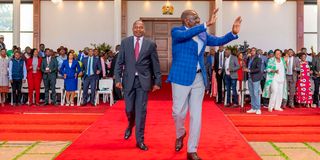
Leaders from Tharaka-Nithi County at State House, Nairobi.
Photo credit: PCS
As Ruto would later recall, the leaders of his group were rewarded with a plot in Eldoret. They sold the plot, and Ruto bought his very first car. He would join many more processions to State House as part of the Uasin Gishu District Students Association, absorbing, almost by osmosis, the theatre of power. His future Deputy President-turned-nemesis, Rigathi Gachagua , was also a master of such student delegations.
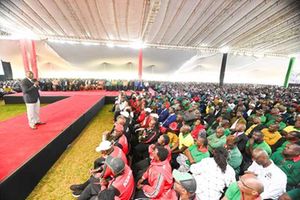
President William Ruto during a meeting with more than 10,000 teachers at State House, Nairobi on September 13, 2025.
Photo credit: PCS
Decades later Ruto, the pupil, has become the master. Today, he presides over State House, re-enacting the very rituals he once observed under Moi. Convoys of matatus, buses, and SUVs grind up the hill towards Gate B. The lawns glisten, newly shorn; the tents rise; aides dart briskly across the gardens, files clutched like lifelines. At the steps of the former colonial mansion — rebuilt under Ruto’s watch — a red carpet cascades down to the pavilions, awaiting the loyalists.
State House is less a residence than a stage — where money, power, and hubris converge in grand performance. From the convoys step elders, steadying themselves on walking sticks. Behind them stream women’s groups, choirs in immaculate uniforms, and youth leaders herded in by local politicians. Within the mob are orators whispering their lines, rehearsing speeches into the air. State House has of late been hosting not a single gathering but a mosaic of factions — each delegation jostling for recognition.
Last week, State House hosted 10,000 teachers — the largest delegation yet — as Ruto tests every formula for a second term. At times, these gatherings are billed as “empowerment” meetings, a vocabulary meant to sanitise patronage. Handouts (read bribes) are recast as investments, and political loyalty is rebranded as participation. Yet beneath the polished tents and well-choreographed prayers, the logic remains unmistakable: State House is the epicentre of transactional politics, a marketplace where access is currency and presence is power.
Inviting African delegations
This script predates Ruto. In 1944, Governor Philip Mitchell unsettled Kenya’s white settler aristocracy when he began inviting African delegations — mostly loyalists — to Government House luncheons and garden parties. The “Muthaiga Club Mafia,” as he derisively called the radical settlers, suddenly found themselves excluded from Government House. “The settler elite were not included, and now seldom graced the building,” historian C.S. Nicholls recorded in White Strangers. In their scorn, they dismissed Lady Mitchell for her shyness and dislike of entertaining, but the precedent was quietly established: Government House as a stage for political patronage was firmly set.
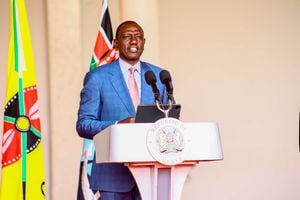
President William Ruto hosts United Democratic Movement party officials at State House Nairobi on July 9, 2025.
Photo credit: PCS
Ruto has perfected the art of hosting delegations on the same lawns, a ritual that has endured for more than half a century. They arrive to sing and pray with rehearsed devotion, to pledge loyalty, to demand favours, to flatter, and to remind him of debts yet unpaid. And when they leave, it is never empty-handed. Some depart with promises of roads or schools; others with envelopes of cash. In Kenya, a delegation is never merely a ceremony. It is a transaction clothed in tradition, an instrument of power disguised as ritual.
The ritual is older than independence itself, tracing back to the colonial Governor’s House, where white settlers once gathered to demand land and licences from the man on the hill. After 1963, the house was renamed State House, but the script remained. Kenya’s presidents inherited the ritual and refined it, each using the red carpet of State House — literal or symbolic — to stage power.
Jomo Kenyatta, the patriarch, made delegations part of his political theatre. At his Gatundu homestead, and in State House, Mombasa and Nakuru, dancers and delegates were always an evening ritual. Whenever Kenyatta had a national challenge, he turned the seat of power into a base to enact loyalty. His Gatundu home at one point was turned into an oathing shrine as Kenyatta went through the Tom Mboya assassination crisis and the challenge from Oginga Odinga. From then, State House grounds were used for pledges of hostility toward perceived enemies.
Prime Minister Jomo Kenyatta reads out a statement at his residence in Gatundu, Kiambu, after chairing a meeting of the ad hoc committee formed to mediate ceasefire in the Congo in 1960. Among those who attended the meeting were the US ambassador to Kenya William Attwood (right) and OAU secretary-general Diallo Telli (third left). PHOTO | FILE | NATION MEDIA GROUP
Moi inherited this script and for 24 years he stamped it with his own flair. At his Rift Valley home in Kabarak, delegations arrived in droves, shepherded onto a stage where choirs in uniform sang, bishops prayed, and elders pledged loyalty. The chapel at Kabarak was Moi’s sacred red carpet: delegations filed in, voices raised in hymns, before envelopes of cash were discreetly distributed. If Kenyatta’s gift was land, Moi’s was money. It was not hidden. That Moi received and dished out money was known; it was broadcast on state television, part of the spectacle. In return, delegations offered their loyalty, their songs, their silence. Even in crisis — after the 1982 coup attempt, during the fight over multiparty democracy — delegations were paraded as proof that Moi still stood tall on the carpet of legitimacy.
Mwai Kibaki recoiled from the theatre. A technocrat trained in Makerere and London, Kibaki disliked the pomp. During his tenure, State House Nairobi, almost lost its red-carpet glow and became an office. Yet Kibaki was not entirely without ritual – until he was under pressure from Raila Odinga . As he sought a second term, and under severe challenge, the State House doors were opened to delegates. In 2010, during the push for a new Constitution, delegations returned to State House in droves. Leaders filed in, petitions in hand, speeches rehearsed. But these were not loyalty pledges to Kibaki himself; they were endorsements of reform. And when his base grew restless, Kibaki retreated to Sagana State Lodge, where delegations from Mt Kenya gathered under chandeliers once lit for royal hunters. There, Sagana became his red carpet — a regional stage for reassurance and control.
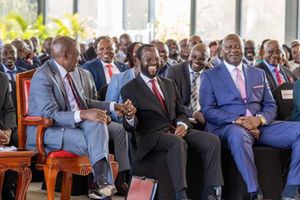
President William Ruto with Kisumu Governor Anyang' Nyong'o (centre), Senator Tom Ojienda (right) and other leaders at State House, Nairobi, on June 18, 2025.
Photo credit: PCS
Uhuru Kenyatta revived the delegations with flair. State House Nairobi rolled out the literal red carpet once again for choirs, elders, clergy, and politicians. Delegations filed in, posed for photographs, and left with donations or promises of projects. But Uhuru added a bureaucratic twist. He opened State House to government functionaries, allowing meetings within its walls. More than once, he arrived uninvited, sat down, and commandeered the agenda. Even in bureaucratic spaces, the old carpet reappeared — the President’s presence overruling process. And like Kibaki, Uhuru used Sagana Lodge as his regional theatre. Delegations from Mt Kenya were summoned, seated before him on a literal carpet of power, to be lectured or cajoled in his mother tongue. Hubris bled into ritual: the son of Jomo performing as patron and preacher.
William Ruto has inherited this tradition with zeal. Since 2022, delegations have streamed into State House Nairobi almost daily. The red carpet is rolled out for church leaders, elders, youth groups, and women’s associations. Photographs and video clips of these meetings flood television and social media. Ruto has perfected Moi’s monetary generosity, repackaging it as “hustler empowerment.” Delegations leave with promises of projects, or cash, presented not as patronage but as inclusion. He casts himself not only as patron but as partner.
President William Ruto with members of Parliament from Vihiga, Kakamega, Busia, Bungoma and Trans-Nzoia Counties at State House, Nairobi on June 5, 2025.
Photo credit: PCS
A man who rose to power through the patronage networks of the notorious Youth for Kanu ’92 — an outfit that was a cash conduit for President Moi’s 1992 campaign — Ruto has long understood the alchemy of promises and cash. He has mastered how to turn loyalty into currency, and currency into loyalty.
Yet for Ruto, State House is more than a stage. It is solace, a fortress where he seeks vindication after the spectacular underperformance of his first term. In moments of reflection, he has even contemplated building a cathedral within the compound — a permanent sanctuary from which to woo the Christian faithful and guarantee their protection, having learned their trust during the last general election.
Just as Kenyatta sanctified Gatundu with oaths, and Moi sanctified Kabarak with hymns, Ruto dreams of a cathedral to cloak the presidency in divine authority.
But a cathedral within State House cannot mask the cracks of governance, nor sanctify failure. For all its pomp, the ritual of delegations reveals less about strength than about insecurity — a President retreating deeper into spectacle to shield himself from a restless republic.