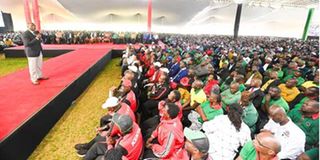
At 9pm on Saturday, thousands of teachers were in long queues at State House waiting to receive a Sh10,000 handout after a meeting. They were the latest visitors to the seat of power that is lately hosting a steady stream of delegations.
At least 10 delegations from various counties have trooped to State House Nairobi, between last month and this month, but the weekend gathering of 10, 000 teachers is the largest so far.
Some of the teachers had travelled to Nairobi on Friday night from far-flung areas for the meeting with President William Ruto “to discuss challenges facing the education sector”.
But the meeting had all the hallmarks of a political gathering. As a pointer, Deputy President Kithure Kindiki led the crowd into chants of “faya si faya” and “Tutam”, a slogan for President Ruto’s re-election bid.
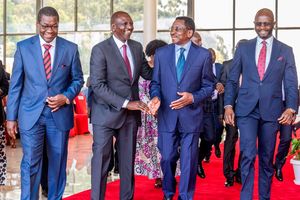
A delegation of leaders drawn from Western region pose for a picture with President William Ruto at State House in Nairobi on August 19, 2023.
Photo credit: Courtesy
State House Nairobi, is slowly turning into a political mobilisation ground for the president. It has been extremely busy hosting county, regional, religious, professional and political delegations for meetings that have blurred the line between government business and partisan political campaigns.
The recent activities have triggered questions on whether State House can balance its constitutional role as the seat of government with its now visible role in partisan politics. Questions of possible misuse of State resources to reimburse delegates have also arisen.
Former Law Society of Kenya President Eric Theuri said no law bars the president from holding such gatherings at State House. He said that, as much as the president is the head of government, he is also a political leader. The problem, he said, is when public resources are spent on such events.
“There is nothing in law that prevents him from using the State House in such a manner. For instance, teachers going there would tell you they are going to discuss matters of education. There have been reports of the State House budget going up, but it would be difficult to prove any misuse of public resources in such events. Proving there was bribery is extremely difficult,” explained Mr Theuri.
While critics say the meetings could be divisive, the president’s allies say the engagements are not unique to the current administration; they have been a tradition even in past regimes.
Kitui Senator Enoch Wambua said Kenyans have to ask hard questions about the source of money being dished out.
Kitui Senator Enoch Wambua speaks during the launch of the Kitui Cultural Festival and goat digital auction website on December 10, 2019.
Photo credit: File | Nation Media Group
“The biggest question to ask is where the money being dished out at State House is coming from. What about the money being dished out by the DP in the so-called empowerment programme? No amount of money will be enough to blind Kenyans from the reality of the hardships that this government visits on them each passing day,” he said.
“I urge all Kenyans to line up and take whatever is being dished out at State House but do the right thing on the ballot. May the one-term mantra ring true in all corners of the country. And this act of doling out money to delegations in State House is one more reason why this administration must be voted out,” he added.
Busia Senator Okiya Omtatah argued that Dr Ruto’s hosting of State House delegations “demonstrates his reckless disregard for public resources”.
Busia Senator Okiya Omtatah.
Photo credit: Dennis Onsongo | Nation Media Group
“It’s a very wasteful approach and attitude towards taxpayers’ money. They are spending as if the resources come from heaven like manna, yet even manna from heaven had rules. This government is simply wasteful and reckless, behaving as if they don’t live in this country. That budget is big enough to fund critical projects, but their spending cannot be justified at all,” he said.
Machakos Deputy Governor Francis Mwangangi said the meetings at State House mirror the 1992 script by then President Daniel Moi. He described the meetings as early campaigns by President Ruto ahead of the 2027 elections.
“I don’t understand why he would invite 10,000 teachers to State House; how do you have such a big delegation if not just for political optics? We are basically back to the 1992 script when President Moi also exploited such delegations by bribing them to win their support,” said Mr Mwangangi.
“The meetings at State House and the so-called empowerment programmes are no different from the activities of the YK92 (Youth for Kanu in 1992) that looted the country dry,” he added.
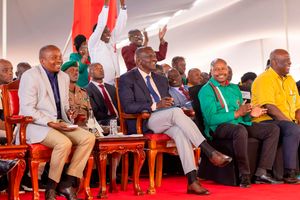
President William Ruto (right) and Public Service CS Geoffrey Ruku (left) during a meeting with Embu County leaders at State House, Nairobi, on July 4, 2025.
Photo credit: PCS
Prof Gitile Naituli, a professor of management and leadership at Multimedia University of Kenya, also said the State House delegations “are paid for using taxpayers’ money in order to influence support”.
But speaking in Mombasa last week, President Ruto dismissed criticism that millions were being spent on food and refreshments for the endless delegations.
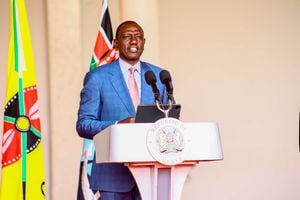
“Those asking me about serving people tea and mandazis at the State House, I don’t know what else they want me to serve,” the president said. “We will continue to make the government, the Executive and even Parliament people-centred. We will make the State House accessible.”
The Nation reached out to State House Spokesperson Hussein Mohammed for a comment on the growing perception that the president has turned his official residence into a ground for political mobilisation. He had not responded by the time of going to press.
Central Organisation of Trade Unions-Kenya Secretary-General Francis Atwoli said it has been a tradition to have delegations visit State House. He described it as a common occurrence even in other countries like Uganda. He expressed surprise that it has become an issue now.
“We used to have delegations to the State House even during Moi, [Mwai] Kibaki and Uhuru [Kenyatta] times. Some of the people raising issues now used to welcome delegations when they served in the previous administrations,” said Mr Atwoli.
“It is not unique to Ruto. During Uhuru’s regime, we even had Labour Day celebrations conducted from State House in 2021 during the Covid-19 pandemic. Moi used to have delegations in all the State lodges,” he explained.
For the teachers’ meeting, they were expected at State House at 6.30am. Upon arrival, they were served breakfast before meeting the President who walked into the tent at 8.50 am.
While introducing the delegates from Nyanza region, Basic Education Principal Secretary Julius Bitok made references to the “broad-based” arrangement. He then asked the national treasurers of the unions and associations to “meet behind the tent for some housekeeping matters” to which the tutors cheered wildly.
President William Ruto hosts Boda Boda national officials at State House, Nairobi.
Photo credit: Photo | PCS
When the meeting ended in the afternoon, the teachers were asked to queue to receive some “lunch”. Each teacher was to receive Sh10,000. However, the teachers described the process as chaotic. In total, the government spent at least Sh100 million on the handouts and much more on logistics.
“We were paid in alphabetical order of our names, so I received my money at 3pm. I left many teachers in the queue,” said a teacher.
“It’s really chaotic. We’ve not had lunch or anything else to eat since morning. I’ve just received my money, and there are still more people in the queue. I can’t travel back to Kakamega. I’ll have to put up in Nairobi and then I leave tomorrow morning. It wasn’t worth it,” said another teacher who received his money at 9pm. He had travelled to Nairobi on Friday night.
The meeting with the teachers offered a platform for the president to highlight his administration’s achievements in the last three years. His Kenya Kwanza government has been on an overdrive to publicise its achievements as part of its strategy to gain support ahead of the 2027 elections. Teachers remain a crucial and influential constituency for those seeking national offices.
“In the last three years, we have increased the education budget from Sh540 billion to Sh702 billion, the largest increase in our history. We have also addressed concerns over the Competency-Based Curriculum, injecting clarity and smooth transition, and hired 76,000 teachers. We will enhance this figure to 100,000 by January to boost the teacher-student ratio,” said the president.
“That is not all. We have built 23,000 classrooms, established the Open University of Kenya, and introduced a student-centred higher education funding model that supports learners while increasing resources for universities and TVETs [technical vocational education and training institutions],” he added.
On Friday, a day before the teachers’ meeting, the president hosted leaders from Murang’a County. This was just a day after holding a similar meeting with leaders from the Kisii, an event also attended by ODM party leader Raila Odinga —his partner in the broad-based government.
In his meeting with Murang’a grassroots leaders, the president also touted his administration's achievements and listed some of the development projects currently underway. He also appeared to respond to his former deputy, Rigathi Gachagua , whom he accused of perpetuating “retrogressive politics of tribalism”.
“We have allocated Sh23 billion for the construction of 10,300 affordable houses, Sh3.5 billion to upgrade roads, Sh2.3 billion for the development of 23 modern markets, and Sh3 billion for new student hostels. We have also committed to building two modern stadiums worth over Sh1.5 billion and to connect Kangema, Mathioya, Kiharu and Kandara to clean water under a Sh2.4 billion water project,” he said.
He gave a similar message of development when he met the political and grassroots leaders from Kisii, highlighting the construction of affordable housing units, student hostels and markets.
President William Ruto meets Migori County leaders at State House, Nairobi, on April 10, 2025.
Photo credit: PCS
On August 9, State House played host to thousands of youth for an empowerment programme. A total of 1,100 business groups drawn from Nairobi were handed tools and equipment to support their start-up businesses.
“Beginning next month, 70 young people in each of our 1,450 wards will receive Sh50,000 each to start and boost their business in a joint programme between the government and the World Bank,” said the President.
A delegation of boda boda riders was hosted at State House on August 7, with the president describing them as “legitimate entrepreneurs whose businesses must be supported”. He also gave amnesty to owners of motorcycles detained at police stations who are not linked to criminal cases. He asked the Ministry of Interior to work with the Inspector-General of Police to have the motorcycles released within a week.