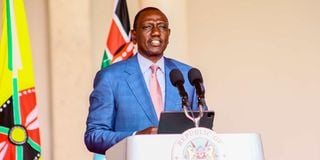
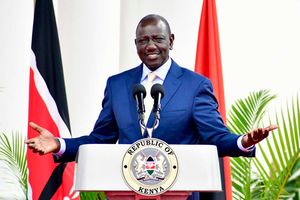
From religious leaders and grassroots mobilisers to youth groups, women’s associations and political delegations, Dr Ruto has made State House, Nairobi, his preferred stage for connecting directly with citizens. These events, however, do not come cheap.
On Friday, the Head of State hosted leaders from Murang’a County, just a day after holding a similar meeting with leaders from the Gusii region, an event also attended by Orange Democratic Movement leader Raila Odinga— his partner in the broad-based government.
“There is no longer any room in Kenya for tribalistic and retrogressive politics that enrich a few at the expense of the many. We are charting a new course; one of bold, visionary leadership that transforms lives and unites our nation,” Dr Ruto said on Friday.
Kuppet Secretary General Akello Misori (second right) gestures during a joint media briefing with officials from Knut on August 07, 2024 in Nairobi. Teachers in hardship areas want their hardship allowance pegged at 40 per cent of their basic salary
Photo credit: Francis Nderitu | Nation Media Group
The latest spectacle of such delegations is scheduled for September 13, when the Head of State is expected to host at least 10,000 teachers at State House.
Officials who spoke to Saturday Nation in confidence said the teachers attending the meeting will be given Sh10,000 each as reimbursement for their travel expenses. Considering the number invited, this totals to Sh100 million.
In general, during such visits, multiple sources told the Saturday Nation that delegates are facilitated with different amounts, with some even pocketing Sh200,000 each, while others receive as low as Sh5,000 each.
State House has been on overdrive, hosting county, regional, religious, professional and political delegations, with a recent report by Controller of Budget (CoB) Margaret Nyakang’o revealing that the Treasury released Sh3.6 billion for travels, hospitality and meetings in just 42 days between May 14 and June 24, 2025 — barely a week to the end of the financial year.
The money was accessed under Article 223 of the Constitution, which permits emergency spending without prior parliamentary approval.
Controller of Budget Margaret Nyakang’o.
Photo credit: File | Nation Media Group
But Dr Nyakang’o cautioned that using the provision to fund routine engagements pointed to “lapses in budget formulation” and contravened public finance rules. Of the Sh3.6 billion, only Sh2.3 billion was formally approved.
During the period under review, the Saturday Nation has established that President Ruto received an array of delegations at State House, Nairobi and the regional State lodges.
The tabulation shows that on June 24, the Head of State hosted the Kenya Police football and volleyball champions, congratulating them for lifting the FKF Premier League and FKF Women’s titles.
A day earlier, he had welcomed diaspora representatives from 27 countries, praising Kenyans abroad for remittances that hit Sh638 billion last year.
While President Ruto has defended the engagements as “people-centred governance,” critics argue the pace and cost of the gatherings amount to populist politics funded by taxpayers.
“These delegations are only building factional units within communities and groups. There is need to present serious, acceptable, tactical, reasonable, productive community leadership instead of choosing a few factional leaders who only pick a few shillings from State House and go away,” a national party official of one of the major parties in the country who did not wish to be named told Saturday Nation .
Insiders and budget observers estimate that millions of shillings have been spent on allowances, transport refunds, meals, and logistical preparations to accommodate the visitors.
Critics warn that in a country grappling with ballooning debt and biting cost of living, the optics of such largesse may be politically popular but fiscally reckless.
Busia Senator Okiya Omtatah.
Photo credit: Dennis Onsongo | Nation Media Group
Busia Senator Okiya Omtatah argues that Dr Ruto’s hosting of State House delegations “demonstrates his reckless disregard for public resources.”
“It’s a very wasteful approach and attitude towards taxpayers’ money. They are spending as if the resources come from heaven like manna, yet even manna from heaven had rules. This government is simply wasteful and reckless, behaving as if they don’t live in this country. That budget is big enough to fund critical projects, but their spending cannot be justified at all,” added Mr Omtatah
Rights activist and 2027 presidential aspirant Boniface Mwangi also criticised the State House delegations that he said were enticed “with goodies, tea and mandazis”.
He went on: “They used to say there was a bar at State House, but now there’s a circus. He should report to work at Harambee House from Monday.”
Prof Gitile Naituli, a professor of management and leadership at Multimedia University of Kenya,
“These State House delegations are paid for using tax payers’ money in order to influence support,” Prof Naituli noted.
“I know for a fact that those who attend the meetings are paid depending on the value they have about you,” he said, adding that some delegates from Mt Kenya have been paid between Sh20,000 and Sh50,000 each.
He added, “They are a complete waste of time, and the government needs to get better advice on what empowerment means.”
Prof Naituli termed it “a deliberate attempt to revive the old Kanu trick akin to the YK92 (Youth for Kanu 1992 lobby group), when they spent a lot of money to bribe voters, leading to high inflation rate.”
While opposition leaders and civil society accuse the President of using State House resources for populist politics, Dr Ruto has strongly defended the expenditure.
Speaking in Mombasa last week, President Ruto dismissed criticism that millions were being spent on food and refreshments for the endless stream of delegations trooping to State House.
“Those asking me about serving people tea and mandazis at State House, I don’t know what else they want me to serve,” the president said. “We will continue to make government, the Executive and even Parliament people-centred. We will make State House accessible.”
According to State House insiders, these curated meetings give the President a more effective channel for engagement compared to traditional rallies.
In closed-door sessions, Dr Ruto is said to gather unfiltered feedback from local leaders, religious figures, professionals, and grassroots mobilisers — all while building bridges to bolster his re-election bid.
“The president values these meetings because they offer him candid insight into the real issues affecting different communities. It also allows him to directly communicate government plans without political noise,” said a senior aide familiar with the meetings, who spoke in confidence.
His remarks came as a new report by the Controller of Budget revealed that State House recorded the single largest hospitality expenditure among government offices — Sh1.1 billion — in the financial year.
Overall, ministries and agencies spent Sh6.3 billion on teas, snacks, and related hosting costs.
The figures appear to contradict the president’s own earlier pledges to rein in non-essential government spending, particularly on travel and entertainment, following public uproar over the withdrawn 2024 Finance Bill.
A woman had named President William Ruto in a case involving abductions and destruction of property during the 2024 Gen Z protests.
Photo credit: PCS
President Ruto had, at the height of anti-tax protests in 2024, announced a series of austerity measures aimed at reducing expenditure across all branches of government.
He directed the removal of allocations for items such as the confidential vote, travel budgets, hospitality, and the purchase of motor vehicles.
Additionally, expenditures on renovations and other non-essential items were supposed to be slashed.
But now, Dr Ruto has insisted that the practice of hosting citizens at State House will continue, framing it as an investment in inclusivity rather than waste.
“There is no longer any room in Kenya for tribalistic and retrogressive politics that enrich a few at the expense of the many. We are charting a new course; one of bold, visionary leadership that transforms lives and unites our nation,” Dr Ruto said on Friday.
Deputy President Prof Kithure Kindiki told the delegation from Murang’a at State House on Friday that the region cannot afford to be out of the government.
Still, questions linger over where the funds for these large-scale delegations are drawn from.
Some MPs have already hinted at pushing for an audit of State House spending when Parliament resumes sittings, arguing that unchecked allocations could amount to abuse of public resources.
Observers also note the political undertones. With eyes on 2027, political analysts say, the delegations allow the president to cement his grassroots connections and reward allies.
For his critics, however, the gatherings are nothing more than a disguised campaign spree bankrolled by taxpayers.
As the convoys of buses carrying teachers snake their way to the State House on Saturday, the debate is unlikely to end soon.