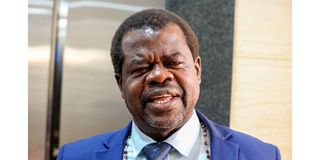
Busia Senator Okiya Omtatah.

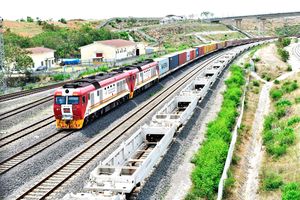
The government has urged the High Court to lift orders halting construction of the Sh12 billion Ngong-Riruta commuter railway, arguing that recent legal changes permit continued use of railway levy funds to finance the project.
At the same time, the Kenya Railways Corporation (KRC) is resisting full disclosure of key project documents.
At the heart of the legal dispute is whether billions of shillings collected in the Railway Development Levy Fund can lawfully be used on a metre-gauge railway project despite the law restricting the fund to standard gauge railway (SGR) projects.
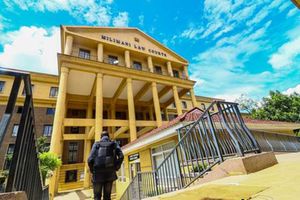
Appearing before Justice Gregory Mutai at the High Court in Milimani, KRC’s advocate said it had already initiated an appeal against a March 19 ruling that halted the construction work.
Mr Gideon Muturi asked the court to suspend the ruling and allow KRC’s contractor to resume works on the 12.5-kilometre line linking Riruta town in Nairobi to Ngong in Kajiado. He added that the project’s suspension risks rendering the intended appeal meaningless.
He said the railway, now about 40.5 per cent complete, has exposed the government to significant financial loss due to halted works, contractor demobilisation costs and disrupted contractual obligations.
“Suspension of this project has a substantial effect. If it remains stalled, the country will lose the value of the work already done, which is in billions of shillings,” Mr Muturi said.
The case arose from a petition filed in December 2025 by Busia Senator Okiya Omtatah and rights advocate Bernard Muchere, challenging the legality of using the railway levy fund cash to finance the project. They argue that the move is unlawful and unconstitutional, making the expenditure an illegal diversion of public funds.
The project was commissioned in December 2023 by President William Ruto, before construction began in early 2024.
KRC warned that more than 600 workers risk losing their jobs, while ongoing contractual arrangements between contractors and State agencies could collapse if the stoppage persists.
The corporation also argued that the court-ordered disclosure of procurement documents risks breaching confidentiality provisions under procurement law, potentially exposing sensitive commercial information and undermining the appeal.
Mr Muturi said the State corporation is willing to comply with any conditions set by the court, including the provision of security, insisting the dispute involves a complex public infrastructure project rather than a straightforward monetary claim.
The National Assembly, through lawyer Mbarak Awadh Ahmed, backed the application, telling the court that the legal basis of the petition had been overtaken by events following amendments to the law governing the Railway Development Levy Fund.
He said the amended law, passed in March and now in force, expanded the use of the levy to financing railway infrastructure broadly, including metre-gauge lines.
“The current legal framework permits utilisation of the levy for the construction of railway infrastructure,” he said.
Mr Ahmed argued that the petitioners themselves had acknowledged the shift by seeking to amend their petition to challenge the new law, an indication that the original dispute had been overtaken.
The Attorney-General, through State counsel Thande Kuria, also supported the KRC application, saying the amended pleadings should guide the court in determining whether to grant the stay.
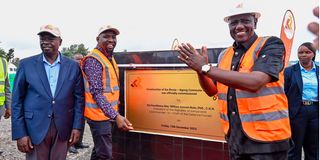
President William Ruto launches the Riruta-Ngong railway in December 2023. Looking on are then-Deputy President Rigathi Gachagua and then-Roads CS Kipchumba Murkomen (on Dr Ruto's left).
The application was further backed by oral submissions highlighting the project’s economic and social benefits, including easing traffic congestion along Ngong Road, improving commuter mobility and enhancing environmental outcomes.
Lawyer Albert Mumma told the court that more than Sh4 billion has already been spent, warning that continued suspension risks waste of public funds.
But the application faced strong opposition from Mr Omtatah, who argued that the State was effectively seeking to re-argue the case through a stay application instead of pursuing the appeal. He disputed claims on the project’s completion level, saying no documentary evidence had been provided to support the figures cited.
Mr Omtatah maintained that the case is anchored on Article 206 of the Constitution, which governs the use of public funds, and not solely on the statute cited by the State.
“The violations have not been cured; they have been made worse,” he said, referring to recent amendments to the law.
He also challenged the legislative changes, questioning the speed of their passage and arguing they could not retrospectively validate alleged constitutional violations.
He further argued that the State had failed to demonstrate substantial loss or meet the legal threshold required to justify a stay of conservatory orders.
The legal dispute stems from a High Court ruling that halted the project and ordered disclosure of key documents, including feasibility studies, procurement records and financing agreements, citing lack of transparency and potential constitutional violations.
The court found that the use of money from the Railway Development Levy Fund to finance a metre-gauge railway raised serious legal questions, as the law limits the fund to SGR projects. It also flagged concerns over lack of clear parliamentary appropriation, alleged procurement irregularities and gaps in public participation.
In granting conservatory orders, the court warned that continued construction risked irreversible expenditure of public funds and creation of facts that could undermine judicial oversight.
“The dissipation of public funds is perhaps the most acute form of irreparable harm,” it ruled.
The court is set to rule on the application on May 14.
Follow our WhatsApp channel for breaking news updates and more stories like this.