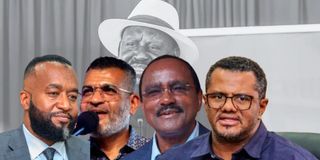
A year after the death of Raila Odinga , the political landscape he dominated for decades is being redrawn at the Coast, where the former opposition chief commanded some of his strongest support.
In the 2022 presidential election, Mr Odinga won overwhelming support across much of the region, making the Coast a critical pillar of his opposition coalition.
His death has left a political constituency without an obvious successor, setting off a contest among his Orange Democratic Movement (ODM), Wiper, President William Ruto’s United Democratic Alliance (UDA) and emerging Coast political formations.
The question is whether the votes he mobilised can be inherited by one politician, divided among competing parties or absorbed into new alliances ahead of the 2027 General Election.
Cabinet Secretary for Mining, Blue Economy and Maritime Affairs Hassan Ali Joho.
Photo credit: Dennis Onsongo | Nation Media Group
Former Mombasa governor Hassan Joho, a longtime ally of Mr Odinga and influential ODM figure, is among the leading claimants to his political mantle. But he faces competition from Wiper leader Kalonzo Musyoka , UDA’s Hassan Omar and other Coast politicians, amid the broad-based arrangement that has brought ODM and UDA into government while they prepare to compete in 2027.
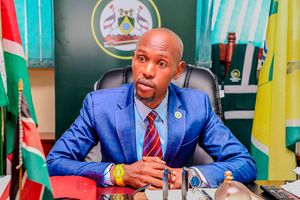
Mombasa Governor Abdulswamad Nassir, a close ally of Mr Joho, maintains that ODM remains the natural political home of Mr Odinga’s supporters.
Mombasa Governor Abdulswamad Nassir.
Photo credit: Kevin Odit | Nation Media Group
“The proof of the pudding is in the eating. Eventually, everything will be decided by the voters. Politics is an issue of numbers. We strongly believe the hearts of the people are still with ODM,” he said.
He said defections did not necessarily signal a collapse in support, noting that some leaders had left Mr Odinga even when he was alive.
“Baba had a political party and he was the face behind it for a very long time. If it is an issue of inheritance, it is the party that has inherited his base,” he said.
Mr Nassir said ODM would protect its independent identity and field candidates for all elective positions apart from the presidency.
He also backed Mr Joho’s claim to Mr Odinga’s political legacy, citing his tenure as ODM deputy party leader before his appointment as Cabinet Secretary.
“Moreover, he was trained by Mr Odinga. He climbed the ranks until he reached where he is today. As a region, we look up to him as a leader, and he has influence over the public at the Coast and across the country,” Mr Nassir said.
At an ODM grassroots meeting in Kisauni, Mombasa, Mr Joho urged supporters to defend the party against rivals.
“You have made ODM the strongest party in Kenya. Let us protect this political party and its leadership. There are people who now think they can penetrate here, dreaming that this is no longer an ODM zone. This is an ODM zone. They will know this during the general elections,” he said.
UDA has stepped up efforts to establish itself in a region traditionally associated with ODM, with East African Legislative Assembly MP Hassan Omar emerging as one of the key figures in the contest.
UDA party secretary general Omar Hassan addresses journalists at the party offices in Nairobi on September 19, 2024.
Photo credit: File | Nation Media Group
Mr Omar has presented himself as a politician whose ideas align with Mr Odinga’s. He recalled meeting him in 1997 while serving as a student leader at Moi University.
“My politics is akin to Nyanza, even the way I talk and articulate issues. My ideologies are akin to Mr Odinga’s more than those of any politician here,” he said.
“I have gone through the political trenches. In fact, I have ODM spirit and ideologies. We are in a broad-based arrangement, but we must elect candidates who will bring changes in the county,” he added.
Mr Omar’s weekly grassroots campaigns in Mombasa, where he is eyeing the gubernatorial seat, have helped him build a sizeable support base in a region where ODM has long held an advantage.
This was evident during President Ruto’s recent Coast tour, when he came face to face with the tensions between ODM and UDA, as Mr Omar’s supporters appeared to expose ODM’s weakening grip on the region.
However, President Ruto urged the two parties to avoid public disagreements and remember that they were partners in the broad-based government.
“We are in a broad-based government. I have seen both yellow and orange colours here today; we are both one. ODM and UDA, I want to urge you to stop the infighting. Let’s not quarrel. Let’s sit together. We are siblings, we are one,” he said while persuading voters who backed Mr Odinga to support the ruling party.
Wiper party leader Kalonzo Musyoka addresses party delegates at Wiper House in Nairobi on April 24, 2025.
Photo credit: Francis Nderitu | Nation Media Group
During his August tour of the Coast, Mr Musyoka declared that the region’s political loyalties were changing and claimed Wiper was ready to replace ODM as the dominant opposition vehicle.
“I hereby declare that the former ODM stronghold now belongs to Wiper,” he said.
Mr Musyoka recalled their campaigns for democracy and social justice. Wiper hopes to build on support among Kamba voters, an important part of Mr Odinga’s Coast coalition.
Nyali MP Mohamed Ali, a close ally of Mr Musyoka, is also seeking to challenge ODM’s dominance.
Businessman, former Nyali MP and leader of the Vibrant Democratic Party, Mr Awiti Bolo, said Mr Odinga’s influence remained visible within ODM but warned against politicians claiming ownership of his voters.
Businessman, former Nyali MP and leader of the Vibrant Democratic Party, Mr Awiti Bolo.
Photo credit: File | Nation Media Group
“The Luo community are planning to meet to discuss their successor following the death of Mr Odinga. At the end of November, we will have consolidated our votes as a community,” he said.
He said ODM could inherit a substantial share of the vote if it organised itself, but communities could reassess their interests and negotiate new alliances.
“Mombasa does not belong to any community. The past is gone with Mr Odinga. No one will inherit his political base. I hope no one is dreaming of owning voters and controlling the region,” he said.
The rise and collapse of Pamoja African Alliance (PAA) also show that established strongholds can be challenged. Former PAA secretary-general and Ganze MP Kenneth Tungule said the party had begun attracting support before it folded in March.
“PAA had penetrated and started to eat into the ODM stronghold. It was rising too fast, but those who felt they owned this region felt threatened,” Mr Tungule said in an interview with a local radio station in Mombasa.
Mr Tungule claimed local leaders pressured President Ruto over PAA’s growth. Former Labour Cabinet Secretary Kazungu Kambi, who later helped establish another formation involving former PAA officials, also blamed Coast political rivalries for the dissolution.
PAA had three MPs, including Mr Tungule, Gonzi Rai of Kinango and Anthony Kenga of Rabai and several ward representatives. Its dissolution and the movement of officials into a new formation altered the 2027 calculations. Smaller parties could still attract local support, negotiate alliances or split votes.
Jubilee Party is also seeking to make inroads at the Coast, with its leader Fred Matiang’i saying it plans to field candidates for all elective positions in the 2027 General Election.
Dr Matiang’i said the party had attracted multiple aspirants in each area and would hold nominations to select candidates.
“In each area, we have three candidates, so we will do nominations to pick the best. Jubilee plans to contest ward representative, parliamentary, woman representative, senatorial and gubernatorial seats, leaving the presidential ticket open for negotiations with opposition leaders,” he said while opening party offices across the region.
The central question is whether Mr Odinga’s political support can be transferred intact to ODM or whether it will fragment among competing parties and individual leaders.
Mr Joho has the advantage of a long association with Mr Odinga and a leadership position within ODM. Mr Nassir argues that the party, rather than an individual, is the principal inheritor of the late leader’s political base. Mr Omar is banking on UDA’s reach and the broad-based arrangement, while Mr Musyoka is seeking to establish Wiper as the new vehicle for opposition politics at the Coast.
Yet the final decision rests with voters, whose choices may differ from one county, constituency or community to another.
The Coast is not a politically uniform bloc. Its electoral outcomes have been shaped by local leadership, community interests, party alliances and national political alignments. Mr Odinga’s ability to bring different groups together gave him an advantage that may prove difficult for any successor to replicate.
As the 2027 General Election approaches, the contest will be measured not only by public declarations and party colours but also by grassroots organisation, candidate selection, alliances and the ability to address voters’ concerns.
For Coast voters who rallied behind Mr Odinga, the question is no longer simply who will take his place. It is whether the political coalition he built will survive his absence or whether his death will usher in a new contest for the region’s political allegiance.