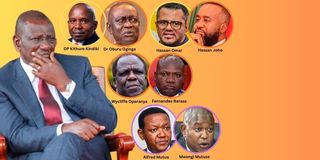
A quiet political war is raging within President William Ruto’s broad-based government, where leaders are fast becoming rivals in a scramble for influence, relevance and a stake in the 2027 succession.
Those who are expected to speak in one voice with a singular focus on President Ruto’s re-election are fast showing signs of strain as senior figures clash over power, succession and regional dominance, exposing deep cracks that could shape the road to the next poll.
Despite being in the same camp, some leaders have extended their previous political rivalries to the current dispensation, openly showing signs of defiance against colleagues, forcing some to seek alternative political vehicles, while others have chosen to wage war from within.
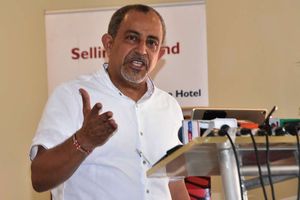
One such incident pits Hassan Omar, Secretary General of the United Democratic Alliance (UDA), against Hassan Joho, Cabinet Secretary for Mining and Blue Economy.
UDA party secretary general Omar Hassan.
Photo credit: File | Nation Media Group
The duo faced each other in the 2017 gubernatorial contest with the latter emerging victorious, but now find themselves in the broad-based government, even though they still do not see eye to eye.
The differences between the two leaders have been renewed by a silent push by some leaders allied to Mr Joho to have him as President Ruto’s running mate in 2027, have exposed fragile fault lines beneath a broad-based arrangement once touted as a symbol of unity and national cohesion.
At the centre of the latest storm is Mr Omar, whose blunt warning to Mr Joho over the 2027 deputy presidency debate has laid bare the simmering tensions.
Mr Omar’s remarks signal an escalating contest over succession politics and the place of newly incorporated leaders within the ruling coalition.
Mining, Blue Economy and Maritime Affairs Cabinet Secretary Hassan Joho
Photo credit: File| Nation Media Group
“The presidency is inseparable,” Mr Omar said, echoing sentiments previously expressed by Senate Speaker Amason Kingi.
“Our deputy president, as UDA, is well known — it is Prof Kithure Kindiki . There’s no way I can go to the ballot with Prof Kindiki and Hassan Joho and choose to vote for Joho. We are not electing leaders for a season, but for seasons.”
By bringing in figures from across the political divide into the broad-based framework, including former critics and opposition heavyweights, the President sought to craft an image of inclusivity and national unity.
But beneath the veneer of cohesion, a different reality is fast taking shape.
A web of rivalries, turf wars, and personality clashes is steadily unravelling the promise of unity, exposing deep-seated political mistrust and competing ambitions.
From the Coast to Western Kenya, senior figures within the broad-based arrangement are locked in bitter supremacy battles — some subtle, others outright confrontational.
These internal “fistfights” are not just personal; insiders warn that they carry significant implications for governance, policy implementation, and ultimately, the President’s re-election prospects.
At the Coast, the rivalry between Mr Omar and CS Joho has become emblematic of the contradictions within Ruto’s political architecture.
Their differences are rooted in history, ideology, and political survival.
Mr Omar has long positioned himself as an alternative voice to ODM dominance at the Coast, while Mr Joho, despite his appointment to the cabinet, remains a formidable figure with deep grassroots networks in the region.
Nyali MP Mohamed Ali, a UDA elected MP, has also in recent times shown signs of defection to Wiper Patriotic Front Party which is in the United Opposition, over what insiders have linked to a feud with Mr Joho.
Nyali MP Mohamed Ali during a function at Khadija Secondary School in Mombasa on January 21, 2026.
Photo credit: Kevin Odit | Nation Media Group
In the Lower Eastern region (Ukambani), the contest between Labour Cabinet Secretary Alfred Mutua and Kibwezi MP Mwengi Mutuse has burst out in the open after the MP led a faction of Maendeleo Chap Chap Party (MCCP) leaders in ditching the party, which is associated with Dr Mutua.
Mr Mutuse, the promoter of the impeachment motion against former Deputy President Rigathi Gachagua, has instead embarked on popularising the United Democratic Alliance (UDA) to the chagrin of Dr Mutua, as details of a sustained push by President Ruto on MCCP to dissolve emerged.
A fierce political rift has opened between Labour CS Alfred Mutua and his long-time ally, Kibwezi West MP Mwengi Mutuse.
Photo credit: Nation
"Some people have shamed the Kamba community," Dr Mutua told a rally at AIC Mukuni in Machakos County on March 3.
The last two weeks have seen Mr Mutuse lead delegations of Machakos and Makueni leaders to meetings with the Head of State at the State House, signalling political realignment as Dr Mutua engaged Machakos residents on the push to dissolve his party.
"We will work closer with President Ruto under UDA. However, the parties are neither dissolving nor merging. MCCP will be parked for now," Mr Mutuse told the Nation in a recent interview.
In Western Kenya, Cooperatives Cabinet Secretary Wycliffe Oparanya has also opened a silent war against his successor, Kakamega Governor Fernandes Barasa, despite the county chief being a member of the Western Kenya Two-Term Movement, formed to steer President Ruto’s re-election campaigns in the region.
The team, which is led by Bungoma Governor Kenneth Lusaka, includes Governors Paul Otuoma (Busia), Wilbur Ottichilo (Vihiga) and Kakamega Deputy Governor Ayub Savula.
The disagreement between Mr Oparanya and Mr Barasa emanated from the ODM party elections, where Kakamega Governor Fernandes Baraza was elected ODM party county chairman against Lugari MP Nabii Nabwera.
Mr Oparanya has however rallied several MPs including Woman Rep Elsie Muhanda behind Mr Nabwera, further throwing the party’s unity and the broad-based at large in the county into disarray.
The political temperatures in the broad-based government have also remained high over ODM party’s staking claim on the deputy presidency come 2027.
The vicious fight has pitted Dr Oginga against DP Kindiki, with the latter choosing to play safe while his allies, led by Public Service CS Geoffrey Ruku leading an anti-Oburu tirade.
During a recent meeting in Embu County, Mr Ruku and Embu Governor Cecily Mbarire told off Dr Oginga over his demands for the DP’s position. He said that the incessant demands were provocative.
Mr Ruku and Ms Mbarire told Dr Oginga that the DP’s seat was not vacant, and he should forget it.
“Prof Kindiki is the Deputy President of the Republic of Kenya; he will be the DP even up to 2032. ODM should look for another seat and leave Kindiki alone. In 2032, Prof Kindiki will be vying for the presidency,” said Mr Ruku.
“The seat of the DP is for Mt Kenya region, and we shall defend it. Nobody can take it away from us; we shall stand with Kindiki and make him even stronger to vie for the presidency in 2032,” he added.
Political analysts say that this highlights the uneasy coexistence between government insiders and ODM loyalists.
The broad-based model, while politically expedient, has effectively brought together leaders with divergent ideologies, competing ambitions, and unresolved historical grievances.
Instead of fostering unity per se, it has, in some cases, transplanted opposition politics into the heart of government.
Advocate Chris Omore says that this has several implications, as competing interests among senior figures can slow down decision-making and hinder the implementation of key policies. Cabinet Secretaries and political leaders focused on regional battles may have little incentive to cooperate on national priorities.”
He argues that conflicting political positions create confusion among the public, weakening the government’s communication strategy and eroding trust.
“Internal divisions make it harder to build a cohesive political base ahead of 2027, as rival factions pull in different directions. Perhaps the biggest beneficiary of these internal wars is the opposition.”
For President Ruto, he says, managing these ambitions will be critical.
Failure to rein in the infighting could weaken his re-election bid, while effective management could turn the broad-based arrangement into a formidable political machine.
“Ultimately, the success or failure of the broad-based government will depend on the President’s ability to balance competing interests without alienating key constituencies, and this will require not just political skill, but also a willingness to enforce discipline and prioritise national interests over individual ambitions.”