Former President Uhuru Kenyatta will tomorrow chair an Azimio Coalition Council meeting in another sign of his growing role in opposition politics ahead of the 2027 General Election.
The meeting comes as opposition leaders race to unite amid concerns that President William Ruto’s allies have gained ground ahead of his re-election bid.
Leaders will discuss Azimio’s future, including plans to reorganise and rebrand it into a broader opposition coalition while retaining constituent parties.
Wiper leader Kalonzo Musyoka has proposed a National Rainbow Coalition (Narc)-style model that allows parties to retain their identities while backing a common presidential candidate.
Wiper Patriotic Front party leader Kalonzo Musyoka.
Photo credit: File | Nation Media Group
Under the proposal, parties would keep their identities while supporting a joint presidential candidate.
In 2002, Mr Odinga’s Liberal Democratic Party joined Mr Kibaki’s National Alliance Party of Kenya to form Narc, which won the presidential election and a parliamentary majority.
However, Democracy for the Citizens Party (DCP) leader Rigathi Gachagua on Friday dismissed suggestions that opposition leaders would endorse a single presidential candidate, saying: “Let everybody market his party. Don’t imagine an endorsement from us. We are mobilising the public. We won’t sit somewhere and dish out positions.”
Although opposition leaders have long promised a united front, competing presidential ambitions have delayed the much-publicised United Opposition convention.
Against that backdrop, Mr Kenyatta has convened Azimio’s top organ to discuss rebranding the coalition ahead of the 2027 election. Makueni Senator Dan Maanzo said Monday’s meeting would focus on reorganising and rebranding Azimio.
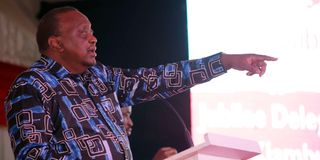
Jubilee Party leader Uhuru Kenyatta (left) with his deputy Fred Matiang'i during the party's delegates meeting at Kiambu Golf Club in Kiambu County on May 25, 2026.
Photo credit: Evans Habil | Nation Media Group
Representatives from Wiper, Jubilee, Kanu and other parties are expected to discuss accommodating emerging formations, including Linda Mwananchi, DCP and the People’s Liberation Party.
Opposition leaders fear they still lack a formal political vehicle to challenge Kenya Kwanza, strengthened by the UDA-ODM cooperation agreement.
ODM leader Oburu Oginga recently said UDA and ODM had each nominated five members for structured talks , underscoring the rapidly evolving political landscape. For opposition strategists, the message is clear: any further delay could prove costly. Senator Dan Maanzo said discussions were underway to reorganise and rebrand Azimio into a more inclusive coalition capable of accommodating new entrants, saying the opposition wanted “a structure that brings together everyone seeking change.”
The proposed model, which political analyst Dismas Mokua described as the most realistic option, would allow parties to field candidates under their own banners while minimising internal competition and preserving the political identities their leaders are reluctant to surrender.
“The probability of party leaders folding their parties into one is almost zero. Political parties give leaders negotiating power and a seat at the table. What is possible is a big-tent coalition where parties retain their identities while backing a common presidential candidate,” Mr Mokua said.
“The opposition’s greatest challenge is not the coalition’s name but whether it can agree on a common vision, governance agenda and decision-making structure. If Azimio becomes an inclusive umbrella treating all parties as equal partners, bringing everyone together is achievable.”
In recent weeks, the Nairobi senator has emerged as an influential opposition figure after consulting Mr Musyoka, Jubilee presidential hopeful Fred Matiang’i and other opposition leaders.
Sources familiar with the discussions said Linda Mwananchi was registering as a political party and was expected to formally join talks on a broader anti-Ruto alliance.
Nairobi Senator Edwin Sifuna engage supporters at Monarch Hotel in Mosocho, Kisii County, on July 3, 2026.
Photo credit: Alex Odhiambo | Nation
The movement’s growing popularity has complicated calculations that previously placed Mr Musyoka and Dr Matiang’i as the leading contenders for the opposition presidential ticket.
“We will engage all formations that support the one-term agenda,” Linda Mwananchi spokesperson Caroli Omondi said.
Until recently, many analysts viewed the race as mainly between Mr Musyoka and Dr Matiang’i, although some in Mr Gachagua’s camp argued he could contest the presidency if he overturns his impeachment in court.
Another question hanging over Monday’s meeting is whether Mr Gachagua and DCP will eventually join a rebranded Azimio coalition.
Democracy for Citizens Party (DCP) leader Rigathi Gachagua.
Photo credit: Bonface Bogita | Nation Media Group
The former Deputy President has emerged as one of the opposition’s most influential figures, drawing large crowds across the Mt Kenya region and positioning himself as the face of resistance to the Kenya Kwanza administration.
However, DCP leaders insist they are not prepared to be absorbed into Azimio.
Embakasi Central MP Benjamin Gathiru, popularly known as Mejja Donk, said any partnership must be based on “numbers and mutual respect”.
“DCP is not part of Azimio, but with agreeable terms we can join, especially for the presidential contest. The coalition must demonstrate its strength in numbers, not just big names.”
His remarks echoed those of DCP deputy party leader Cleophas Malala, who said the party remained focused on building its own structures while remaining open to cooperation.
“We are ready to partner with any coalition that believes President Ruto should serve only one term,” Mr Malala told the Nation.
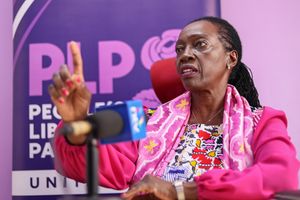
People’s Liberation Party leader Martha Karua.
Photo credit: Wilfred Nyangaresi | Nation Media Group
“Perish the thought that we shall return to one-party politics, whether in the opposition or government. Even the government we seek to remove is a coalition, and so is the opposition. Let us not deceive ourselves; we will never have a one-party state because our Constitution does not permit it,” she said in Murang’a on Friday.
Jubilee insiders have privately expressed discomfort with Mr Musyoka’s elevation as Azimio leader, arguing that it could disadvantage their preferred presidential candidate, Dr Matiang’i.
However, Jubilee co-deputy party leader Jeremiah Kioni said Mr Musyoka’s appointment was purely administrative.
“Kalonzo was picked because he was the senior-most politician remaining in Azimio after Raila’s exit. We do not expect a presidential candidate to preside over selecting the coalition’s presidential candidate.”
Behind the scenes, sources close to Dr Matiang’i said his camp was closely monitoring developments.
Their concern has grown amid discussions on several possible opposition ticket combinations, including Kalonzo-Matiang’i, Matiang’i-Kalonzo, Kalonzo-Sifuna and Sifuna-Kalonzo.
While Jubilee publicly supports coalition talks, some strategists fear momentum is building around a Kalonzo-Sifuna ticket that could leave Dr Matiang’i isolated despite being the party’s preferred candidate.
The emerging strategy mirrors events leading to the 2002 General Election, when opposition parties and Kanu defectors united under Narc to end the ruling party’s four-decade hold on power.
Led by Mr Kibaki and backed by Mr Odinga, Michael Wamalwa Kijana and Charity Ngilu, Narc capitalised on the famous “Kibaki Tosha” moment to defeat Mr Kenyatta, who was backed by President Daniel arap Moi’s Kanu. Mr Musyoka believes a similar model can succeed again.
“We shall discuss the details. The parties will come together and compete. Whoever emerges victorious will carry the coalition’s flag.”
Unlike in 2002, however, today’s opposition faces a far more complex political environment.
History offers a cautionary lesson. The opposition paid heavily for fragmentation in the 1992 and 1997 elections.
As Monday’s meeting convenes under Mr Kenyatta’s stewardship, opposition leaders face a defining test: whether they can move beyond personal ambitions and build a coalition capable of convincing Kenyans that it offers a credible alternative government.
The outcome could determine not only the future of Azimio but also whether the anti-Ruto movement enters the 2027 General Election united or divided.