Officials of the electoral agency, the commission tasked to check hate speech and clergy have warned that the dangerous rhetoric by various political factions is a recipe for disaster.
The country is quickly entering campaign mode, even though the elections are still some 16 months away, with an emerging pattern of brinkmanship by politicians led by President William Ruto and his rivals, mainly former Deputy President Rigathi Gachagua.
The public insults come on the back of worrying developments, including chaotic political events in which deaths and injuries have been reported, as well as violence during church meetings attended by politicians, especially Mr Gachagua.
From public rallies laced with sharp insults to behind-the-scenes strategies aimed at outmanoeuvring opponents, the political class appears to be courting trouble—raising fears that the country could slide into a familiar cycle of division if restraint and issue-based engagement is not restored.
'They started it': Ruto doubles down on insults against Opposition leaders in Busia visit today
Dr Danvas Makori, a commissioner at the National Cohesion and Integration Commission (NCIC), cautioned that the country is treading a dangerous path and urged leaders to exercise restraint before tensions spiral out of control.
“It doesn’t bode well for the country. Differences should not degenerate to that level,” he warned.
He emphasised that while political competition is inevitable, it must remain within the bounds of respect and national unity.
He cautioned about the power of the tongue, saying that just as a single matchstick can trigger a catastrophic wildfire that consumes millions of trees, so too can the words of politicians.
Ruto goes bare-knuckles: Wengine waende gym, kichwa iko karibu inapasuka
He termed the political situation in the country a “clear case of courting trouble” and told leaders to be mindful of the weight of their words in a politically charged environment.
He urged leaders across the political divide to shift focus from personal attacks and political grandstanding to addressing the real challenges facing citizens, pointing to the economic strain and social concerns affecting millions.
Independent Electoral and Boundaries Commission (IEBC) Chairperson Erastus Ethekon said that the commission was concerned about rising cases of political intolerance. While condemning the “violence, disorder, intimidation and unlawful conduct” linked to recent political gatherings, the IEBC boss said the trend threatens public safety and undermines constitutional principles governing political competition.
He added that reports of injuries and confrontations at recent rallies and political events had raised “grave concerns” about compliance with the law.
Ruto: You can't steal from widows and their children then lecture us
“Political rights must be exercised responsibly,” Mr Ethekon said, urging political parties, candidates, supporters and event organisers to uphold public order.
Anglican Church of Kenya Bishop David Kodia yesterday also criticised the rising tide of insults among political leaders, warning that such conduct undermines civility and erodes the moral authority expected of those in positions of power.
Speaking in reference to recent political exchanges, Prof Kodia recalled that he had raised similar concerns when the church hosted President Ruto in Bondo.
“I urged leaders not to use insults. It does not auger well with civility,” he said, noting that political leaders are regarded as role models whose words and actions influence millions. He added that public spats and the airing of political differences through harsh language risk eroding the moral fabric of society.
“Leaders are parents, and many people look to them for moral guidance. When they wash dirty linen in public, it erodes that,” he said.
Politics in the country appears not to just be getting dirtier but also vicious. The arena has been marked by public rallies that descend into verbal insults and personal attacks, and organised goons storming private properties. There have also been violent invasions of church gatherings; police raids and summons targeting government critics; chaotic party grassroots elections; and retaliatory confrontations at funerals, fundraisers and sporting events.
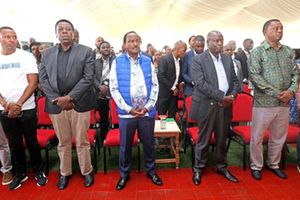
From left: Opposition chiefs Eugene Wamalwa, Kalonzo Musyoka, Rigathi Gachagua and Justine Muturi during Interdenominational service at Kitharani Grounds in Gatanga Constituency on March 15, 2026.
Photo credit: Pool
In one of the lowest moments of political campaigning in Kenya, the country’s leaders on Tuesday descended into mudslinging, name-calling, body-shaming, raw insults and generally indecent language. The competition for power in 2027 has devolved into a bruising contest of egos, accusations and counter-accusations, with little regard for decorum or policy direction.
The exchanges, delivered in charged public rallies, leaders have warned, have not only lowered the tone of national discourse, but also set a worrying precedent for the country’s democratic culture.
Political commentators Prof Gitile Naituli of Multi-Media University and Mr Dismas Mokua hold that the escalating political exchanges in the country signal the early stages of a calculated and high-stakes electoral contest.
Prof Naituli argues that both President Ruto and the United Opposition are deliberately crafting narratives aimed at shaping public perception ahead of the 2027 General Election.
According to him, the president’s camp is working to frame the opposition as disorganised, ethnic-driven and grievance-based, a strategy he says is designed to erode its credibility before it fully consolidates.
“It is a pre-emptive delegitimisation strategy that conditions the public to associate opposition unity with instability rather than governance,” he argues.
Prof Naituli notes that the opposition’s attacks seek to portray the Ruto administration as illegitimate, corrupt and harmful to the country’s social fabric. This, he explains, is meant to transform the next election into a moral judgment on leadership rather than a comparison of performance.
For Mr Mokua, the rise of insults and provocative rhetoric is a communication strategy by politicians seeking to dominate public attention and outmanoeuvre rivals. He says leaders with strong oratory skills have “perfected the art of insults” as a tool to push policy positions while discrediting competitors.
He notes that such tactics are not unique to Kenya, citing figures like Winston Churchill, and Donald Trump, who has frequently used provocative language in public.
United Opposition leaders led by DCP Party Leader Rigathi Gachagua, DAP K's Eugene Wamalwa and Mithika Linturi during a rally in Heshima, Bahati sub-county in Nakuru City on February 28, 2026.
Photo credit: Boniface Mwangi | Nation Media Group
Yesterday, President Ruto maintained that the opposition offers no better plan. He vowed to take them head on whenever they attack him.
“When our competitors rise to engage on issues, we shall meet them there with clarity and reason. But when they descend into insults and distraction, we shall not lose focus; we will dedicate only 1 per cent of our time to respond to them. The remaining 99 per cent of our time is reserved for what truly matters; serving Kenyans,” said President Ruto.
Deputy President Kithure Kindiki defend his boss, insisting that there was nothing “un-presidential” about his sentiments against the opposition.
“The opposition deserves what they got for demeaning and insulting the president, being disrespectful to the presidency,” he said.
From Kiambu to Western Kenya, the rhetoric has grown increasingly harsh, with both the government and opposition deploying language that critics say borders on incitement. The tone, cadence and choice of words—often laced with anger and ridicule—have left many Kenyans questioning whether the country’s leadership is losing sight of its responsibility to unite rather than divide.
As leaders trade barbs, their supporters often interpret the hostility as licence for confrontation, leading to cycles of retaliation.
Beyond the rhetoric, the situation on the ground has been equally troubling. Properties linked to prominent figures, including former Cabinet Secretary Raphael Tuju and ex-Principal Secretary Irungu Nyakera, have come under attack from suspected hired goons.
Safina Party leader Jimi Wanjigi and Siaya Governor James Orengo yesterday railed against the current political trajectory.
Mr Wanjigi told the Nation that the fixation on personalities and verbal duels is masking a deeper failure by the political class to articulate meaningful solutions.
“If its agenda, they all lack the credibility. We need to sell our agenda to the people and give them better alternatives. We must elevate the debate to people issues,” he said.
People’s Liberation Party leader Martha Karua with other opposition leaders during PLP's launch in Nairobi on February 27, 2025.
Photo credit: Boniface Bogita | Nation Media Group
Mr Orengo said: “The president must be called to order. His utterances amount to abomination, which constitutes hate speech.” He warned that such language could inflame tensions and erode national unity.
Social media has further complicated the situation. Platforms have become battlegrounds where misinformation, doctored content and inflammatory messaging spread rapidly, amplifying divisions and deepening mistrust.
Civil society groups and governance experts warn that the erosion of civility in political discourse, coupled with rising violence, risks undermining decades of democratic gains.
In the past, Kenya has experienced the consequences of unchecked political hostility, most notably during the 2007/08 post-election violence. The conflict resulted in more than 1,300 deaths and more than 600,000 people displaced. There were hundreds of rapes and over destruction of properties worth millions. Memories of that period continue to serve as a stark reminder of how quickly tensions can spiral out of control.