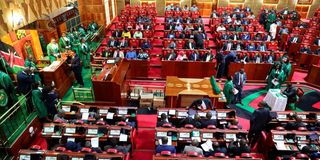
Members of Parliament have backed a Bill seeking to compel the government to provide financial resources, learning and teaching equipment to Alternative Provision of Basic Education and Training schools (APBET).
APBET schools are informal schools that operate in informal settlements, mostly in towns and cities. They include adult and continuing education centres, non-formal education and learning centres, alternative education learning programs and informal programs, mobile schools and night schools
These learning centres often use churches, social centres and other places as their operation areas to provide education to children and adults in the informal settlements.
However these schools are not recognised under the Basic Education Act of 2013 which only categorises schools as either public or private.
Learners in these institutions do not have the National Education Management Information System (Nemis) hence miss out on government capitation and any other resources channelled to other formal education centres.
The government uses Nemis to calculate capitation to schools. The unique identifier number is also used by the Kenya National Examination Council (KNEC) to register learners for exams.
Mathare MP Anthony Oluoch during a previous press briefing.
Photo credit: File | Diana Ngila | Nation Media Group
However, through the Basic Education (Amendment) Bill, 2025 sponsored by Mathare MP Anthony Oluoch, lawmakers now want the government to formally recognise these schools and offer them financial support.
Clause two of the Bill seeks to amend the Basic Education Act so as to make APBET schools fall within the basic education framework and therefore benefit from budgeting and other government support for the development of infrastructure
“Section 26 of the Principal Act is amended by inserting the new paragraph. Provide infrastructure for all schools, including Alternative Provision of Basic Education and Training schools, learning and teaching equipment and appropriate financial resources,” reads the Bill.
During debate of the Bill, MPs pointed out that children in these schools should not be discriminated against by the government since education is a constitutional right.
“There are these 3 million children who are neither in public nor private schools, and because they don’t have the Nemis number they are not planned for, so the question is what happens to them? Asked Mr Oluoch.
“The constitution does not contemplate treating other children as children of lesser God and are not part of the government plan in terms of infrastructure,” he added.
Mr Oluoch pointed out that despite the schools operating outside the ambit of the Basic Education Act, they operate under a curriculum used by other formal schools.
“Why would 3 million Kenyan children under the new constitution that talks about equality, equalisation, and affirmative action be discriminated against? Why can’t we use the same affirmative action to equalise those children in the informal sector?" He asked.
National Assembly Deputy Speaker Gladys Boss Shollei during an interview at her home in Kitusuru, Nairobi on July 2, 2025.
Photo credit: File | Nation
Deputy Speaker Gladys Boss, while supporting the Bill, pointed out that the problem is widespread across the country.
She said the Bill, if passed into law, will complement the government effort to provide basic education to all children in the country.
“The right to basic education must be enjoyed directly by that young child, it should not only be enjoyed through a formal facility. It doesn't make sense because it seems like the right to education belongs to formal schools rather than the individual child,” she said.
“The fact is these informal schools exist and our children go to them because they can’t access the formal schools,” she added.
Ruaraka MP Tom Kajwang' pointed out that parents of children in APBET schools are normally worried about the future of their children’s education because the institutions are not formally recognised by the government.
“Nobody is ever happy taking their children to squalid places, this is not just an informal sector problem. This is a national problem that we must face. How will these children transition to Higher education, tertiary and vocational if we don’t plan for them effectively? He asked.
Mr Kajwang’ claimed that education inspectors inspect the schools, but when the children want to register for exams, they are told they are not recognised.
“So these schools have been used as a cash cow, where inspectors and chiefs threaten sponsors of closing them if they are not given something,” he said.
“Parents are therefore constantly worried and their only mistake is to live in the informal sector,” Mr Kajwang’ said.
Kibra MP Peter Orero said the same funding model being used to fund other schools must also be used to fund APBET schools
“Why would the government not support these children, it’s not their wish nor the wish of their parents to live in the informal sector,” he said.
National Assembly committee on Health chairperson and Seme MP James Nyikal.
Photo credit: Jared Nyataya | Nation Media Group
Seme MP James Nyikal termed the Bill as a constitutional matter that seeks to achieve inclusivity currently not captured in the Basic Education Act 2013
“One of the members of the board shall be the National chairperson of Alternative Provision of Basic Education and Training schools in Kenya,” reads the Bill.
It also seek to amend the principal education act in order to allow the National education Board to oversee operations of the APBET schools
Through the Bill, the County Education director will be required to maintain data of all the APBET schools in their respective counties
An analysis from the Parliamentary Budget Office indicates that over 3 million Kenyans in APBET schools are excluded from receiving capitation under Nemis and funds for infrastructure development under the Basic Education Act
According to a 2014 United Nations Children's Fund (UNICEF) report titled Out of school children situation in Kenya , 852,000 children aged between six and 17 years are out of school
According to the 2019 census data, persons between the ages of 10 and 14 years are 6.3 million whereas the enrolment levels in primary schools class five to eight is five million.
This implies that close to 1.3 million children who are supposed to be in school are either at home or attending informal schools.