Political parties are uncomfortable with the electoral commission’s broad powers to control campaign financing, detailed donor disclosures and restrictions on loans from individuals, even as poll chiefs clashed with MPs in Parliament over the spending caps.
United Democratic Alliance (UDA) and Orange Democratic Movement (ODM) are among major parties that have expressed these reservations on the election campaign financing regulations that impose spending ceilings, including Sh6 billion for presidential candidates.
President Ruto’s UDA is concerned that “the audit and investigative powers of the commission may lack express procedural safeguards” and insists “any sanctions against non-compliance should not exceed or bypass” those provided for under the Election Campaign Financing (ECF Act).
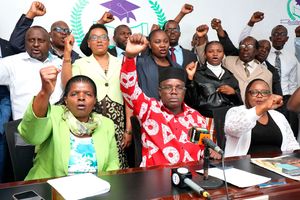
ODM party leader Oburu Odinga is presented with the instruments of power during the Orange Democratic Movement (ODM) Special Delegates Convention at the A.S.K Dome, Jamhuri Expo Centre in Nairobi.
Photo credit: Bonface Bogita | Nation Media Group
Dr Oburu Oginga’s ODM has complained that the commission’s investigative powers are broad, donor disclosure obligations are excessive and proposes changes to limit public disclosure to reportable donations.
In a bid to shield more funds from scrutiny, ODM also proposes the mandatory audit threshold be increased from Sh5 million to Sh20 million.
“The proposed Sh20 million limit is too high,” the Independent Electoral and Boundaries Commission (IEBC) counters in its report dated October 19. “To achieve transparency and accountability, the Commission has amended regulation 26 to require the preparation of an audit report of campaign expenses exceeding Sh750,000 by a registered auditor,” the report says.
ODM has also criticised provisions that intrude on the privacy of donors by collecting “unnecessary personal data contrary to privacy principles.”
Instead, ODM is proposing an amendment to “require only information necessary to identify contributors” and further wants introduction of a statutory disclosure threshold, which the party proposes is capped at Sh100, 000.
But the IEBC has rejected this proposal, saying “the information required is necessary for the Commission to ensure effective regulation of election campaign financing.”
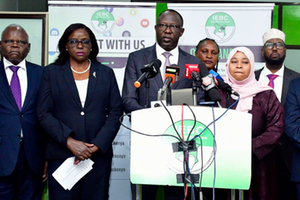
UDA Party Chaiperson Cecily Mbarire (centre), flanked by UDA leaders, speaks to the media at the party headquarters in Nairobi on January 21, 2026.
Photo credit: Wilfred Nyangaresi | Nation Media Group
IEBC also rejects another ODM proposal to limit public disclosure to only authorised persons, citing privacy and security concerns, saying the Commission will process all information in compliance with the Data Protection Act.
ODM has also criticised another regulation restricting loans to financial institutions authorised under the Banking Act, which the party argues restricts access to lawful campaign financing for smaller parties.
The Orange party wants the regulation amended to “permit loans from political parties and individuals provided they are disclosed and comply with statutory limits.”
IEBC has, however, rejected the proposal, saying the restriction is necessary to discourage questionable political contributions that circumvent the law disguised as loans.
“Restricting loans to financial institutions authorised under the Banking Act is to safeguard the integrity, transparency and accountability of campaign financing by ensuring that loans used to finance election campaigns are legitimate commercial transactions rather than disguised political contributions,” IEBC says.
Progressive Party of Kenya (PPK) has also challenged the basis for the presidential ceiling derived by averaging three widely divergent county/constituency/ ward estimates without explaining the methodology.
Transport ceiling of Sh11.8 billion
The party wants IEBC to publish the complete spending-limit model, weights, formulas, and the Model 4 derivation included, not only the final output table.
“This observation is appreciated. The requested model will be made available. The Commission relied on the published 2009 Population Census report (Recent data/formula on allocation of resources to be confirmed with Commission for Revenue Allocation),” IEBC says.
IEBC also commits to review the transport ceiling of Sh11.8 billion, which PPK notes at 67 per cent of party total, it “is too high.”
UDA, like other parties, including the Grassroots Development party, wants the regulations amended “to limit directives strictly to administrative implementation and prohibit any directive that creates new legal obligations.”
However, IEBC has defended its authority, saying the Statutory Instruments Act gives the Commission the discretion to issue directives and guidelines, including modification of forms, where necessary, for full implementation of the ECF Act.
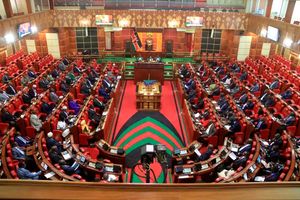
In the National Assembly on Thursday, October 22, 2026, IEBC officials and members of the Delegated Legislation committee clashed over who had the ultimate authority to approve the Election Campaign Financing Regulations, 2026.
The committee chaired by Ainabkoi MP Samuel Chepkong’a insisted that the Legislature maintains the statutory right to vet, alter, or reject the newly introduced campaign spending limits before they can take effect.
“You gazetted but never remitted to Parliament for a review. Anything that has a consequence of the law must pass through Parliament,” said Mr Chepkong’a, citing Article 94 (5) of the Constitution.
The Article states that “no person or body, other than Parliament, has the power to make provision having the force of law in Kenya except under authority conferred by this constitution or by legislation.”
“We intended that everything must go through Parliament,” said Mr Chepkong’a.
Article 88 (4) (i) of the Constitution mandates the IEBC to regulate the amount of money that may be spent by candidates and political parties during an election, to promote equity in electoral competition, curb undue financial influence and safeguard public confidence in electoral outcomes.
However, IEBC chairperson Erastus Ethekon rejected parliament's oversight role, arguing that the constitution and the law give the commission an independent and absolute mandate to gazette and enforce the spending caps without requiring parliamentary green light.
Dr Ethekon told the committee the court has since settled the dispute over whether the regulations need parliamentary approval before implementation.
“The law does not require parliamentary approval. It is self-executing,” said Dr Ethekon.
The High Court, among others, held that the regulations are statutory, not constitutional instruments.
The Independent Electoral and Boundaries Commission Chairperson, Erastus Ethekon.
Photo credit: File | Nation
It held that section 29 (1) of the Election Campaign Financing Act requiring parliamentary approval before gazettement is unconstitutional “in so far as it requires Parliament to approve the regulations before publication.”
Further, the court established that sections 12, 18 and 19 of the Act do not require parliamentary approval but “must be subjected to appropriate public participation.”
“It was this directive that the current regulations and the accompanying public participation exercise were intended to satisfy,” reads the IEBC document presented to the committee.
“This side (MPs) is aggrieved. We are seeing the regulations for the first time. Maybe you need to consider the public participation exercise on people who represent the electorate next time in the spirit of fairness,” Mr Chepkong’a responded.
In an attempt to have the regulations shot down, Mr Chepkong’a had accused the IEBC of failing to remit them to parliament, but Dr Ethekon told him that all the documents were presented to the National Assembly, including the public participation report, among others.
However, the High Court has temporarily stopped implementation of the new election expenditure limits gazetted by IEBC on August 7, 2026, introducing stringent cash ceilings for various elective posts to limit disproportionate spending for next year’s General Election, pending determination of a petition.
The court order blocking implementation of the new spending rules presented an opportunity for the committee to disembark from an exercise the members felt they were not involved.
“It will be a zero-sum game for us to consider the regulations that have been stayed by the court,” the Ainabkoi MP said as he adjourned the meeting.
The court order effectively halts any immediate parliamentary deliberations or regulatory enforcement ahead of next year’s General Election.
Because these positions share identical geographical boundaries, they share identical caps within their specific region, scaling dynamically based on the regional matrix.
For instance, the high-geographic sprawl baseline- Turkana and Marsabit had different limits.
“The spending limits that a candidate for County Elections may spend during an expenditure period in Turkana County shall be Sh142.1 and in Marsabit County Sh127.02 million.”
This means that the spending limits that a candidate for county elections may spend during an expenditure period in Vihiga County shall be 37 million and Sh28.7 million for Lamu County.
The Third Schedule outlines individual caps for the 290 constituencies, highlighting extremes such as North Horr Constituency capped at Sh100.42 million and Wundanyi Constituency capped at Sh15.43 million.
The Fourth Schedule sets localised ward caps, noting examples like Turbi Ward in Marsabit County at Sh22.1 million and Ziwani/Kariokor Ward in Nairobi City County at Sh3.63 million.
Campaign expenses may only be incurred for approved purposes such as campaign venues, publicity materials, advertising, personnel, transport, and other administrative costs.
But the implementation of these caps was challenged in a suit by the Republican Liberty Party and the Grassroots Development Party.
The petitioners contested the omission of transparency and audit processes on the basis that the commission deliberately left out clear transparency and tracking requirements regarding how campaign funds will actually be used.
The failure to enforce source disclosure was also questioned. The petitioners noted that the regulations create a loophole for illicit and unmonitored "dark money" to flood the electoral system.
“The IEBC failed to strictly require political aspirants to disclose the sources of their campaign donations.”
The petitioners argued that without stringent safeguards, monitoring systems and digital spending controls, unregulated finances will inevitably be deployed for widespread voter bribery and buying influence ahead of the 2027 polls.