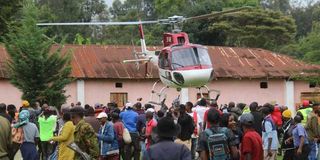
Chartered helicopters ferrying politicians across the country, billion-shilling campaign budgets and an expanding army of political consultants have become defining features of Kenya’s elections, raising concerns that financial muscle is increasingly determining political competition.
With the 2027 General Election about a year away, analysts, election observers and campaign strategists agree it is shaping up to be the country’s most expensive election.
The rising cost of seeking office has fuelled fears that politics is becoming the preserve of wealthy candidates and deep-pocketed financiers.
Critics argue that such spending in political campaigns is often viewed as a long-term investment, with financiers expecting influence and access to public contracts once their preferred candidates assume office.
The trend contrasts sharply with the ideals advanced by Greek philosopher Plato in The Republic, where he argued that “it is an essential feature of the just state that the wealthy be kept away from political power and that the politically powerful be kept away from wealth.”
Under the proposed Election Campaign Financing Regulations and the Election Campaign Contribution, Spending Limits and Authorised Expenditures published on July 6, 2026, presidential candidates would be allowed to spend up to Sh4.44 billion, while political parties fielding candidates from MCA to presidential level would have a combined ceiling of Sh17.7 billion.
Governorship, Senate and woman representative candidates would face limits ranging from Sh12.3 million to Sh123 million, depending on electoral area size and population.
Parliamentary candidates would spend between Sh17.5 million and Sh123 million, while MCA candidates would be capped at Sh2.5 million to Sh20 million.
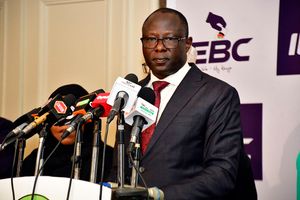
“The proposed regulations aim to strengthen accountability in the management of campaign funds by candidates and political parties,” IEBC chairperson Erastus Ethekon said.
Independent Electoral and Boundaries Commission Chairperson Erastus Edung Ethekon during the signing of a Memorandum of Understanding between IEBC and the Kenya Media Sector Working Group on March 27, 2026 at Pullman Hotel.
Photo credit: Francis Nderitu | Nation Media Group
Even before the rules take effect, campaign financing has become a political battleground, with the opposition accusing President William Ruto’s administration of using state resources and financial muscle to influence by-election outcomes.
The allegations have focused on the Ol Kalou parliamentary by-election, which opposition leaders describe as a preview of strategies likely to dominate the 2027 race.
Democracy for the Citizens Party leader Rigathi Gachagua claimed government officials had descended on the constituency with a fleet of helicopters.
“Government officials in Ol Kalou are more than voters… helicopters are almost crashing down because of a heavy aerial traffic jam in Ol Kalou,” Mr Gachagua remarked.
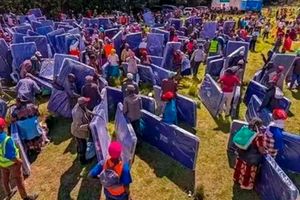
In a joint statement, former Chief Justice David Maraga, Wiper leader Kalonzo Musyoka , Jubilee Party leader Fred Matiang’i, People’s Liberation Party leader Martha Karua and Linda Mwananchi de facto leader Edwin Sifuna alleged voters were being influenced through cash handouts, government-branded mattresses, gas cylinders and hastily launched projects.
They warned that if the trend reflected next year’s national campaigns, Kenyans had reason to worry because public resources should not become campaign tools.
Government Spokesperson Isaac Mwaura dismissed the allegations as misleading, while National Assembly Majority Leader Kimani Ichung’wah described them as false, baseless and malicious.
Mr Ichung’wah accused Mr Gachagua of resorting to “cheap theatrics, manufactured propaganda and outright lies” after allegedly realising his preferred candidate was headed for defeat.
Beyond the political exchanges, analysts say the Ol Kalou contest has revived concerns about the growing influence of money in elections and whether existing safeguards can guarantee a level playing field.
Residents of Ol Kalou Constituency in Nyandarua County receive mattresses, blankets, and gas cylinders as campaigns for the July 16 by-election gather momentum.
Photo credit: Pool
The debate extends beyond public rallies and by-elections. Beneath the campaign machinery lies an opaque political financing system in which wealthy individuals, business interests and financiers wield significant influence, often without public scrutiny despite disclosure requirements.
The role of money was evident during the 2022 General Election when former President Uhuru Kenyatta rallied businessmen associated with the Mt Kenya Foundation, led by chairman Peter Munga, to support the presidential bid of late Azimio la Umoja candidate Raila Odinga . The foundation had earlier organised a Sh1 million-a-plate fundraising dinner to boost Mr Kenyatta’s campaign war chest.
For opposition parties, matching the financial and logistical advantage of an incumbent administration remains a major challenge.
A member of the United Opposition’s technical committee said the coalition was developing “an appropriate resource mobilisation framework for campaign sustainability”.
Political analysts say the challenge is not new. University of Nairobi Institute for Development Studies research professor Karuti Kanyinga has estimated that a competitive presidential campaign requires at least Sh14 billion.
“Running for presidency in Kenya does not cost you less than Sh14 billion, especially the last three days to an election,” Prof Kanyinga said during the launch of an analysis of Political Participation of Women in the Political Economy in Nairobi in 2023.
Ms Karua rejected the idea that electoral success should depend on financial strength, arguing voters should judge candidates on integrity, competence and public service records rather than campaign budgets.
“We will not spend above our means; we will not borrow for the campaign, nor shall we use public resources. We shall use what we have and what we collect from our supporters.”
Energy Principal Secretary Alex Wachira gifts an Ol Kalou ward electorate with a six kilogram gas cylinder on July 7, 2026.
Photo credit: Boniface Mwangi | Nation Media Group
Other opposition leaders argue that the challenge extends beyond raising campaign funds to ensuring that state resources are not used to tilt the electoral playing field in favour of incumbents. Dr Matiang’i cited recent by-election campaigns as evidence of what he described as the misuse of public resources.
“In a single ward where you could just walk through, the government operatives would land with choppers, money and arrogance. That’s a clear abuse of state power,” he said.
Nyamira Senator Okong’o Omogeni echoed the concern, claiming that as many as six helicopters had been deployed during a recent MCA by-election in the county. “An amount that can be spent to pay for Kenyans’ healthcare is simply used to bribe voters.”
Former Cabinet Secretary Mithika Linturi also alleged that up to Sh600 million was spent during last year’s Mbeere North parliamentary by-election campaign, underscoring what opposition figures describe as the escalating cost of competitive elections.
DAP-Kenya leader Eugene Wamalwa said discussions on the coalition’s presidential flag bearer and campaign financing strategy were still underway but declined to disclose details, saying they remained part of the alliance’s internal planning. He maintained that the coalition was opposed to corruption in all its forms.
Election observers and governance experts argue that Kenya’s greatest weakness is not the absence of campaign finance laws but the persistent failure to enforce them.
Centre for Multiparty Democracy Executive Director Frankline Mukwanja said the country should fully operationalise campaign finance regulations, require real-time disclosure of donations and expenditure, strengthen IEBC audits and impose meaningful sanctions on candidates and parties that violate the rules.
“Transparency is essential to safeguard electoral integrity and public trust,” Mr Mukwanja said, warning that opaque financing continues to conceal the identities of financiers and the true scale of campaign spending.
Elections Observation Group (ELOG) coordinator Mulle Musau said Kenya already has a legal framework through the Campaign Financing Act, 2013, which defines lawful and unlawful sources of campaign funds, empowers the IEBC to regulate campaign financing and requires candidates to disclose both the sources and use of campaign money.
Mr Musau attributed delays in implementing the law to Parliament’s reluctance to approve the commission’s proposals, which he linked to vested political interests. However, he noted that a High Court ruling has since cleared the way for the IEBC to develop regulations following public participation.
Governance experts say transparency and accountability must remain central to Kenya’s electoral process if the country is to prevent money from becoming the decisive factor in political competition.
Kenya National Civil Society Centre Executive Director Suba Churchill said openness in campaign financing was part of the broader constitutional requirement for accountable governance.
“It’s not only elections in Kenya that require transparency. Transparency, accountability, rule of law and good governance form an integral part of the national values and principles of governance that should underpin all processes in the management of public affairs,” he told the Sunday Nation.
Political commentator Mark Bichachi said opposition parties would need to rethink their campaign strategies by combining stronger fundraising structures with greater use of technology to compete effectively.
Multimedia University professor Gitile Naituli noted that while incumbency provides President Ruto with significant advantages, money alone does not determine electoral victory.
“Campaign resources unquestionably matter in presidential elections. However, history teaches us that elections are not won by money alone. Resources are important, but they are not sufficient conditions for victory,” he said.
As Kenya heads towards another closely contested General Election, the debate over campaign financing is likely to intensify.
The proposed IEBC regulations represent an attempt to bring greater order to an electoral system where campaign spending has often operated with limited transparency.
However, analysts warn that rules alone will not be enough. Their effectiveness will depend on enforcement, disclosure of political donations, independent oversight and voters’ willingness to reject inducements.
Without these safeguards, Kenya risks moving towards elections where financial power outweighs ideas, integrity and leadership.
In that contest, the price of political victory could ultimately become too high for democracy itself.