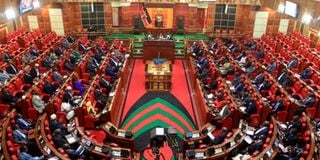
Election-related Bills meant to facilitate implementation of electoral reforms and preparations for the next years’ General Election will be given priority as the National Assembly resumes sittings on Tuesday next week.
The lawamkers will be resuming for the second part of the fifth session with the Justice and Legal Affairs Committee expected to table its report on its consideration of various proposals from the Independent Electoral and Boundaries Commission (IEBC) ahead of the 2027 polls.
The electoral agency had told parliament that they need all elections related Bills considered and concluded by August 31.
Electoral reforms have always been undertaken at least one year before the general election in line with the Kriegler Commission Report which recommended that the electoral and legal reforms should be completed at least one year before the election date.
This was the case in the 11th Parliament where the 2016 electoral reforms that were spearheaded by the Parliamentary Joint Select Committee on the IEBC and electoral legislation were enacted with more than one year to the election date.
Among the proposals that the electoral commission wants parliament to consider is repealing of Section 20 (breach of Electoral Code of Conduct) in order to give prosecutorial powers of election offences related cases.
According to IEBC, the mandate to deal with electoral related matters is an exclusive function of the commission and not that of the Office of Director of Public Prosecutions’.
The legal affairs committee has been reviewing a proposal by IEBC seeking to review Clause 19 (8A) of the Elections Laws (Amendment) Bill, in order to provide that for one to be nominated in the county assembly of a respective political party, the individual must be a registered voter in that particular county.
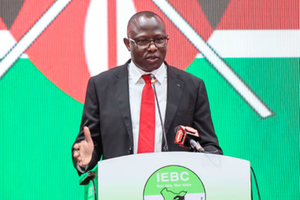
Independent Electoral and Boundaries Commission (IEBC) Chairperson Erastus Edung Ethekon during the launch of the IEBC Strategic Plan 2024–2029 and Election Operations Plan 2025–2027 at the Kenyatta International Convention Centre in Nairobi on June 24, 2026.
Photo credit: Wilfred Nyangaresi | Nation Media Group
According to the dispatch from Parliament, the House has also lined up the Kenya Revenue Authority (Amendment) Bill, 2026, Strategic Goods Control Bill, 2026, the County Governments Election Laws (Amendment) Bill (Senate Bill No. 2 of 2024) among others for consideration during this fifth session.
The Kenya Revenue Authority (Amendment) Bill, 2026 seeks to amend the Kenya Revenue Authority Act to strengthen tax administration, improve operational efficiency and enhance revenue collection
The Strategic Goods Control Bill, 2026 seeks to establish a legal framework for regulating, controlling and monitoring strategic goods, technology and related services in order to meet Kenya’s international non-proliferation and security obligations
The County Governments Election Laws (Amendment) Bill (Senate Bill No. 2 of 2024) which seeks to amend the Elections Act and County Governments Act to provide for nomination of members to a county assembly to represent marginalized groups.
With 13 months to the elections, the House is racing against time to ensure that important Bills are passed before the lawmakers break for 2027 campaigns.
To this end, the House leadership has resolved to prioritise only budget related matters, electoral laws and constitutional amendment Bills that have an effect on the 2027 polls during the remaining short period.
The House racing against the financial cycle which often runs between February to June which is the period within which the National Assembly is required to consider and pass the budget policy statement such as the debt management strategy, the budget estimates, and key financial legislation including the Division of Revenue and County Allocation of Revenue Bills, the Appropriation and Supplementary Appropriation Bills and the Finance Bill.
Since the consideration of the budget and attendant legislation has key constitutional and statutory timelines, lawmakers have no choice but to burn the midnight oil to ensure compliance with the law in concluding the budget cycle in particular for the next financial year.
The consideration of the budget is crucial since it is from the allocations that IEBC is waiting for to get resources to conduct the 2027 general election.
The 13th Parliament is expected to proceed for sine die (where Parliament shall adjourn indefinitely until after the general election is held) in June, 2027, a move now makes the House to operate in a tight schedule.
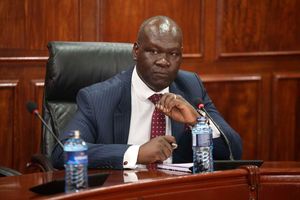
The Independent Electoral and Boundaries Commission (IEBC) Chairperson Erastus Edung Ethekon (right), Vice Chairperson Fahima Araphat Abdallah (centre) and commissioner Hassan Noor Hassan when they appeared before the Constitution Implementation Oversight Committee at Parliament Buildings in Nairobi on September 25, 2025.
Photo credit: DENNIS ONSONGO | NATION
The decision to only consider key legislations was informed by hard lessons drawn from previous Parliaments, particularly the 10th Parliament, where some lawmakers lost their seats after remaining in Nairobi to complete legislative business while their political competitors were actively campaigning in their constituencies.
Speaking during this year's annual National Assembly legislative retreat in Naivasha, Clerk of the National Assembly Samuel Njoroge said they intend to release members early hence the House will only prioritise critical legislative business.
“By mid-June, around June 18, we plan for a sine die recess so that members are able to go out and campaign. We learned from the lessons of the 10th Parliament that when we hold members back to do parliamentary business while your competitors are on the ground, we disadvantage you,” Mr Njoroge said.
In relation to Bills proposing to amend the Constitution, the Constitution of Kenya (Amendment) Bill, 2025 is pending consideration at the Senate having been passed by the National Assembly in July last year.
The Bill seeks to entrench the three key development Funds namely the National Government Constituencies Development Fund, Senate Oversight Fund and the National Government Affirmative Action Fund.
The Bill is critical in resolving the long-standing challenges in the implementation of the funds and is seen by many as a shot in the arm on the efforts towards guaranteeing access by the Kenyan people of critical national government services and enhancing affirmative action measures.
Another Bill proposing to amend the Constitution is the Constitution of Kenya (Amendment) Bill, 2025, co-sponsored by the Deputy Speaker Gladys Boss, Dagoretti North MP Beatrice Elachi and Laikipia woman representative Jane Kagiri.
The Bill seeks to implement the two-thirds gender rule which has remained elusive since the promulgation of the Constitution. If enacted, this could see the next Parliament take in additional nominated Members of Parliament hence enhancing the representation of women in Parliament.
Beyond electoral matters, MPs must also address urgent sectoral challenges through legislation including the challenges ensuing within the education sector.
These Bills include the Basic Education (Amendment) Bill, 2026; the Kenya Institute of Curriculum Development (Amendment) Bill, 2026, the Pre-Service Education and In-Service Training in Basic Education Bill, 2026 the Kenya National Education Assessment Education Bill, 2026 the Tertiary Education Placement and Funding Bill, 2026 and the Kenya National Qualifications Framework (Amendment) Bill, 2026.
Other regulatory Bills include the Kenya Plant Health Inspectorate Service (Amendment) Bill, 2026; the Heraldry Bill, 2026, the Strategic Goods Control Bill, 2026 and the Competition (Amendment) Bill, 2026.