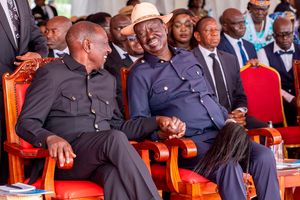
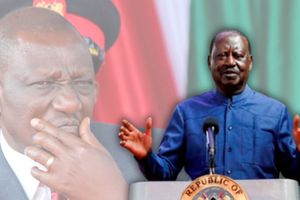
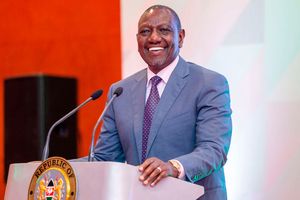
When ODM leader Raila Odinga stood before his party legislators last week and declared that no one should assume ODM will not field a presidential candidate in 2027, he reignited political jitters across the country.
His statement rattled not only President William Ruto ’s Kenya Kwanza camp, which has been counting on his support in the next election, but also unsettled some of his own loyalists already serving in government courtesy of the ODM–UDA cooperation pact.
“Who told you that ODM will not have a presidential candidate in 2027? First, think as ODM, we have a clear plan that we have negotiated and agreed on; other decisions will be taken when the time comes,” Mr Odinga declared during the meeting last Monday.
The remarks came just weeks after he had assured mourners at the funeral of former Karachuonyo MP Phoebe Asiyo in Homa Bay that his “broad-based government arrangement” with President Ruto would hold until 2027.
At the time, he had sounded fully committed to working with the Head of State, asking critics to “judge us in 2027.”
That assurance emboldened ODM politicians and technocrats who had crossed over into the government, taking up cabinet positions and state appointments.
But now, with Mr Odinga’s latest signal, those same allies are said to be anxious—unsure whether the party leader is preparing to walk back on the political pact that gave them a foothold in government.
President Ruto has in recent months intensified his charm offensive in Mr Odinga’s camp, roping in close allies of the opposition chief into his administration.
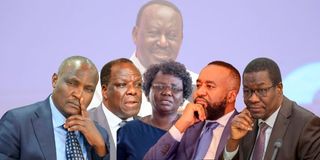
From left: Hassan Joho, Wycliffe Oparanya, John Mbadi and Opiyo Wandayi.
Photo credit: Nation Media Group
From Cabinet slots—Opiyo Wandayi (Energy), John Mbadi (National Treasury), Hassan Joho (Mining), Wycliffe Oparanya (Cooperatives) and Beatrice Askul (EAC)—to fresh appointments in state corporations, the list of Mr Odinga’s men finding space in government continues to grow.
In recent weeks, the President appointed Prof Lawrence Gumbe, a long-time Odinga ally from the NDP and LDP days, as chair of the Nuclear Power and Energy Agency.
In another move, the Water ministry revoked the appointment of Odoyo Owidi—an Odinga critic—and replaced him with Daniel Shem Omino, scion of the late Joel Omino, a loyal Raila ally.
Cabinet secretaries from the ODM wing of government have also been placing allies into state boards.
Energy CS Wandayi appointed Anne Michura to the Nuclear Power and Energy Agency, while George Odhiambo Oballa also secured a role to the Kenya Animal Genetics Resource Centre.
President Ruto has been rewarding those aligned to Mr Odinga while easing out critics in Nyanza and beyond, all in a bid, according to analysts, aimed at cementing a working alliance that could secure him support in 2027.
The ODM–UDA Memorandum of Understanding (MoU) signed in March this year outlines a 10-point agenda covering inclusivity, devolution, corruption, public debt audit, youth empowerment, and human rights protections.
According to Siaya Senator Dr Oburu Oginga, Mr Odinga’s elder brother, if the pact is implemented to ODM’s satisfaction, the party could consider backing President Ruto’s re-election bid.
“Our agreement with the government is hinged on a 10-point agenda which we are seeking to achieve through collaborative measures. We shall work with them until 2027, and if we recognise that we worked well, we shall agree; if not, we shall part ways,” Dr Oginga recently said.
The sentiment hinted at conditional loyalty, but Mr Odinga’s latest pronouncement has left even his inner circle guessing about which way the party will go.
“At some point, service to the nation must take precedence over party politics,” one of the Odinga-allied appointees confided in Nation, signalling a possible defiance against the ODM leader should he decide to walk away from his cooperation with UDA.
Another one quipped: “I have always been loyal to Raila, but times change. We can’t live in permanent political uncertainty. It’s not automatic that we will follow anyone into another political contest. Some of us have found new ground in government and are determined to deliver. I cannot resign my position simply because of shifting political winds. My loyalty to the country comes first.”
President Ruto, facing growing challenges from within his own ranks—including his former deputy Rigathi Gachagua’s new party—has little room for political uncertainty.
President William Ruto and the Cabinet Secretary for National Treasury John Mbadi during a thanksgiving service in Suba South, Homa Bay County.
Photo credit: PCS
For him, Mr Odinga’s support or even neutrality could be the difference between an easy re-election and a bruising contest in 2027.
But by keeping both options open—supporting Ruto or fielding a candidate—Mr Odinga has once again demonstrated his political unpredictability.
His allies in government now face the difficult task of reconciling their loyalty to him with their current service under Dr Ruto.
UDA National Organising Secretary Vincent Kawaya argues that Mr Odinga was only seeking to strengthen his ODM party before formally entering into a coalition with UDA.
He argued that Mr Odinga’s decision to rebuild and strengthen ODM was in fact, in UDA’s interest, warning that a weakened opposition party would only embolden smaller outfits to eat into Raila’s base, weakening the coalition’s prospects in the long run.
“Politically speaking, the easiest way we can lose is if ODM is not strong because other small parties could emerge and start taking control of Raila’s base. It’s extremely important for us to have Raila as strong as possible,” the UDA official explained.
UDA Deputy Secretary General Omboko Milemba said their coalition’s 2027 game plan would depend on decisions made at the top level between President Ruto and Mr Odinga.
“For 2027, Raila and President Ruto will agree at their own level, and we shall execute it at that time. We shall execute the instructions they will give us,” he said as he dismissed talk of a fallout.
Mr Odinga’s shifting signals are not new. In past elections, he has often left both allies and opponents guessing until the very last minute. Yet this time, the stakes are higher: his own lieutenants are firmly embedded in government, enjoying power and influence.
Political observers argue that his Monday remarks could either be a bargaining chip to extract more concessions from Dr Ruto or the first signs of an impending split.
Either way, his men in the “broad-based government” are on edge, uncertain whether they will be forced to choose between loyalty to him and service under President Ruto.
“Baba has left us in a very tricky place. We are in government, but we do not know if he still wants us here after 2027,” a pro-broad-based legislator told Nation.
Political analyst Dismas Mokua argues that Mr Odinga has now introduced strategic confusion in Kenyan politics as a strategy to grow and develop his political capital.
“The statement about his possible candidacy, in effect, means that he’s available for the 2027 political permutations and combinations and that he may not necessarily support President Ruto’s 2027 presidential re-election agenda.”
“This strategic flip-flopping makes him the Centre of 2027 presidential conversations. All presidential candidates will want to hold court with him because, in effect, he has stated that ODM hasn’t taken a position in the 2027 presidential elections. This is Raila- the enigma of Kenyan politics,” Mr Mokua noted.
He says that while Mr Odinga's withdrawal of his support from President Ruto is one of the options, “it is unlikely that Mr Odinga will bolt given his hook, line, and sinker relationship with President Ruto.”